Poetiq Raises $45.8M to Boost LLM Performance Through Meta-System Technology
The startup, founded by former Google DeepMind researchers, has secured seed funding to scale its platform that enhances large language model capabilities and reduces inference costs.

Poetiq Inc. has closed a $45.8 million seed funding round aimed at advancing its technology for making artificial intelligence language models both more powerful and economical to operate. The funding was led jointly by FYRFLY Venture Partners and Surface Ventures, with the announcement made Thursday. Additional backers included Y Combinator, 468 Capital, Operator Collective, Hico Ventures and Neuron Venture Partners.
The company was established last year by Shumeet Baluja and Ian Fischer, both veterans of Google DeepMind. Baluja previously headed the Alphabet subsidiary's computer vision division, while Fischer contributed to the development of foundational LLM technologies. The founding team draws on expertise from multiple researchers who previously worked at the search and advertising giant.
Poetiq's core offering is a software platform designed to strengthen the performance of leading language models including Google's Gemini series and GPT-5.2, as well as open-source alternatives. The system employs what the company calls a "meta-system" mechanism to identify optimization opportunities that elevate response quality while simultaneously lowering the computational expense of running inferences.
Organizations can deploy the meta-system by supplying several hundred examples of tasks they aim to automate. Poetiq's technology then transforms the underlying model into an autonomous agent capable of self-directed improvement. This self-refinement capability serves as a primary mechanism through which the platform amplifies LLM performance.
When executing a task, a Poetiq-enabled agent produces an initial response and gathers evaluative input. The system then leverages the base LLM to enhance the answer drawing on that feedback. For particularly demanding assignments, Poetiq's system generates a series of clarifying questions designed to deepen its comprehension of the underlying objective.
Beyond quality improvements, Poetiq contends its platform achieves cost reduction by determining the precise moment when sufficient information has been gathered to formulate an answer, thereby terminating additional search operations and preventing wasteful computation.
The funding announcement arrives shortly after Poetiq achieved a notable result on the ARC-AGI-2 benchmark, a notoriously challenging industry test comprising 1,000 visual reasoning puzzles meant to evaluate LLM reasoning abilities. Using its meta-system, Poetiq enabled GPT-5.2 to surpass the previous record by 16 percentage points.
For ARC-AGI 1 and 2, we used recursive self-improvement to produce specialized agents in a matter of hours
Shumeet Baluja
Poetiq enters a competitive space where other startups are pursuing similar objectives. AI21 Inc., another company offering a platform to enhance existing LLM capabilities, is currently in discussions with Nvidia Corp. regarding a potential acquisition that could value the company at as much as $3 billion.
Read more
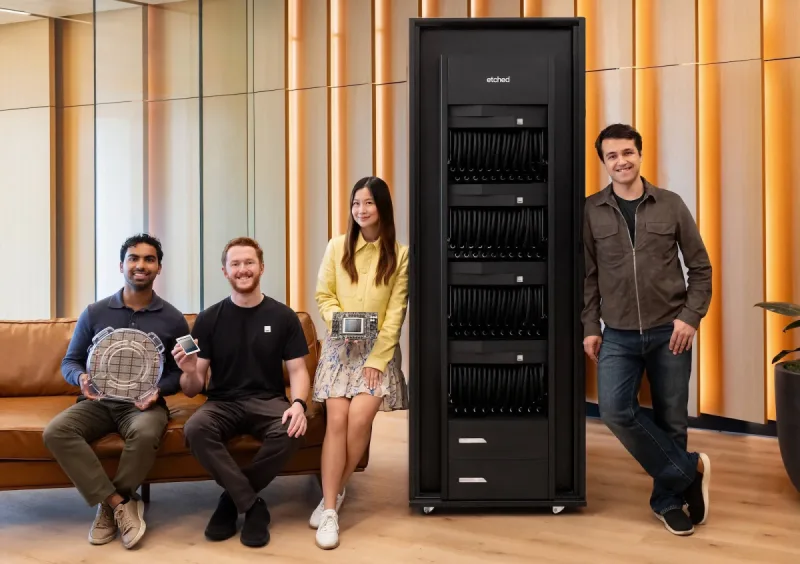
Etched's Valuation Doubles in Months as VCs Bid $40B–$50B for AI Chip Maker
The startup that raised $700 million at a $21 billion valuation just weeks ago is now fielding investment offers valuing it at double or more, as investors race to back its challenge to Nvidia's dominance in AI hardware.

Menlo's Factory bet signals confidence amid founder clash with Khosla
Menlo Ventures has invested in AI coding startup Factory as part of its latest funding round at a $5 billion valuation, a move that carries weight beyond typical round extensions given the company's recent public dispute with prominent investor Vinod Khosla.

Venture funding hits $679 billion in first nine months of 2026 as AI startups dominate
Global venture investment reached $159 billion in Q3 2026, with a record 27 companies closing billion-dollar rounds as artificial intelligence companies continue to attract the vast majority of capital.