Nvidia Authorizes Record $150B Buyback, Citing Data Center Dominance and Startup Windfalls
Nvidia announced a $150 billion share repurchase program through January 2028, the largest expansion ever, alongside plans to increase its dividend as the chipmaker capitalizes on surging AI infrastructure demand and gains from its venture portfolio.
Nvidia Corp. unveiled an additional $150 billion commitment to repurchasing its own shares by January 2028, marking the most substantial enlargement of a stock buyback initiative in the company's history. The semiconductor giant also signaled its intention to raise its quarterly dividend from the current $0.25 per share, though it declined to disclose specifics about the magnitude or timeline of that increase.
Two principal drivers underpin these capital allocation decisions, according to the company. Nvidia points to its accelerating top-line expansion alongside the exceptional returns generated by its startup investment holdings. The buyback program represents an additional mechanism through which shareholders can participate in the value created by these business drivers.
Our cash generation gives us the capacity to invest in the technologies that advance this transformation and return capital to shareholders. This authorization reflects our confidence in the long-term opportunity ahead.
Nvidia Chief Executive Officer Jensen Huang
At the conclusion of its fiscal second quarter, Nvidia held $22.44 billion in cash and equivalents. The company's adjusted earnings and sales both more than doubled during the period, driven by sustained appetite for its graphics processors. Chief Financial Officer Colette Kress informed Wall Street analysts that the company projects a 70% sales increase in fiscal 2028, substantially outpacing the Street's prior 40% forecast.
Expanding Product Portfolio Drives Revenue
Nvidia's revenue expansion benefits from a significantly broadened product ecosystem. A half-decade ago, its data center offerings centered almost entirely on graphics processing units. Currently, the company delivers to customers a diverse array of solutions encompassing GPUs, central processing units, interconnect technology and supplementary hardware.
During today's presentation, Nvidia disclosed that it generates $40 billion in annual revenue for each gigawatt of data center infrastructure deployed by its customers—a fourfold jump from 2022 levels. Following the introduction of its next-generation Feynman series processors, projected for 2028, the company anticipates revenue per gigawatt will climb to $60 billion.
Venture Portfolio Delivers Outsized Returns
The second rationale for expanding buybacks stems from Nvidia's successful venture investing track record. The company revealed in its presentation that it maintains ownership stakes in 13 publicly listed firms and 229 private startup ventures. Nvidia's exits from these positions have yielded returns exceeding three times the original capital deployed.
Nvidia stands to realize substantial additional gains as two major portfolio companies prepare for public markets. Anthropic PBC and OpenAI Group PBC are both moving toward initial public offerings, positioning the chipmaker to benefit from significant appreciation in its holdings.
Nvidia committed $10 billion to Anthropic in November, when the AI company carried a $183 billion valuation. The startup is now preparing to list at a reported $2 trillion valuation, representing an enormous uplift for Nvidia's investment.
OpenAI received $30 billion from Nvidia as part of a February transaction that valued the ChatGPT creator at $730 billion. The company is currently pursuing fresh funding at a potential valuation reaching $1.5 billion. An OpenAI public offering would further amplify the gains on Nvidia's stake in the enterprise.
Read more
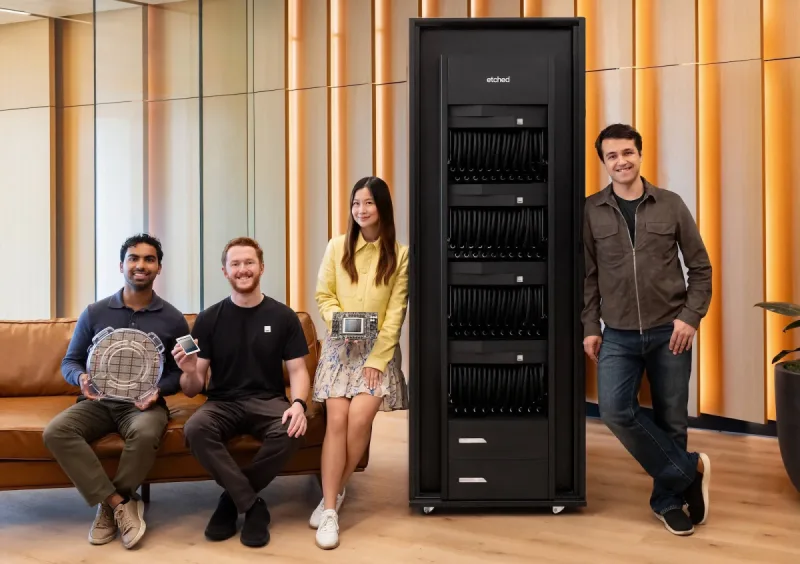
Etched's Valuation Doubles in Months as VCs Bid $40B–$50B for AI Chip Maker
The startup that raised $700 million at a $21 billion valuation just weeks ago is now fielding investment offers valuing it at double or more, as investors race to back its challenge to Nvidia's dominance in AI hardware.

Menlo's Factory bet signals confidence amid founder clash with Khosla
Menlo Ventures has invested in AI coding startup Factory as part of its latest funding round at a $5 billion valuation, a move that carries weight beyond typical round extensions given the company's recent public dispute with prominent investor Vinod Khosla.

Venture funding hits $679 billion in first nine months of 2026 as AI startups dominate
Global venture investment reached $159 billion in Q3 2026, with a record 27 companies closing billion-dollar rounds as artificial intelligence companies continue to attract the vast majority of capital.