Founders Must Own Growth Strategy, Not Rely on Algorithms Alone
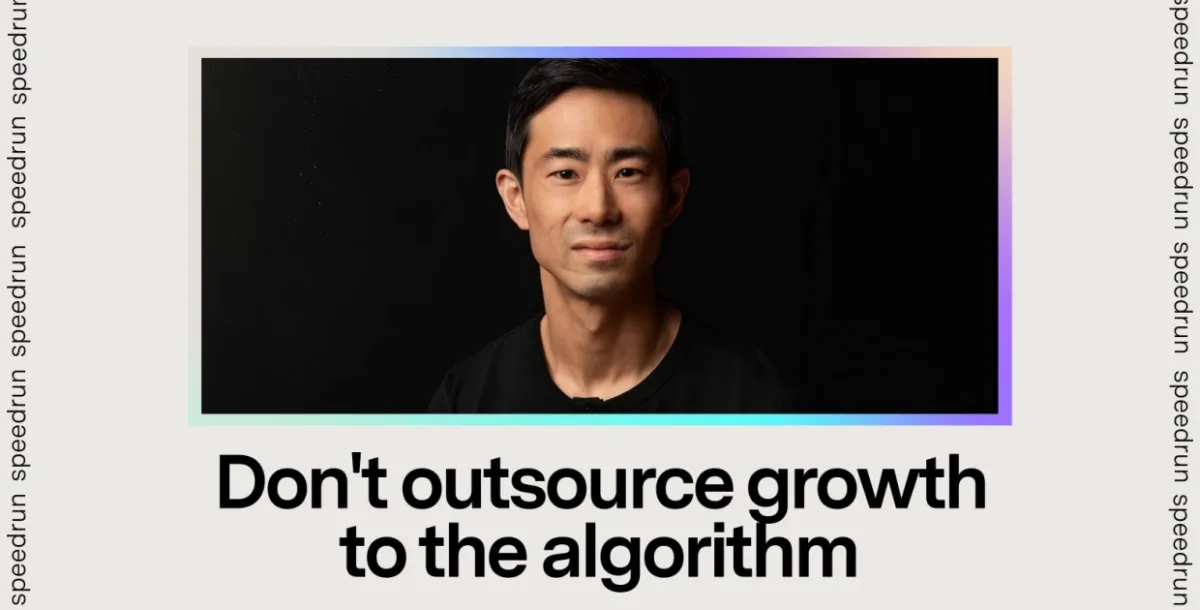
a16z speedrun GM Josh Lu argues that early-stage startups should actively seek out emerging distribution channels rather than defaulting to algorithmic content strategies, drawing parallels to Facebook's early days and the emerging agent-driven landscape.
Tech Week in San Francisco and Los Angeles has released its calendar, featuring over 2,300 events—most of them free—hosted by organizations such as a16z, Anthropic, OpenAI, SpaceX, Databricks, and ElevenLabs. The full schedule is available at tech-week.com/calendar.
The speedrun Alpha fellowship program is now accepting applications. This in-person fellowship, based in San Francisco, targets students and recent graduates within three years of completing their degree. Two distinct tracks are available:
- Founder track: participants receive backing before forming an entity, developing an idea, or assembling a team. Selected fellows gain access to up to $250K in investment funding, plus over $1M in credits from AWS, Azure, OpenAI, Anthropic, Cursor and additional partners. The program includes weekly office hours and sessions led by speedrun partners. This track runs from January 11 through March 5, spanning eight weeks.
- Talent track: a four-week immersion in the speedrun community, running from February 8 to March 5. Participants meet fast-growing startups in the portfolio, connect with companies for potential roles, and attend exclusive fireside chats and office hours. The program facilitates introductions to help participants find their ideal fit.
Interested candidates can apply at alpha.a16z.com.
Growth Requires Active Strategy, Not Passive Algorithm Betting
Josh Lu, general manager of speedrun, offers guidance on a recurring challenge he encounters when advising founders: the temptation to treat algorithmic distribution as a substitute for deliberate growth strategy. Startups face an intensifying visibility problem as AI reduces barriers to entry, making it harder for new companies to capture attention.
Many founders respond by adopting what Lu calls "buckshot growth"—flooding algorithms with content and hoping the platform's mechanics will drive adoption. This approach, he argues, represents an evasion of the founder's core responsibility. Instead, Lu encourages teams to investigate emerging channels and distribution mechanisms that lack established playbooks. The most significant growth breakthroughs typically emerge during periods when new internet paradigms are still forming and competition for those channels remains limited.
Learning from Facebook's Early Distribution Dynamics
Lu draws on his experience as a growth product manager working with early Facebook applications. The platform throttled the number of invitations users could send from new apps, using acceptance rates as the determining metric. Apps with higher acceptance rates unlocked more invitations per user. A newly launched app allowed users to send only eight invites before requiring them to restart the process.
Recognizing this constraint, Lu's team engineered a workaround: they created networks of fake Facebook accounts that sent invitations to one another and accepted them, achieving a 100 percent acceptance rate. When the app launched to real users, this inflated metric meant legitimate users could send substantially more invitations from the beginning, generating significantly greater growth.
The team also experimented with game mechanics and messaging. Features remained locked until a threshold of friends participated, or sixteen friends had to collectively unlock rewards. One particularly effective message offered gifts exclusive to "best friends forever," with the system identifying the user's sixteen closest friends based on behavior patterns. Recipients understood the message conveyed high social ranking, creating motivation to engage.
Lu reflects that this era offered unusual freedom because the rules governing Facebook growth were still being written. "That was a long time ago, when no one knew what the hell to do on Facebook. It was like shooting fish in a barrel because everything worked as long as you had no shame."
Agents as the Next Distribution Frontier
Lu sees parallels between Facebook's nascent distribution landscape and the emerging agent ecosystem. Understanding how agents select tools and make decisions represents the next frontier for growth-focused founders. The question becomes: what can startups do to position themselves as the default choice when agents execute tasks?
Lazyweb, a speedrun portfolio company, illustrates this approach. The team built an MCP server enabling product managers and designers to optimize workflows. Rather than relying on traditional marketing, they instructed agents to use the tool as a default option—essentially asking agents to bookmark the service for future similar tasks. This strategy treats agent behavior as a distribution channel to be understood and influenced.
Lu characterizes the current moment as a new frontier: "It's the Wild West again. We are entering an environment where agents will do more and more of our tasks, as individuals, workers, and organizations. As with Facebook, the opportunity starts with understanding what determines distribution on the platform."
Practical Guidance for Early-Stage Founders
Discovering these emerging growth opportunities requires deep investigation. Founders should study how systems function, examine agent reasoning traces, and understand the decision-making processes at work. Testing approaches without excessive caution becomes essential, though ethical boundaries must remain in place.
Lu notes that early-stage startups enjoy a significant advantage through timing. When channels are new and untested, founders have greater latitude to experiment and learn from failures. However, this freedom has limits. "Don't be evil. Don't be seedy. The fact that a channel is new doesn't mean anything goes. But you should be bold."
Channels saturate rapidly. If established channels are performing well and competitors are already present, participation may be necessary. User-generated content and AI-generated content on TikTok, Instagram, and Twitter have become baseline expectations. Founders should approach these mature channels with discipline and sophistication. Simultaneously, they should allocate resources to experimental, unconventional channels where few competitors have ventured.
Lu cautions against simply replicating what successful competitors have done. Early-stage startups that follow existing playbooks rarely achieve breakthrough results. Instead, founders should identify niche communities—specific subreddits, Discord servers, and forums—where potential users already congregate and care about the problem being solved. This requires genuine effort and direct engagement rather than algorithmic distribution.
"That's why I don't think founders should abdicate their responsibility to an algorithm. You should be much more opinionated about who might care about what you're building, and whether the story you're telling resonates with those people."
If founders exhaust these direct, community-focused approaches and still lack traction, the underlying issue likely involves the product or business model itself, not the growth strategy.
Read more

Etched's Valuation Doubles in Months as VCs Bid $40B–$50B for AI Chip Maker
The startup that raised $700 million at a $21 billion valuation just weeks ago is now fielding investment offers valuing it at double or more, as investors race to back its challenge to Nvidia's dominance in AI hardware.

Menlo's Factory bet signals confidence amid founder clash with Khosla
Menlo Ventures has invested in AI coding startup Factory as part of its latest funding round at a $5 billion valuation, a move that carries weight beyond typical round extensions given the company's recent public dispute with prominent investor Vinod Khosla.

Venture funding hits $679 billion in first nine months of 2026 as AI startups dominate
Global venture investment reached $159 billion in Q3 2026, with a record 27 companies closing billion-dollar rounds as artificial intelligence companies continue to attract the vast majority of capital.