Deep tech dominates Y Combinator's latest Demo Day as VCs spot nine standout startups
Y Combinator's newest cohort shifted heavily toward deep tech ventures, with investors identifying nine companies tackling everything from floating nuclear data centers to brain-cell computing.

Y Combinator held its latest Demo Day on Thursday, and the presenting batch showed a marked tilt toward deep technology compared with previous quarters. The cohort brought forward founders working on ambitious, science-heavy problems across multiple sectors.
To identify the standout companies, Fathom Tech surveyed early-stage venture investors about which startups generated the most buzz and topped their watchlists. The resulting list includes nine startups that at least two investors flagged as the most compelling in the batch.
One investor described the technology on display as "like science fiction." Yet despite the boldness of the ideas, investors noted that valuations remained considerably more reasonable than in recent cohorts.
The nine standout startups
Atomarine
What it builds: Nuclear-powered data centers floating at sea
Data center capacity remains constrained while local opposition to new facilities continues to mount. Atomarine, founded by an MIT computer science and naval engineer alongside an MIT PhD in nuclear engineering, proposes placing data centers on ocean barges where seawater serves as a cooling source at minimal cost. The company plans to operate a gas-powered pilot by 2028, with a shift to floating nuclear power vessels planned for 2032. According to the startup, it has already accumulated more than $4 billion in customer interest documented through letters of intent. Investors cited this revenue pipeline as a key factor in Atomarine's status as one of the batch's highest-valued companies.
Dipole Labs
What it builds: Effective and energy-efficient high-speed optical networking hardware for AI data centers
GPU clusters frequently lose compute cycles waiting for data transfers between processors. Within networking infrastructure, data undergoes conversion from light to electrical signals and back—a process consuming substantial power and generating significant heat. Dipole Labs has developed an optical switch that bypasses this conversion cycle, allowing data to remain in light form and travel directly to its destination. The problem is particularly urgent given GPU costs and the industry's drive to maximize utilization of expensive compute resources.
Isengard
What it builds: Locally producible, jet-powered strike and counter-drones
Isengard aims to manufacture jet-powered attack and counter-drones within allied nations at costs substantially below what U.S. prime contractors charge. The company was co-founded by a former Australian Army officer and a defense entrepreneur who previously grew a Ukraine-focused drone venture to $60 million in annual revenue. Isengard itself is already generating $10 million in revenue. Two investors identified it as commanding one of the batch's most impressive valuations.
Lamb Labs
What it builds: Custom inference chips with hardcoded AI model weights
Inference on traditional AI chips demands substantial energy as model weights are retrieved from memory. Lamb Labs, co-founded by an Imperial College London AI PhD and an Oxford theoretical physicist, proposes embedding AI model weights directly into silicon to create ultra-efficient processors. These custom chips, branded "Model Processing Units" (MPUs), eliminate memory-bandwidth constraints that plague conventional architectures.
Unnamed data collection company
What it builds: Collecting real-world data on which to train robots
This startup partners with businesses to capture video and data of human workers performing tasks, then converts this material into training datasets for robotics companies. The company reports active partnerships with publicly traded firms and has recorded video data across more than 150 distinct work environments. As organizations increasingly evaluate which tasks suit human workers versus robotic systems, this data collection capability could prove strategically valuable.
Nori
What it builds: Creating affordable robots to handle everyday tasks
Nori launched just six weeks before Demo Day yet has already achieved nearly half a million dollars in sales. The company offers a humanoid robot designed to clean and fold clothes, controllable through a laptop application. Priced around $1,600, it undercuts competing humanoids such as Neo, which costs approximately $20,000. A central question in robotics concerns whether affordable home robots can reliably perform household chores like loading dishwashers. Nori represents another attempt to answer this challenge.
Unnamed heavy-lifting robotics company
What it builds: Autonomous robots that can lift heavy objects
The founders envision constructing a city on Mars, with heavy-duty robotics as the foundation. The company reports that its technology is currently installing solar panels across the United States and has secured $25 million in contracts extending through 2027. The startup positions this robotic capability as essential infrastructure for Mars colonization efforts. It is coordinating its development timeline with SpaceX's Mars ambitions, targeting an exploratory mission launch by 2028.
Parasma
What it builds: Training human brain cells to one day power compute
Parasma addresses the energy demands of running large AI models by exploring human brain cells as a more power-efficient computing substrate compared with current hardware architectures.
Waddle Labs
What it builds: An API layer that writes robot control code
Industry observers anticipate a ChatGPT-like breakthrough moment for robotics is approaching, spurring multiple approaches to general-purpose robotic models. Rather than training foundation models on raw video or human teleoperation data, Waddle Labs employs a layer of large language model agents to generate code and control robots directly. Founded by Harvard graduates, the startup positions itself as "Claude Code for robotics." According to the company, developers can connect any hardware to Waddle's API and instruct the robot in plain language; its AI agents will then autonomously write executable control code, verify execution, and configure the robot within approximately 20 minutes.
Read more

Spotify Founder's Health Screening Startup Neko Brings Preventative Medicine to the U.S.
The body-scanning company co-founded by David Ek has arrived in New York with a 300,000-person waitlist and backing from nearly $1 billion in funding.
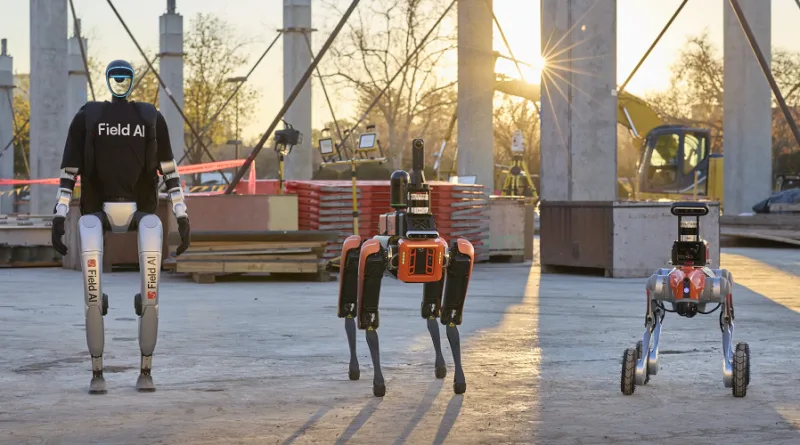
FieldAI Seeks $700M at $10B Valuation as Robot AI Demand Accelerates
The robotics AI startup is in advanced fundraising talks that would quintuple its valuation from last year, according to sources familiar with the matter.

Tech hiring slows even as employers post record open positions
A surge in IT job listings to three-year highs masks a contraction in actual hiring, with technology sector roles declining and unemployment ticking upward.