Charter Space lands $5M seed to expand space insurance platform
The El Segundo startup, which competed in TechCrunch's Startup Battlefield, is scaling its insurance brokerage after signing over 50 clients in the U.S. space and defense sector.

Charter Space, a TechCrunch Startup Battlefield finalist, has closed a $5 million seed funding round to expand its space insurance operations. The El Segundo, California company announced Wednesday that it now works with more than 50 organizations across the American space and defense industrial base, having launched its nationally-licensed insurance brokerage in May.
Crystal Venture Partners led the investment, joined by fintech backers QED and Blank Ventures, early-stage firm Hustle Fund, and Gaingels, a syndicate focused on funding startups with underrepresented founders.
Space industry operations frequently encounter setbacks, prompting companies to develop risk mitigation strategies. Yet insuring space-bound assets remains uncommon. Founder and CEO Yuk Chi Chan attributes this gap partly to the expense involved in underwriting satellite coverage. According to Charter Space's messaging, space companies often encounter traditional insurers who "heard a bunch of scary science words and freaked out."
Chan and co-founder Yukun Yin initially envisioned Charter Space as a unified software platform for aerospace engineering, consolidating technical, manufacturing, and testing information for clients. Chan subsequently identified substantial opportunity in applying that data to insurance underwriting workflows.
We want more satellites to get insured, because that means that everything as a whole is much, much safer. If we can proliferate insurance coverage, one, that's good for the space industrial base, a lot more companies have a safety net… But it's also a lot healthier for the overall economy, because then that encourages global investment from different alternative capital sources. You're not solely reliant on VC or some growth equity. You can start bringing in debt, credit, lots of different options that you have in any other sort of advanced industry.
Yuk Chi Chan
The space sector historically offered limited financial services options due to its small player base. Governments and defense contractors dominated the industry until recently, operating with the deliberate, cautious approach typical of the post-Cold War era.
A decade-long wave of commercial space startups, largely catalyzed by SpaceX's Falcon 9 reducing launch costs, has created sufficient market demand for ventures like Charter Space. Emerging satellite manufacturers, spacecraft builders, and launch providers are now competing as SpaceX prepares to retire the Falcon 9.
"Charter Space sits at the intersection of two enormous opportunities: the rapid growth of the commercial space economy and the need for a modern approach to understanding and insuring the increasingly complex risks that accompany that growth," stated Jonathan Crystal, managing partner of Crystal Venture Partners. "Insurance is critical infrastructure for a strong and sustainable space industry, and we believe Charter Space is building the platform that will help the space economy scale safely and sustainably."
Michael Yaworsky, Florida's insurance commissioner and representative of the nation's leading launch hub, characterized insurance as "the precondition for growth in space" and noted its role in attracting regional capital. "The state that leads on insurance will be the destination for capital investing in the industries of the future, and lay the foundation for continued American greatness for the next 250 years and beyond," Yaworsky stated.
Charter Space has accumulated $8 million in total funding. The company plans to deploy the seed round proceeds toward expanding its sales team and broadening its insurance product portfolio. Planned offerings include protection for "novel mission concepts," encompassing space-based nuclear power generation, lunar exploration, and orbital spacecraft maintenance services.
Read more
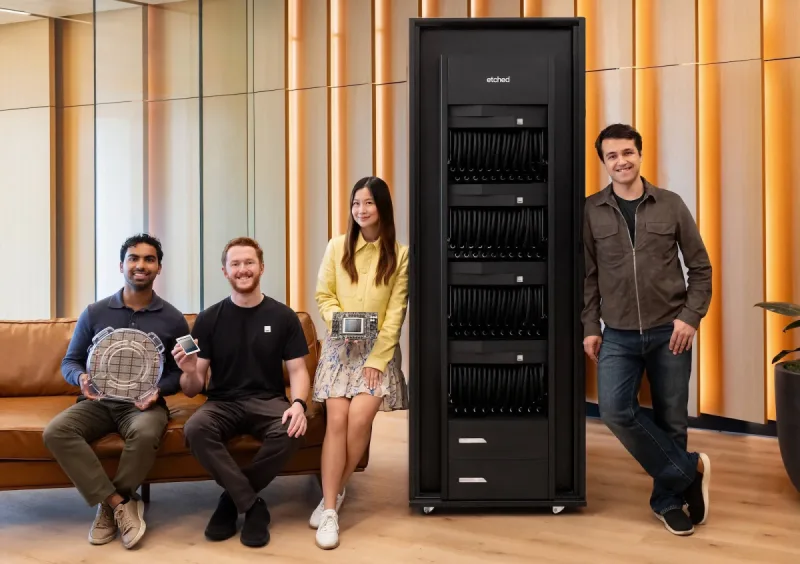
Etched's Valuation Doubles in Months as VCs Bid $40B–$50B for AI Chip Maker
The startup that raised $700 million at a $21 billion valuation just weeks ago is now fielding investment offers valuing it at double or more, as investors race to back its challenge to Nvidia's dominance in AI hardware.
Menlo's Factory bet signals confidence amid founder clash with Khosla
Menlo Ventures has invested in AI coding startup Factory as part of its latest funding round at a $5 billion valuation, a move that carries weight beyond typical round extensions given the company's recent public dispute with prominent investor Vinod Khosla.

Venture funding hits $679 billion in first nine months of 2026 as AI startups dominate
Global venture investment reached $159 billion in Q3 2026, with a record 27 companies closing billion-dollar rounds as artificial intelligence companies continue to attract the vast majority of capital.