Arlequin AI Secures €28M to Scale Topological Neural Networks for Complex Data Analysis
The Paris-based startup has closed a Series A funding round to advance its alternative AI architecture, which processes intricate relationships across heterogeneous data sources more efficiently than conventional approaches.

Arlequin AI SAS, headquartered in Paris, announced completion of a €28 million Series A funding round—equivalent to approximately $32 million—aimed at advancing a novel AI model architecture designed to identify and learn complex relationships across large datasets.
The company's approach relies on topological neural networks rather than the graph-based neural networks that power most contemporary large language models. Arlequin has already developed and deployed a scalable platform capable of ingesting diverse data types, including documents, transactions, video footage and operational records.
Redalpine and OTB Ventures jointly led the Series A round, with participation from Bpifrance's Defense Innovation Fund. Vsquared Ventures and 10x Founders, both existing backers, expanded their commitments. Xavier Niel and Zebox also participated in the financing, which drew exclusively from European investors.
The capital infusion will support the scaling of Arlequin's proprietary model, which identifies patterns by capturing how data elements relate to one another and interact across multiple pathways at scale.
Today, another revolution is taking shape: the development of new AI systems capable of understanding highly complex dynamics hidden within millions of data points. At a time when we are overwhelmed by information, we need to regain control.
Hugo Micheron, co-founder and Chief Executive of Arlequin AI
Micheron emphasized that Arlequin is positioning itself within Europe's broader competition against technological powers in the United States and China in the race to develop advanced AI capabilities. The announcement arrives shortly after Mistral AI SAS, another European open-source AI company, announced €3 billion in funding this week.
How Topological Neural Networks Differ
Arlequin describes its TNN networks as capable of learning not merely from isolated data points but from the connections between data at scale, simultaneously processing multiple elements. The architecture enables systems to examine complex systems comprehensively and trace outcomes back to their origins.
The company highlighted counterterrorism as a primary use case: the platform can process billions of data points from thousands of confiscated devices to map relationships between individuals, geographic locations, communications channels and incidents. Beyond security and defense applications, Arlequin identified potential uses in criminal investigations, fraud detection, anti-money laundering, information integrity, cybersecurity and AI safety.
These domains depend on predictive algorithms, yet the ability to establish verifiable, auditable chains of reasoning helps clarify what actually transpired.
Computational Efficiency
Arlequin engineered its TNN architecture to demand substantially less computational resources, thereby reducing demands on energy consumption, specialized hardware and infrastructure. As data centers proliferate globally—particularly in nations pursuing sovereign AI capabilities—the operational expenses and per-token costs associated with running AI systems have become critical concerns for both enterprises and governments.
Research Partnerships and Expansion Plans
Arlequin is developing its architecture through collaborations with research divisions at the French National Institute for Research in Digital Science and Technology, the French National Center for Scientific Research and the Max Planck Institute. Academic partnerships also extend to Oxford, Cornell, Princeton and the University of California at Santa Barbara.
The company plans to deploy the new funding toward growing its international workforce and accelerating commercial rollout across Europe and beyond. Arlequin has already established offices in London and Berlin, with plans to launch an AI lab in Silicon Valley within the coming months.
Read more

Spotify Founder's Health Screening Startup Neko Brings Preventative Medicine to the U.S.
The body-scanning company co-founded by David Ek has arrived in New York with a 300,000-person waitlist and backing from nearly $1 billion in funding.
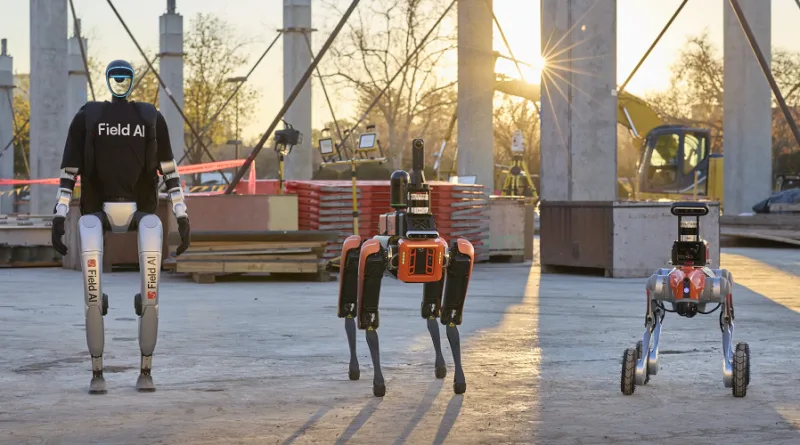
FieldAI Seeks $700M at $10B Valuation as Robot AI Demand Accelerates
The robotics AI startup is in advanced fundraising talks that would quintuple its valuation from last year, according to sources familiar with the matter.

Tech hiring slows even as employers post record open positions
A surge in IT job listings to three-year highs masks a contraction in actual hiring, with technology sector roles declining and unemployment ticking upward.