PSI's AI-Powered Physics Lab Solves 18-Year-Old Quantum Problem, Raising Questions About Scientific Discovery's Future
A startup using specialized AI models has cracked a longstanding conjecture in quantum computing, signaling how machine learning is reshaping the pace and nature of scientific breakthroughs.

At Physical Superintelligence (PSI), a startup focused on AI-driven research, David Turturean—a recent MIT graduate who postponed graduate studies to join the company—leveraged early access to Anthropic's Claude 5.2 model to resolve the Aaronson-Ambainis conjecture, a problem in quantum computing that had remained unsolved for 18 years.
Turturean, who works as a member of the technical staff at PSI, expressed uncertainty about his academic future in light of the breakthrough. "I'm totally accepting the idea that this might be the last paper I ever put out," he told TechCrunch, adding, "In a few months, like, why would you even put out a paper?"
The Aaronson-Ambainis conjecture addresses whether quantum computers can outperform classical machines at solving specific problems. Scott Aaronson, one of the two researchers who originally posed the problem, acknowledged that while he does not fully grasp the proof, he trusts its validity because it was autoformalized in Lean, a mathematical coding language, and validated by leading researchers with whom PSI shared the findings.
The solution represents a negative result—it eliminates one potential pathway for quantum computing to achieve speedups on certain difficult problems. "It's a negative result that allows people to know, okay, we're no longer looking there," Turturean explained.
Aaronson described his reaction to the news as a mix of satisfaction, awe, disappointment, and exhaustion. He noted that the conjecture was among the last unresolved open problems in quantum query complexity that the field considered fundamentally important. "I was surprised, honestly, to see it missing from OpenAI's Mathocalypse dump a few weeks ago. Surely they tried it, so was it really so much harder than all the problems that were solved?" he wrote.
PSI's Approach to AI-Powered Research
PSI's strategy centers on deploying specialized model harnesses and scaffolding to tackle scientific challenges. CEO Matt Pines outlined the company's philosophy to TechCrunch: "An effective kind of research system should have lots of things related to harnesses, lots related to tools, memory systems, simulation infrastructure. You want to be able to really go after a problem at breadth and depth, and be able to consider a wide range of potential alternatives."
Currently, PSI generates revenue by using its tools to optimize data centers, modeling variables including heat, power, water, and sound—factors that directly influence both facility performance and community impact. The company's longer-term vision, however, involves translating theoretical physics discoveries into practical technologies.
Pines reflected on the shift in investor conversations over recent months. "Six to nine months ago, when I was talking to investors, like I had to sort of stretch to validate that conditional, right? Like, 'no, no, no, trust me, pretty soon, theoretical physics is going to be mostly the domain of machines,'" he said. "And it's not there yet, but it's on its way."
The Limits of AI in Physical Sciences
While AI has achieved significant breakthroughs in mathematics and computer science—fields where solutions can be expressed and validated through code—applying similar approaches to less abstract disciplines like physics and life sciences remains challenging. Last week, the startup Discovered Materials announced a $1 million grand challenge inviting researchers to use AI to address problems such as superconductivity and heat dissipation.
Pines emphasized a fundamental distinction: "At the end of the day, physics is different than math because it's the real world … nature gets a vote in your models of reality." PSI is concentrating on determining how to take computational predictions and validate them experimentally with maximum efficiency.
According to Pines, validated discoveries open new possibilities for technological development. "If it's a true fact of nature, that's a trick that you can exploit. You could build a device out of it, right? The AI suggests an idea; it allows you to do something in the world you weren't able to do before … and so each of those are kind of loops that PSI is building."
Establishing Standards for AI-Driven Science
As AI-powered research labs emerge as potential drivers of scientific advancement, the research community is still developing norms and best practices for this new era. PSI's ability to hold its findings until Anthropic's model neared release allowed the team to share results with relevant experts for deeper understanding and validation.
Jim Halverson, a Northeastern University professor advising PSI, emphasized the importance of responsible conduct. "As an academic, we wanted to play our role in doing things the right way," he told TechCrunch. Halverson will attend an MIT summit next week where leading physicists plan to discuss how the field should respond to the accelerating pace of AI-driven discovery. "Best practices are still emerging … We figured that transparency is a good way to go, and contacting experts is a good way to go."
Turturean described the process of preparing the AI-generated proof for publication, noting that he spent time refining how the solution was presented to make it more accessible to human readers. "We had some time to sit on it … and it was the first time that I actually took one of my AI-elicited solutions on print, and I read through it, and I was like, okay, how can I make this … be presented more naturally for a human?" he said. He acknowledged that the academic community will expect researchers to fully understand and articulate their results. "And I think it also made me realize, oh my God, the weight of what AI can do."
Read more

Kubernetes gets new purpose running autonomous AI agents, Google donates open-source tools
Google is repositioning Kubernetes as the platform for enterprise agentic AI workloads, donating foundational open-source projects to the Cloud Native Computing Foundation to help orchestrate autonomous software more efficiently.
Black Friday 2026: date, AI shopping agents and what changes for retailers
Black Friday 2026 falls on November 27, with Cyber Monday on November 30. This piece covers which AI assistants can check out in the US, why ChatGPT stepped back from Instant Checkout, and what Adobe and Salesforce forecast.
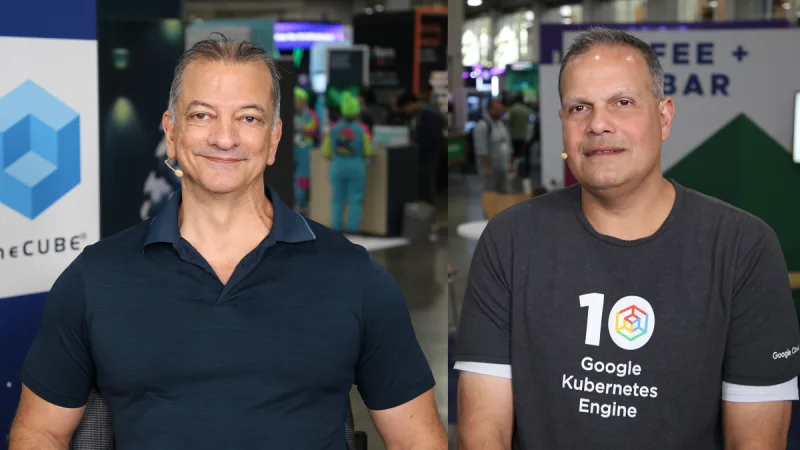
Google donates AI agent tools to open-source community to slash idle compute costs on Kubernetes
Google has contributed three projects to the Cloud Native Computing Foundation to help organizations reduce expenses when AI agents sit idle on Kubernetes clusters, addressing a growing cost challenge in agentic workloads.