Nebuly Closes $21M to Help Enterprises Measure AI's Real Business Impact
The Italian startup has built a platform to track whether AI investments actually deliver value, addressing a widespread gap in how companies evaluate their AI spending.
Nebuly S.r.l., an Italian startup, has secured $21 million in funding to address a critical blind spot in enterprise AI: measuring whether these investments actually move the needle on the bottom line. Planven led the round, joined by Exor Ventures, Tenacity Capital, TGVG Capital, Fastweb, Vodafone and CDP Venture Capital's Digital Transition Fund.
Large organizations have poured billions into artificial intelligence, yet most struggle to articulate concrete returns. While executives might cite surface-level metrics, they often lack hard evidence of business impact. This gap is becoming urgent: a Gartner Inc. survey found that 85% of business leaders plan to increase AI spending next year, but only 22% have successfully deployed the technology across multiple units. The problem has grown acute enough that Uber Technologies Inc. exhausted its entire 2026 AI budget in just four months.
The root cause, according to Nebuly co-founder and Chief Executive Franceso Signorato, lies in fragmentation. Most enterprises run a scattered collection of AI models and applications from OpenAI Group PBC, Anthropic PBC, Microsoft Corp., Google LLC and others, alongside custom-built tools. This patchwork makes it nearly impossible to isolate which projects generate real business value. Companies can easily count tokens and prompts, but genuine productivity gains remain hidden.
Every enterprise is about to face the same question from its board, if it hasn't already: What is AI actually worth to us? Nebuly exists to answer that question. Until now companies have measured AI by counting users, prompts and responses, which has fueled the rise of tokenmaxxing, where usage itself becomes the goal.
Franceso Signorato, Nebuly co-founder and CEO
Signorato emphasized that tracking usage metrics alone reveals nothing about whether AI actually benefits the organization. "It doesn't tell you whether an employee got back an hour of work or if a customer got the answer they needed," he said. The stakes are high because AI decisions now drive hiring and budget allocation across companies. "Companies are making decisions about hiring and head counts based on assumptions about AI productivity, not evidence," Signorato noted. "Decisions of that weight need real data."
How Nebuly Measures AI Value
Nebuly's platform connects directly to AI agents operating within customer environments and observes their behavior through a unified control plane. The system evaluates agentic productivity across two distinct dimensions.
Internal, Employee-Facing Agents
- Tracks operational efficiency metrics, including hours of work saved for human employees and capacity freed up
- Measures net-new work that human teams could not previously accomplish
- Categorizes the types of work staff apply AI to—routine tasks versus higher-level strategic work—to identify where agents deliver the most value
External, Customer-Facing Agents
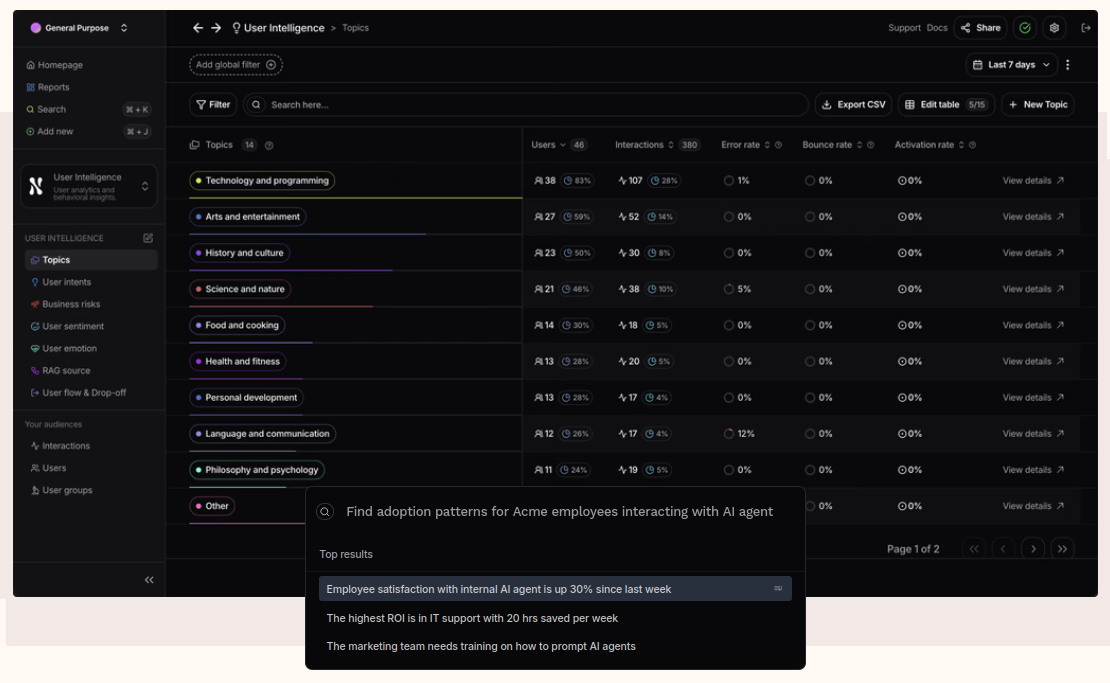
- Monitors revenue influence and impact on customer churn
- Tracks ability to generate upsell opportunities
Auditability matters deeply to Nebuly's design. Financial teams can inspect the underlying assumptions and verify the math behind performance insights. The platform supports on-premises and private cloud deployment to protect sensitive business data.
Customer Base and Expansion Plans
Nebuly's customer roster skews toward large enterprises: nearly all generate annual revenue exceeding $100 million, with roughly half surpassing $1 billion yearly. Current customers include Carl Zeiss AG, Iveco Group N.V. and Oura Health Oy, predominantly based in Europe. The new funding will fuel expansion into the U.S. market through increased go-to-market hiring.
Giovanni Canetta Roeder of Planven said he backed Nebuly because he believes every large organization will eventually need to measure AI's return on investment. "Nebuly is building the way to do it," he said. "The team turns what AI agents actually do into evidence of business value. That capability and the traction Nebuly has built among major enterprises made this a compelling investment for us."
Read more

Kubernetes gets new purpose running autonomous AI agents, Google donates open-source tools
Google is repositioning Kubernetes as the platform for enterprise agentic AI workloads, donating foundational open-source projects to the Cloud Native Computing Foundation to help orchestrate autonomous software more efficiently.
Black Friday 2026: date, AI shopping agents and what changes for retailers
Black Friday 2026 falls on November 27, with Cyber Monday on November 30. This piece covers which AI assistants can check out in the US, why ChatGPT stepped back from Instant Checkout, and what Adobe and Salesforce forecast.

Google donates AI agent tools to open-source community to slash idle compute costs on Kubernetes
Google has contributed three projects to the Cloud Native Computing Foundation to help organizations reduce expenses when AI agents sit idle on Kubernetes clusters, addressing a growing cost challenge in agentic workloads.