Google's SynthID Detector Launches Publicly, but Coverage Gaps Limit Its Usefulness
Google is opening its AI-content detection tool to the general public, though the system struggles to identify synthetic media that lacks its proprietary watermark.
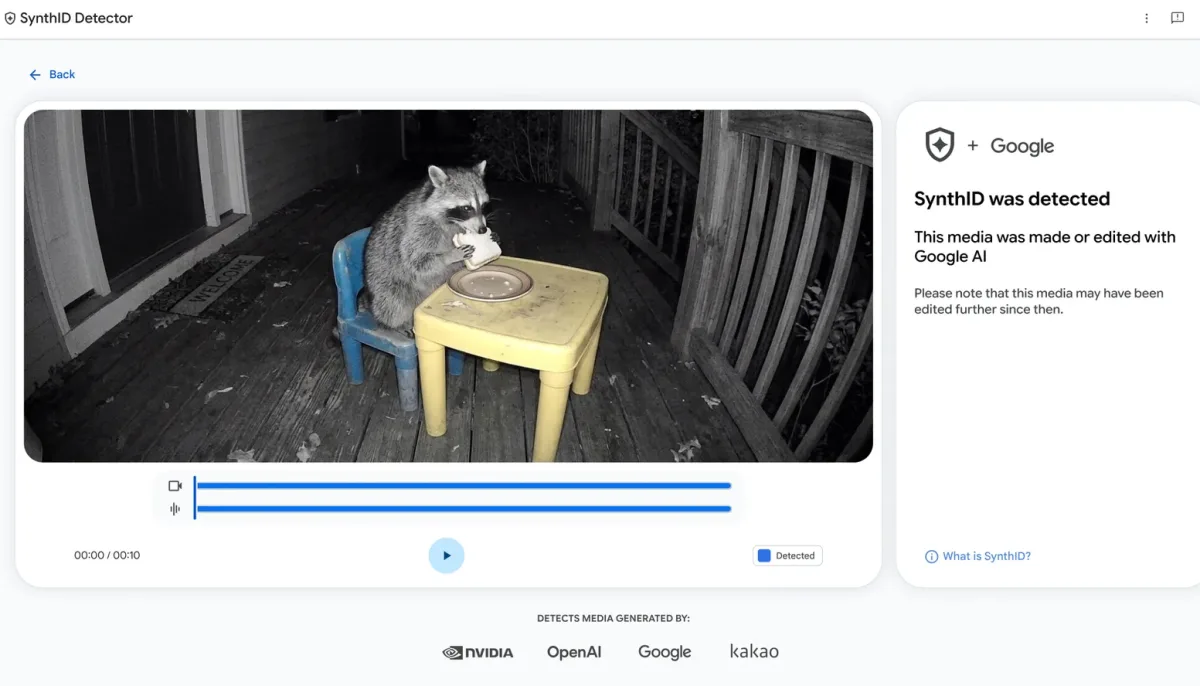
Google has rolled out a public version of SynthID Detector, expanding access to its technology for spotting artificially generated and manipulated media. The web-based tool can now be used by anyone with a Google, OpenAI, or Apple account to scan images, video, and audio files produced by models from Google, OpenAI Group PBC, Nvidia Corp., and Kakao Corp. Apple Inc.'s detection capabilities, including support for its Image Playground tool, will arrive within weeks.
SynthID itself emerged in 2023 as an invisible watermark embedded in AI-generated content from participating companies. Until now, identifying this watermark required specialized detection software available only to journalists and media professionals. The new public detector represents a significant shift toward broader accessibility, complementing existing Google tools such as Circle to Search on smartphones and the ability to upload content to Gemini for AI-origin verification.
Significant Blind Spots
The detector's effectiveness is severely constrained by its fundamental design. Since it looks specifically for SynthID watermarks, it cannot reliably identify AI-generated content lacking this signature. A substantial portion of synthetic media falls into this category: Anthropic PBC's Claude and xAI Corp.'s Grok chatbot do not employ SynthID, nor do the numerous open-source Chinese AI models circulating globally.
Another critical limitation prevents the tool from distinguishing between content created entirely through AI and content merely edited with AI assistance. When presented with modified material, SynthID Detector cannot pinpoint which portions are synthetic and which are authentic.
The Standardization Problem
The underlying challenge extends beyond any single tool: no universally accepted watermarking standard exists across the AI industry. Meta Platforms Inc. has experimented with its own watermarking approach and can identify images produced by Muse Image, but this system proves ineffective against content from competing models. Without coordinated adoption of a common watermarking protocol by all major AI developers—particularly those in China—reliable detection remains elusive.
Google appears uniquely positioned to drive industry alignment, given its market influence and existing partnerships with major technology companies. The company acknowledges this responsibility and indicated on the SynthID Detector website that it is "continuously working on extending our partnerships" to broaden detection capabilities across more AI-generated media types.
Building industry-wide standards takes time, and different content types (image, audio, video) have different technical requirements. The goal is a layered ecosystem where watermarking, metadata standards, and verification tools work together across the industry.
While SynthID Detector represents progress in making detection tools accessible, it falls short of providing comprehensive protection against synthetic media. Until the industry coalesces around unified standards, identifying AI-generated content will remain an incomplete and fragmented process.
Read more

Speed to operational status now matters more than GPU counts in AI infrastructure buildouts
As organizations race to deploy AI factories, the bottleneck has shifted from securing graphics processors to managing data pipelines and storage. Infrastructure vendors are rethinking how they approach these projects from the ground up.

SpaceXSI's Grok Voice 3.0 Tops Industry Benchmarks in Speech-to-Speech Showdown
Elon Musk's SpaceXSI has unveiled Grok Voice 3.0, a speech-to-speech model that outperforms competitors from OpenAI and Google across multiple independent testing frameworks.

Microsoft Pursues Composable Memory to Ease AI Data Center Bottlenecks
As memory scarcity constrains AI workloads across data centers, Microsoft is exploring composable memory architectures that dynamically allocate capacity across servers rather than locking it within individual machines.