AI's Ironic Victory: Machine Learning Is Making CAPTCHAs Obsolete
As artificial intelligence grows better at solving the visual puzzles designed to block automated access, websites are shifting toward invisible verification systems that analyze user behavior instead of asking humans to identify traffic lights.
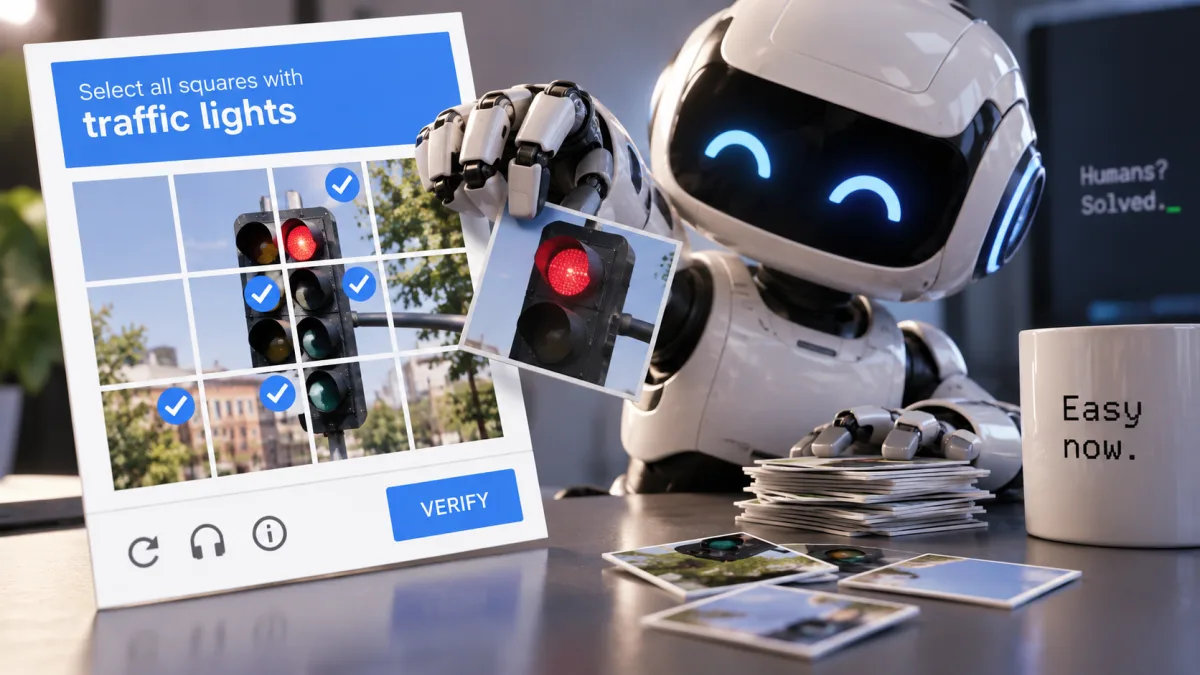
For decades, the web has relied on a peculiar ritual: clicking traffic lights, spotting motorcycles, or reading distorted text to demonstrate humanity. Now that very defense mechanism is crumbling under the weight of the technology it was meant to resist.
According to reporting from the Wall Street Journal, artificial intelligence has become remarkably adept at recognizing images and completing visual tasks that once posed genuine obstacles to automated systems. This capability has rendered traditional CAPTCHA challenges far less effective as security tools, creating an ironic situation: the security puzzles built to separate humans from machines have been undermined by machines trained to excel at exactly those kinds of visual recognition tasks.
The CAPTCHA Is Already Changing
The visible CAPTCHA hasn't disappeared entirely. Websites still deploy these puzzles when they flag a visitor as potentially suspicious. However, the landscape of bot detection has shifted substantially toward systems operating beyond user awareness.
Google's reCAPTCHA v3 exemplifies this transition. Rather than requiring users to complete a puzzle, the system evaluates incoming traffic and generates a risk score that websites can reference when determining whether an interaction appears authentic.
Cloudflare has pushed this concept further with Turnstile, which the company positions as a "smart CAPTCHA alternative." The system examines browser attributes and other behavioral signals through minor background checks, frequently without demanding any action from the visitor. Cloudflare even offers guidance for websites seeking to transition away from reCAPTCHA toward Turnstile.
The company has also unveiled Precursor, a more recent addition designed to monitor behavior patterns across an entire browsing session rather than relying on isolated verification moments.
This evolution reflects a fundamental shift in how the question gets framed. Instead of asking "Can you prove you're human?" systems now essentially inquire "Does your activity appear trustworthy?"
But Don't Celebrate Yet
The fading of those frustrating puzzles masks a deeper challenge. The bot problem itself isn't vanishing; if anything, increasingly sophisticated AI agents make it substantially harder to distinguish between genuine users, beneficial automated systems, and malicious bots.
This dynamic could usher in a generation of CAPTCHAs that operate entirely invisibly. Browser fingerprints, device specifications, network history, and behavioral patterns could collectively determine access without users ever encountering a single puzzle.
For designers and developers, this prospect carries genuine appeal. Few interface elements have derailed a smooth user experience quite like an unexpected interruption asking someone to identify crosswalks or fire hydrants.
The CAPTCHA likely hasn't reached its final form. Yet the iteration that has frustrated internet users for years appears headed toward retirement. And in a twist that captures the absurdity of technological progress, the very machines these puzzles were engineered to stop may be the ones delivering the final blow.
Read more

Kubernetes gets new purpose running autonomous AI agents, Google donates open-source tools
Google is repositioning Kubernetes as the platform for enterprise agentic AI workloads, donating foundational open-source projects to the Cloud Native Computing Foundation to help orchestrate autonomous software more efficiently.
Black Friday 2026: date, AI shopping agents and what changes for retailers
Black Friday 2026 falls on November 27, with Cyber Monday on November 30. This piece covers which AI assistants can check out in the US, why ChatGPT stepped back from Instant Checkout, and what Adobe and Salesforce forecast.

Google donates AI agent tools to open-source community to slash idle compute costs on Kubernetes
Google has contributed three projects to the Cloud Native Computing Foundation to help organizations reduce expenses when AI agents sit idle on Kubernetes clusters, addressing a growing cost challenge in agentic workloads.