AI data centers demand specialized infrastructure across every subsystem
Artificial intelligence workloads are forcing data center operators to rethink infrastructure design across four critical subsystems, each facing distinct challenges in power, cooling, density and deployment speed.
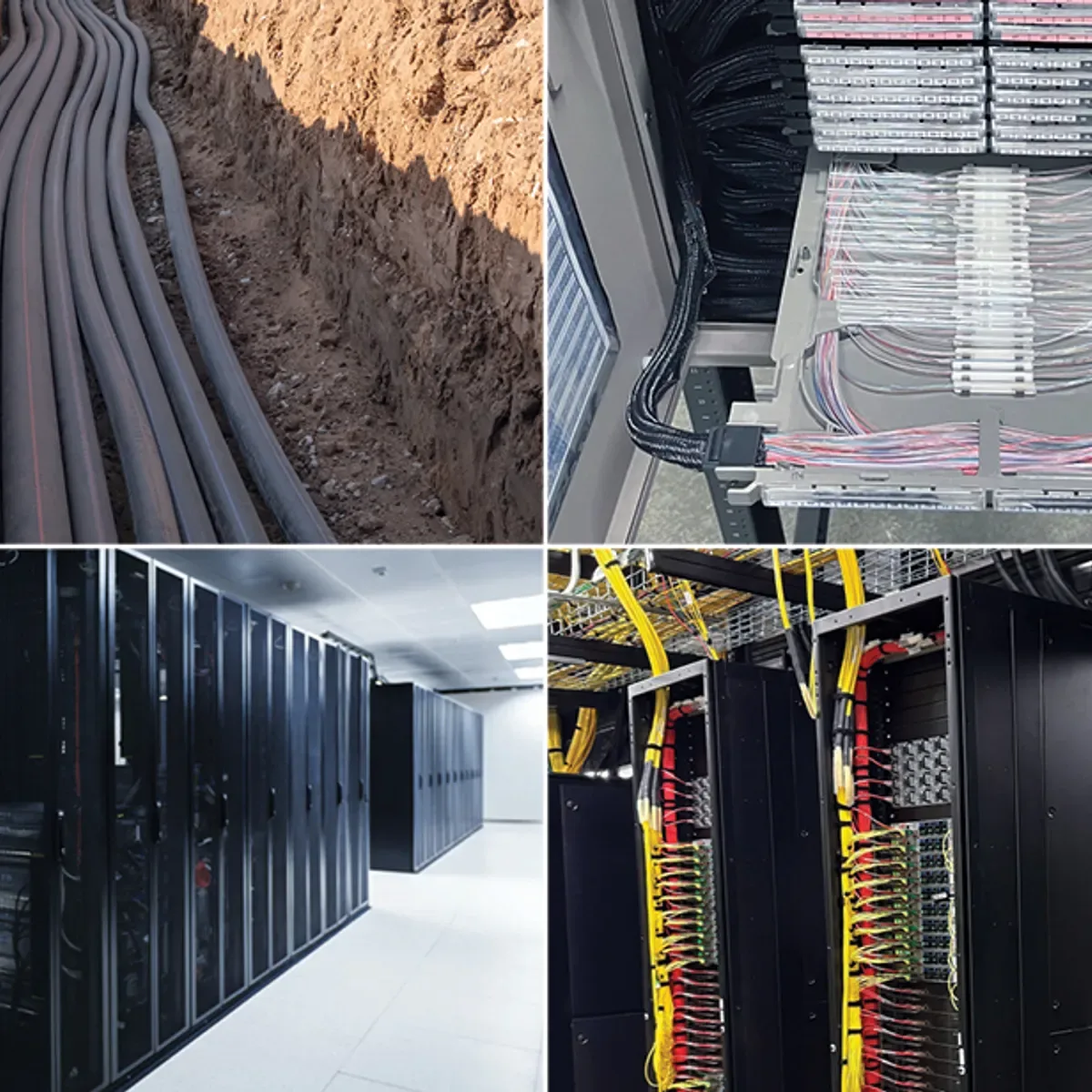
Deploying AI at scale introduces strain on data centers that extends far beyond power consumption alone. Cooling requirements, latency constraints, deployment velocity and geographic distribution all create distinct pressures throughout the facility's infrastructure layers, or subsystems. Each of these areas faces varying degrees of impact, and collectively they eliminate the possibility of a one-size-fits-all data center design. Operators seeking to build AI-capable infrastructure need partners capable of delivering high-performance cabling systems engineered for real-world conditions, combined with deep knowledge of how AI workloads interact with each subsystem and what operational teams should anticipate.
Four key subsystems define modern data center architecture: the Entry Point, Front End, DC Interconnect and Back End.
Entry point
The Entry-Point subsystem occupies the data center's gray space, serving as the infrastructure layer that routes cables from outside the building into the main hall. At this location, fiber strands are sorted and distributed throughout the facility.
AI applications drive exponential increases in fiber density entering the Entry Point, while simultaneously, heightened power and cooling demands shrink the available gray space. This combination creates bottlenecks in space allocation, cable organization and staffing, making rapid deployment the paramount concern at the entry point.
Data center operators can address this constraint through speed-focused installation methods. Innovative splicing enclosures, splicing and interconnect trays, and pre-terminated cable solutions enable a modular infrastructure approach. These techniques support quick, straightforward upgrades as requirements change and substantially reduce installation timelines.
Front end
The Front-End subsystem resides in the white space where computation takes place, managing traffic flows between end users, internal systems and outside networks.
Among the four subsystems, the Front End experiences the least disruption from AI adoption, protected by its mature infrastructure foundation. The Front-End Subsystem's core design has seen only incremental refinements over the past five years. Regulatory compliance, however, remains a persistent challenge during expansion efforts, particularly when facilities span multiple jurisdictions with varying local codes. Standardized infrastructure solutions can mitigate this concern by enabling consistent deployment across geographically dispersed locations despite minor code variations.
Data center interconnect
The DC Interconnect subsystem occupies gray space and typically comprises numerous high-fiber-count cables linking separate facilities and connecting network pods across the infrastructure.
Paradoxically, AI struggles with the very capability the DC Interconnect was engineered to provide: distance-spanning connectivity. An AI cluster functions as a unified system located in a single physical space, yet must distribute itself across the broader facility. As AI clusters expand, the DC Interconnect system must scale exponentially to sustain maximum-speed communication between locations. Expanding this subsystem presents a persistent operational challenge, consuming significant time and labor to install or upgrade cabling.
Operators can reduce this friction by implementing infrastructure capable of supporting the higher densities AI requires while enabling swift installation. Leviton's 1728-strand MMC trunks, part of the STRATA™ family of Hyperscale and AI data center solutions, deliver substantially higher density than conventional options. Leviton's trunk designs prioritize rapid, straightforward installation—a critical advantage when recabling a subsystem historically demanding intensive labor.
Back end
The Back End subsystem houses the AI cluster itself, where AI implementation fundamentally transforms the subsystem's operational requirements. Increased density to accommodate AI workloads elevates cable management and power delivery to critical priorities. The substantial electrical demands of AI systems force data center operators to extract greater performance from their existing power infrastructure.
Managing heightened density represents a familiar challenge for data center teams: achieving more within existing constraints. Very-Small-Form-Factor (VSFF) connectors, including MMC, address this need by enabling higher density at connection points while consuming less physical space than MPO alternatives. This approach allows operators to expand fiber capacity without proportionally increasing rack footprint. Leviton's STRATA™ family exemplifies this approach, supporting up to 3,456 fibers per rack unit through 16-fiber MMC connectors.
Optimizing existing power infrastructure often hinges on cooling efficiency. Immersion cooling represents an emerging approach in which servers are submerged in non-conductive, thermally conductive liquids, enabling rapid heat dissipation in high-density environments. Immersion cooling's effectiveness depends on both thermal performance and network infrastructure reliability in submerged conditions. Solutions such as Leviton TORRENT™ address this requirement by preserving signal integrity and resisting degradation when exposed to dielectric cooling fluids.
Read more

Speed to operational status now matters more than GPU counts in AI infrastructure buildouts
As organizations race to deploy AI factories, the bottleneck has shifted from securing graphics processors to managing data pipelines and storage. Infrastructure vendors are rethinking how they approach these projects from the ground up.

SpaceXSI's Grok Voice 3.0 Tops Industry Benchmarks in Speech-to-Speech Showdown
Elon Musk's SpaceXSI has unveiled Grok Voice 3.0, a speech-to-speech model that outperforms competitors from OpenAI and Google across multiple independent testing frameworks.

Microsoft Pursues Composable Memory to Ease AI Data Center Bottlenecks
As memory scarcity constrains AI workloads across data centers, Microsoft is exploring composable memory architectures that dynamically allocate capacity across servers rather than locking it within individual machines.