Colombian Fintech Palomma Closes $14M to Modernize Rental Payments and Landlord Financing
Cipriano Echavarría, a former Nubank executive, has raised $14 million for his Medellín-based startup Palomma, which combines rent collection software with financial products for tenants, landlords and property managers across Colombia.

The origin story began in 2020 when Echavarría, then working at Morgan Stanley in New York, spotted a familiar name on a desk plaque: David Vélez, founder of Brazilian digital bank Nubank and a fellow native of Medellín, Colombia. After reaching out via LinkedIn, Echavarría learned that Nubank was preparing to launch operations in Colombia. He relocated home by late 2020 to lead that expansion, with ambitions to eventually launch his own venture.
That venture is now Palomma, which has just secured a $10 million Series A round led by Mexican venture capital firm Cometa. The funding brings total capital raised to $14 million when combined with $4 million in earlier rounds that had not been previously disclosed. The investment group includes Volpe Capital, Clocktower Technology Ventures, Tekton Ventures, Simma Capital, Yango Ventures, Y Combinator, 17Sigma, Nido Ventures and Norte Ventures.
Palomma's metrics demonstrate rapid expansion. The company's annual recurring revenue has increased thirty times over 18 months, reaching approximately $3 million. It now handles roughly $130 million in monthly rental transactions, supports more than 200,000 tenants working with over 500 property managers throughout Colombia, and estimates $1.5 billion in annualized rent payment volume.
The capital will fund expansion within Colombia, development of new AI capabilities and financial products, and preparation for entering additional markets. Echavarría indicated the company is evaluating opportunities in Mexico, Brazil and Spanish-speaking regions of the United States, though he emphasized that Colombia remains the core focus. "We want to win Colombia," he said in an interview.
Identifying opportunity in the rental market
Palomma's platform integrates software for property managers to handle lease inquiries, customer support and collections with a payments infrastructure for rent transfers and landlord payouts. This foundation enables the company to offer financing products, rental guarantees and other financial services to both tenants and property owners.
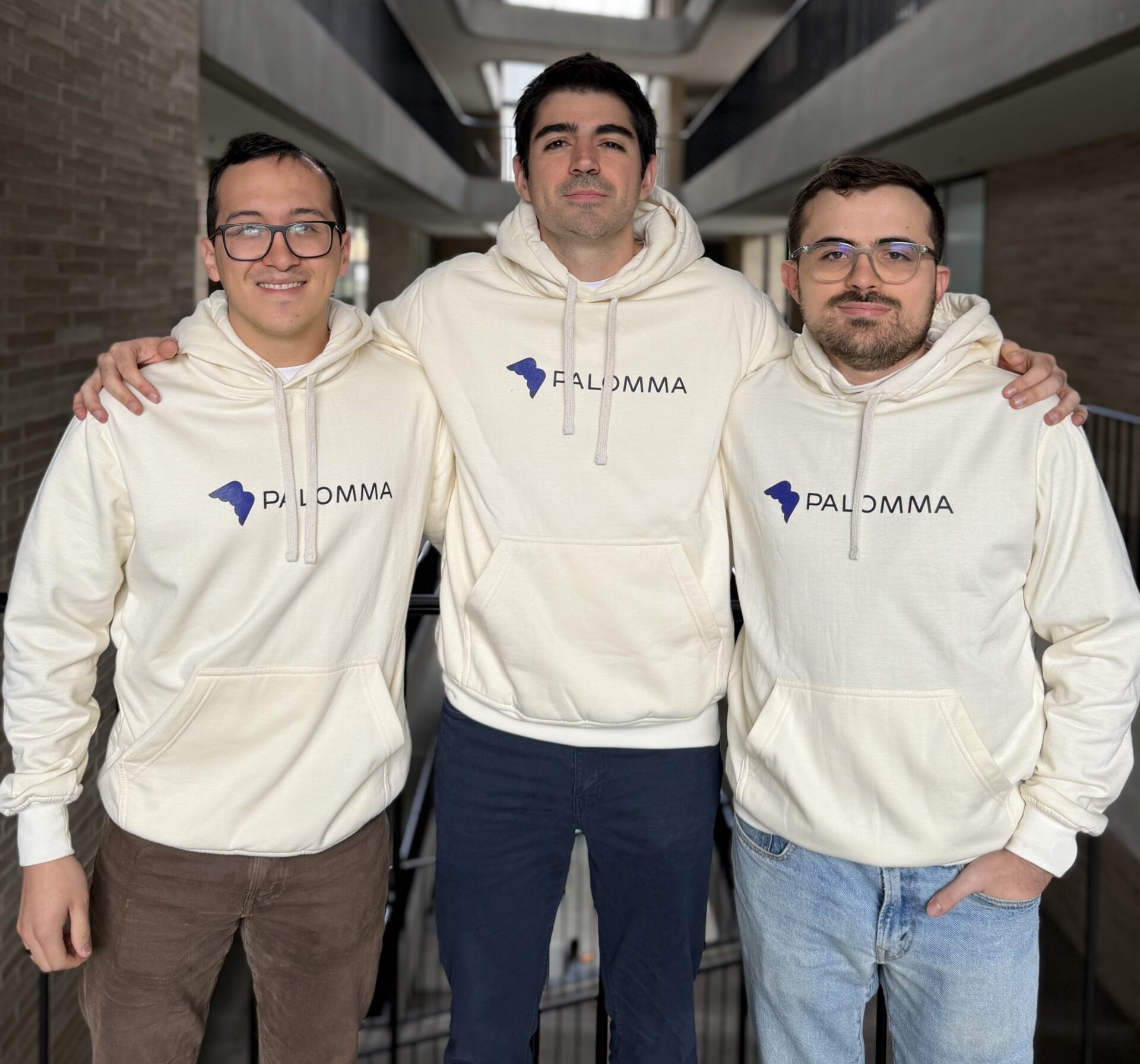
Echavarría co-founded Palomma with Felipe Monsalve and Nicolás Gómez del Campo, both MIT-educated engineers with prior roles at Meta, Cobre and JP Morgan. The three entered Y Combinator in January 2023 with plans to build an account-to-account payments system for Spanish-language Latin America. Initial traction was slow during the first year, according to Echavarría, until property managers began requesting assistance with rent collection.
The founders recognized structural inefficiencies affecting both sides of rental transactions. Tenants typically received paychecks twice monthly but needed to pay rent early in the month. Landlords relied on rental income but faced difficulty borrowing against it or protecting themselves from payment defaults. Property managers managed collections and distributions using manual, labor-intensive methods. Rather than pursuing individual tenants and landlords as customers, Palomma chose to work through property management companies as distribution partners. "Let's basically use the property managers as a distribution channel," Echavarría recalled.
Building a multi-product financial services platform
Property managers gain access to Palomma's AI software that automates leasing conversations and related tasks. The platform then offers to handle rent payment processing. These transactions create a data record of rental income and tenant payment behavior that supports underwriting for financial products.
The company offers distinct services for different users. Palomma Plus provides tenants with rewards and credit-building features. Palomma Advance enables landlords to receive up to 12 months of future rental income upfront. Palomma Protect insures rental income against tenant defaults. The company is also developing Palomma Flex, which would allow tenants to divide monthly rent payments into two installments.
Property managers pay subscription fees for the AI software, while Palomma generates revenue through a percentage of rent processed and from financial services. Expanding customer adoption of additional services has driven company growth. Palomma reports net revenue retention of 390% after 12 months, indicating that revenue from an existing customer cohort nearly quadrupled even after accounting for churn and reduced spending.
Echavarría's strategy reflects his belief about building large-scale businesses in Latin America. He cited U.S. companies including EliseAI, Bilt, TheGuarantors and Flex as models for different components of Palomma's offering. He contends that achieving comparable scale in Latin America requires a broader product portfolio. "In the U.S., you can build one solution and be really large because the market allows it," he said. "In Latin America, if you want to be really large, you need to do all the things."
Managing underwriting and operational risk
AI powers Palomma's tenant qualification process for rental guarantees. The leasing agent communicates with applicants through WhatsApp and collects required documentation. Palomma claims it can deliver approval decisions in under 30 seconds by drawing on leasing conversation data and rental payment history.
Palomma initially assumes the risk when tenants fail to pay on guaranteed leases. However, Echavarría told Crunchbase News the company is working to finalize an insurance partnership that would distribute risk and enable Palomma to offer more guarantees.
AI also helps maintain a lean workforce. As of November 4, the company employed 18 people, up from approximately 14 when the Series A closed roughly three weeks prior. A single customer service representative works alongside AI agents to support the roughly 200,000 tenants using Palomma's payment platform, according to Echavarría.
Palomma operates on the premise that AI can reduce the cost of delivering real estate financial services, similar to how mobile technology enabled digital banks to compete against traditional lenders with extensive branch infrastructure. Looking ahead, Palomma plans to expand beyond rental payments into homeowners association fees and residential property transactions.
Pepe Bolaños, managing partner at Cometa, highlighted the founding team and the opportunity to modernize Colombia's fragmented rental sector as key reasons for the investment. He noted that nearly 8 million Colombian households rent their homes.
We look for companies tackling markets where outdated processes create an opportunity to build a proprietary data asset that can be leveraged and monetized through AI
Pepe Bolaños, managing partner at Cometa
Bolaños emphasized Echavarría's track record scaling Nubank and the technical and financial expertise of Monsalve and del Campo. He noted that Palomma grew to process around $130 million in monthly rental payments and serve more than 200,000 tenants with about 14 employees in roughly 18 months. "That kind of execution is unusual. It convinced us that this team has what it takes to build a much larger business," he wrote.
Unlike competitors offering individual services, Palomma integrates rent collection, tenant screening and rental guarantees while accumulating data throughout each transaction, Bolaños said. Direct payment processing provides visibility into tenant behavior that improves credit decisions, identifies default risks and supports new financial products, while AI automates operations. "We believe the combination of distribution, proprietary payment data and AI gives Palomma a competitive advantage that can become stronger as the company grows," he concluded.
Read more

Huang's exit creates funding vacuum for AI startups as Nvidia shifts investment strategy
Jensen Huang's departure from Nvidia removes a major source of capital for early-stage AI companies, with investors warning that his successor is likely to be far more selective about startup backing.

Nvidia's Startup Investment Spree Hits 120+ Deals in 2026, But Leadership Transition Raises Questions
Nvidia and its venture arm NVentures have backed more than 120 startups this year, surpassing last year's record, but Jensen Huang's sudden departure creates uncertainty about the company's future investment strategy.

LangChain Raises $300M at $3B Valuation as AI Agent Management Heats Up
The open-source framework turned enterprise platform has doubled its valuation in a year, backed by CapitalG and others, as it positions itself as a vendor-neutral alternative for building and managing AI agents.