Microsoft's NLWeb Protocol Takes Center Stage at Build 2026
A year after its debut, Microsoft's natural language web protocol is moving from concept to production deployments, with early adopters from Shopify to TripAdvisor signaling real-world traction.
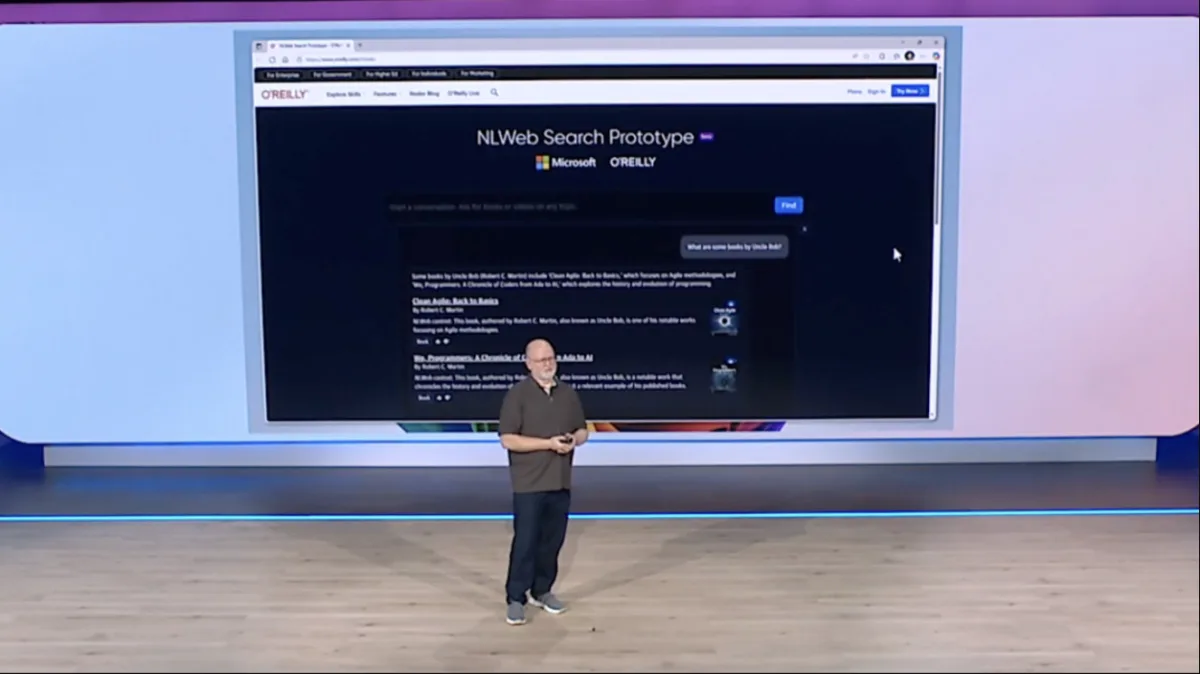
For the past several decades, web browsers have served as the primary gateway to online information. That dynamic is shifting as AI-powered search tools reshape user expectations. Microsoft Copilot and similar systems now allow users to pose questions in natural language and receive answers directly, sidestepping traditional search result pages. NLWeb represents Microsoft's effort to push this transformation further, enabling individual websites themselves to respond to natural language queries without intermediaries.
Unveiled at Build 2025, NLWeb is an open protocol designed to let any web property accept and respond to natural language queries, transforming ordinary websites into AI-powered applications. The protocol was created by R.V. Guha, who joined Microsoft as CVP and Technical Fellow. Guha's track record in web infrastructure is significant: he developed RSS, RDF, and Schema.org—three foundational formats that now govern how structured content flows across the web.
Microsoft positioned NLWeb alongside HTML when introducing it at Build 2025 in May, drawing a parallel to how HTML democratized website creation. This comparison is ambitious and warrants scrutiny. While HTML addressed the challenge of publishing content, NLWeb tackles a different problem: enabling both humans and AI agents to query published content.
How NLWeb Functions
NLWeb operates atop structured data that websites already publish. The protocol reads existing formats such as Schema.org and RSS—formats deployed across more than 100 million websites according to project documentation—and layers natural language capabilities on top using an LLM of the developer's choosing.
The protocol exposes two distinct endpoints. The /ask endpoint processes natural language queries from human users via JSON over REST, returning structured Schema.org JSON responses. The /mcp endpoint runs an MCP server, enabling external AI agents to connect and query site content programmatically under publisher-controlled conditions.
When a query reaches /ask, NLWeb does not route it to a single LLM call. Instead, it decomposes the query into multiple parallel processing steps: decontextualizing the query, retrieving relevant content from a vector database, and using the LLM to rank and synthesize the final response. This multi-step approach yields more reliable results than a single-pass method.
The /ask endpoint also preserves chat history within a session, allowing follow-up questions to build on prior context without requiring users to restate their information needs. This represents a practical departure from keyword search, where each query operates independently.
What distinguishes NLWeb from a standard chatbot widget is that every NLWeb endpoint also operates as a Model Context Protocol (MCP) server. MCP is an open standard that Anthropic developed in November 2024 for connecting AI systems to external data sources, and it has since achieved broad industry adoption. By constructing NLWeb on top of MCP, Microsoft integrates website content directly into the wider ecosystem of AI agents.
Because NLWeb remains technology-agnostic, developers face no vendor lock-in with respect to specific models, infrastructure providers, or operating systems. The project's GitHub repository supplies a Python reference implementation and quickstart guides, with compatibility across all major vector databases and LLM endpoints.
Early Adoption and Ecosystem Growth
Early adopters of NLWeb span Shopify, TripAdvisor, Eventbrite, O'Reilly Media, Hearst properties including Delish, Chicago Public Media, and Common Sense Media. A pattern emerges across these organizations: well-structured sites with organized content catalogs that align cleanly with the web formats NLWeb depends on.
Cloudflare added native NLWeb support through its AutoRAG infrastructure in early 2026, offering a managed deployment option rather than requiring manual integration. This development signals that the ecosystem is beginning to mature. Microsoft joined the MCP Steering Committee at Build 2025 and contributed an updated authorization specification alongside the design of an MCP server registry service.
What to Expect at Build 2026
Build 2026 runs June 2-3 at Fort Mason Center in San Francisco, marking a significant venue change from the Seattle Convention Center that hosted the conference for most of the past decade. Microsoft has characterized this year's event as deliberately "no-fluff," emphasizing technical substance over mass-market announcements.
The session catalog contains over 90 entries distributed across seven tracks: Agents and Apps, Azure AI Platform / Azure AI Foundry, GitHub and developer productivity, Microsoft Fabric, Responsible AI, Windows, and Working with Models. NLWeb connects most directly to the Agents and Apps track, which is anticipated to cover MCP tooling updates reflecting Microsoft's sustained commitment to that protocol.
Since NLWeb's announcement just over a year ago, Build 2026 represents the first major conference where the protocol can be assessed against documented real-world deployments rather than theoretical potential. Microsoft's opening keynote from CEO Satya Nadella typically frames platform-level priorities. At Build 2025, Nadella characterized the event as marking "the age of AI agents." Whether NLWeb receives dedicated keynote coverage in 2026 or emerges primarily through breakout sessions, it aligns squarely with the conference's stated central theme: transitioning AI agent development from announced to production-ready.
Implications for Web Developers
NLWeb creates practical incentives for developers to evaluate the structural quality of their site's data. The protocol performs optimally with content organized as lists of items: products, events, recipes, reviews. Sites with weak or absent semantic markup will experience noticeably degraded results, because NLWeb's retrieval layer depends on Schema.org annotations that many publishers have neglected.
More fundamentally, NLWeb erodes the distinction between a website and an API. Operating an NLWeb endpoint transforms a site into something queryable by external AI agents, not merely human visitors using a browser. This raises governance questions: which agents can access your content, at what rate, and under what terms?
On the tooling front, Microsoft has been strengthening Azure AI Foundry and its MCP-related developer infrastructure, both expected to feature prominently at Build 2026. For developers seeking to add NLWeb to an existing property today, the GitHub reference implementation offers the clearest entry point. Cloudflare's AutoRAG integration now provides a more managed deployment path for teams preferring not to manage underlying infrastructure themselves.
Read more
Identity governance faces new test as AI agents proliferate across enterprises
Autonomous AI agents are forcing organizations to rethink how they manage access and permissions at machine speed. SailPoint's Navigate conference will explore how identity security must evolve to handle this expanding population of non-human actors.
Vertical AI and Purpose-Built Hardware Drive Next Wave of Technology Growth
Specialized AI systems tailored to specific industries are emerging as the primary engine for the next phase of technology expansion, according to insights from the Bank of America Private Tech Trailblazers Conference 2026.
CrowdStrike and CoreWeave Partner to Automate AI Security at Machine Speed
As cyberattackers breach systems in seconds, CrowdStrike and CoreWeave are embedding automated defenses throughout AI infrastructure, turning attacks into training data for faster response.