Sovereignty by Design: Why AI Control Is Now a Business Requirement
As U.S. technology dominates global AI infrastructure, organizations in regulated industries face a critical architectural choice: how much control do they need over the systems generating their intelligence, and what risks emerge when that control passes to external vendors?
Sovereignty is shifting from a compliance checkbox to a foundational design principle for enterprises operating across borders, particularly those in heavily regulated sectors. The central tension for decision-makers involves determining the degree of oversight their organization requires over AI systems and infrastructure, alongside understanding the consequences of relinquishing that oversight to third parties.
The technological landscape tilts heavily toward American providers. Most frontier AI models and cloud infrastructure originate from U.S. companies, creating jurisdictional, operational and commercial exposure for global buyers. Organizations must actively identify and implement compensating controls to address these risks, a requirement that extends to American firms themselves, particularly those subject to regulatory oversight.
https://www.youtube.com/embed/82HyUOpNxGA?start=1&feature=oembed
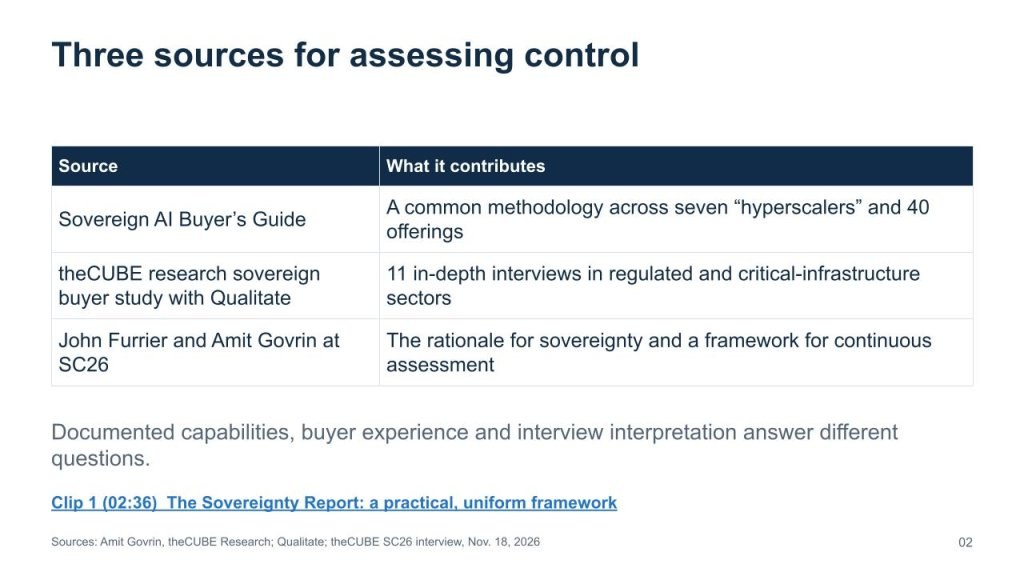
This analysis draws from three distinct research streams: a buyer's guide documenting the control mechanisms available across major cloud platforms by region; interviews with eleven senior technology leaders at regulated and critical-infrastructure organizations; and conversations examining the reasoning behind a comprehensive sovereignty framework. The buyer's guide independently validates vendor claims, while the interviews surface what purchasing decisions actually prioritize and what organizations have tested in practice. The theCUBE interview connects these findings to architectural and business risk considerations.
The gap between concern and verification
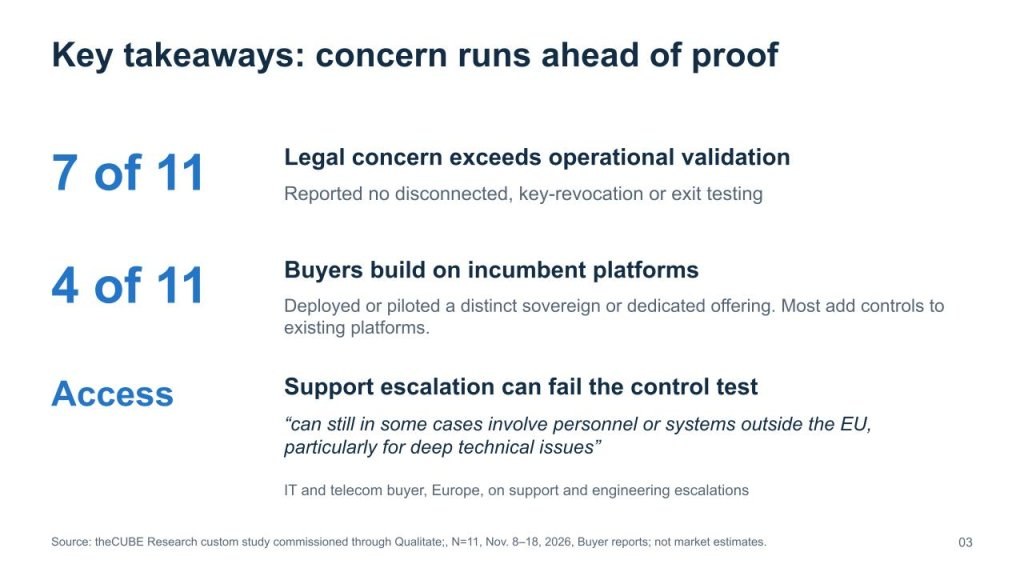
Survey respondents consistently ranked legal exposure as a top purchasing concern. However, the operational reality diverges sharply from stated priorities. Seven of the eleven interviewed buyers reported having conducted no testing of disconnected systems, key-revocation procedures or exit scenarios. This disconnect suggests that while organizations express deep anxiety about losing control, they have limited tangible evidence that their systems actually function as intended under those circumstances.
When organizations do implement additional controls, they typically layer them onto existing platforms rather than deploying distinct sovereign or dedicated offerings. Only four of eleven respondents had deployed or piloted a separate sovereign solution. Cost pressures and the operational burden of maintaining multiple environments emerged as the primary barrier to adoption.

Support escalations present a particular vulnerability. A European IT and telecom buyer noted that "deep support escalations can still in some cases involve personnel or systems outside the EU, particularly for deep technical issues." This observation underscores that sovereignty frameworks must account for support protocols, emergency access and privileged escalation paths as core architectural components. Sovereignty does not demand absolute purity; organizations can tolerate certain exposures during emergencies, provided they understand the exposure, evaluate the risk and implement appropriate compensating controls.
Regulatory uncertainty and cost-driven decisions
Many customers remain in a holding pattern, awaiting clearer sovereign-specific mandates or enforcement guidance from local governments before expanding sovereignty testing and deployment. In the interim, they rely on existing privacy and cybersecurity frameworks. This cautious approach carries risk; regulatory ambiguity actually strengthens the case for conducting acceptance testing sooner, not later.
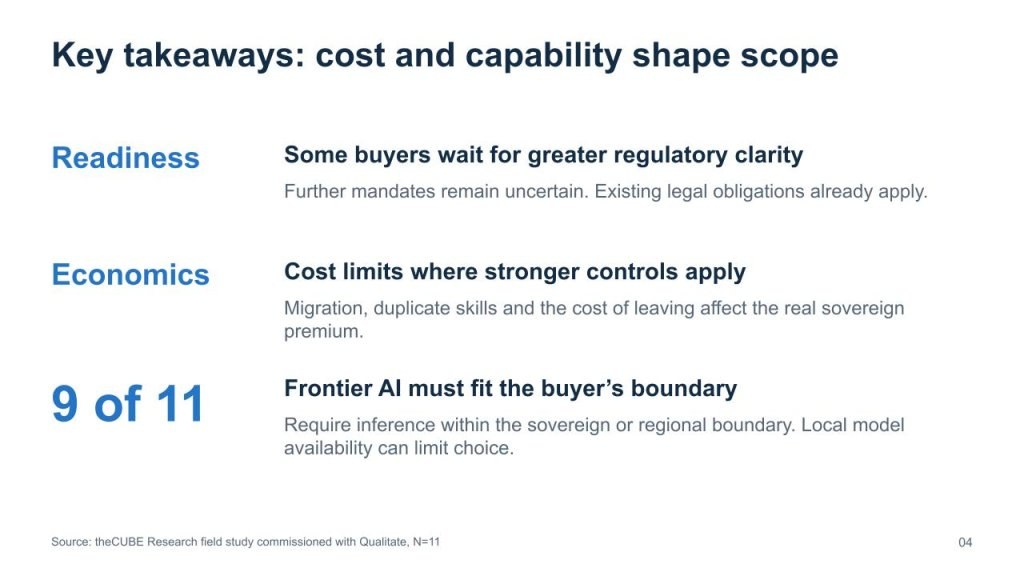
Financial considerations heavily shape sovereignty investment scope. Organizations justify stronger controls for high-sensitivity workloads while accepting greater exposure for lower-risk activities. Migration complexity, retraining requirements and exit costs all factor into these decisions. At minimum, enterprises should assess their sovereign exposure using the same rigor they apply to cybersecurity risk.
AI inference introduces a distinct complication. Nine of eleven respondents require inference to execute within sovereign or regional boundaries. Yet model availability frequently lags within those constrained environments. This forces a tradeoff between jurisdictional risk and model capability. The underlying question becomes whether the business value justifies stepping outside established boundaries. As one perspective suggests, sometimes the cost of accepting the exposure proves acceptable.
Vendor capabilities measured across regions
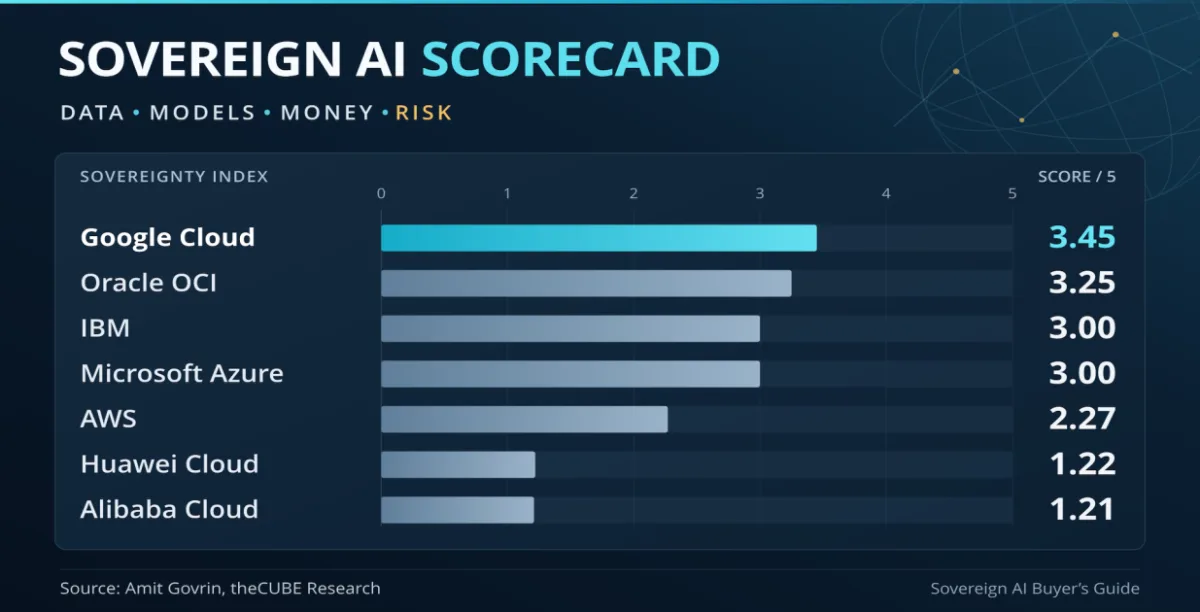
A point-in-time index from November 14 ranks cloud vendors across five buyer regions, averaging each supplier's strongest available offering. The framework evaluates five pillars—territorial, legal, operational, technical and financial—using seventeen yes-or-no tests across four non-legal dimensions plus separate legal assessment.
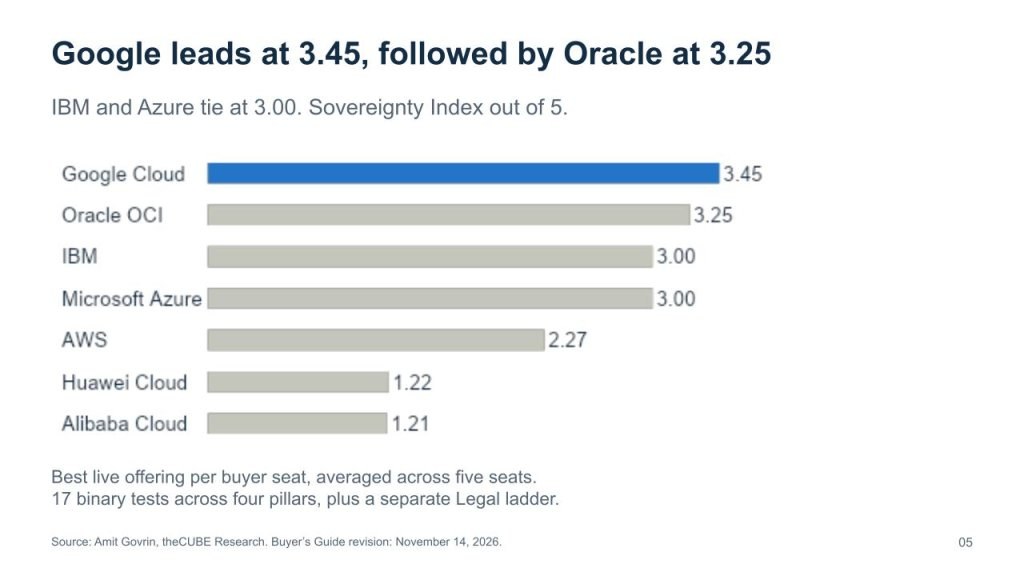
Google LLC achieved the highest score at 3.45, followed by Oracle Corp. at 3.25. IBM Corp. and Microsoft Corp.'s Azure each scored 3.0. Amazon Web Services Inc. scored 2.7, with its rating constrained by the absence of customer-operated, air-gapped stack options without vendor involvement. Huawei Technologies Co. Ltd. and Alibaba Group Holding Ltd. each scored 1.2.
Lower scores at the aggregate level do not necessarily disqualify vendors from selection. Amazon Web Services frequently remains the chosen platform despite its lower score, owing to service quality and incumbent position. Azure experiences similar dynamics as an entrenched cloud option. Comparable patterns emerge within IBM and Oracle customer bases. Customer-operated deployments generally improve scores because the methodology rewards controls that buyers can exercise independently. Missing documentation also depresses ratings. The chart should serve as an evaluation starting point; buyers must then examine the actual offering available in their jurisdiction against specific workload requirements and applicable local laws.
Five foundational questions
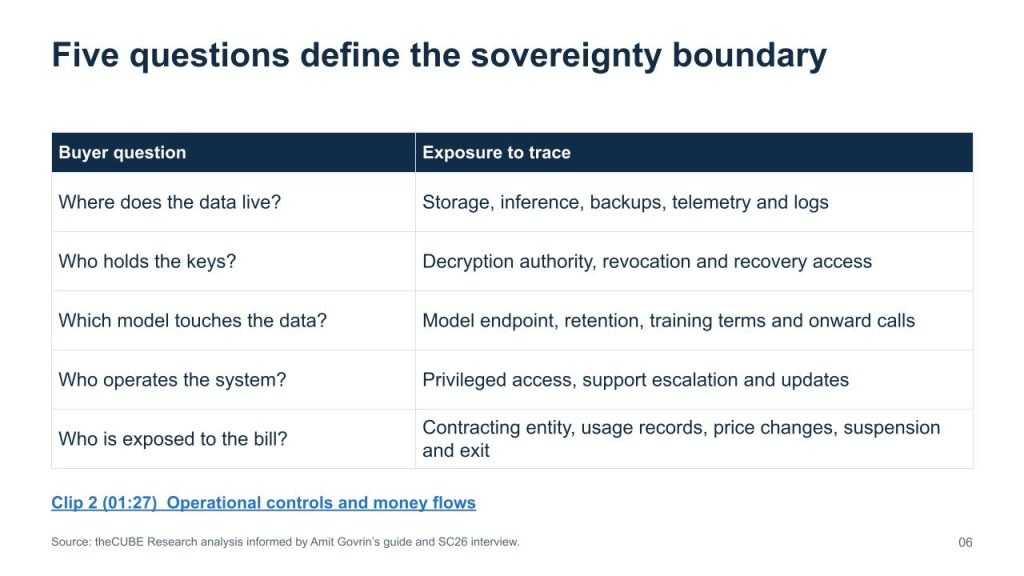
- Where does the data reside, including logs and recovery copies?
- Who holds the keys, and who possesses actual decryption capability?
- Which model accesses the data, and through which endpoint?
- Who operates the system, including support escalations?
- Who receives the invoice, controls the service relationship and bears the cost of exit?
Legal frameworks and the limits of technical controls

Seven of eleven buyers indicated that a locally incorporated subsidiary does not definitively resolve the local jurisdiction question. This assessment points toward the necessity for rigorous legal analysis extending well beyond technical evaluations.
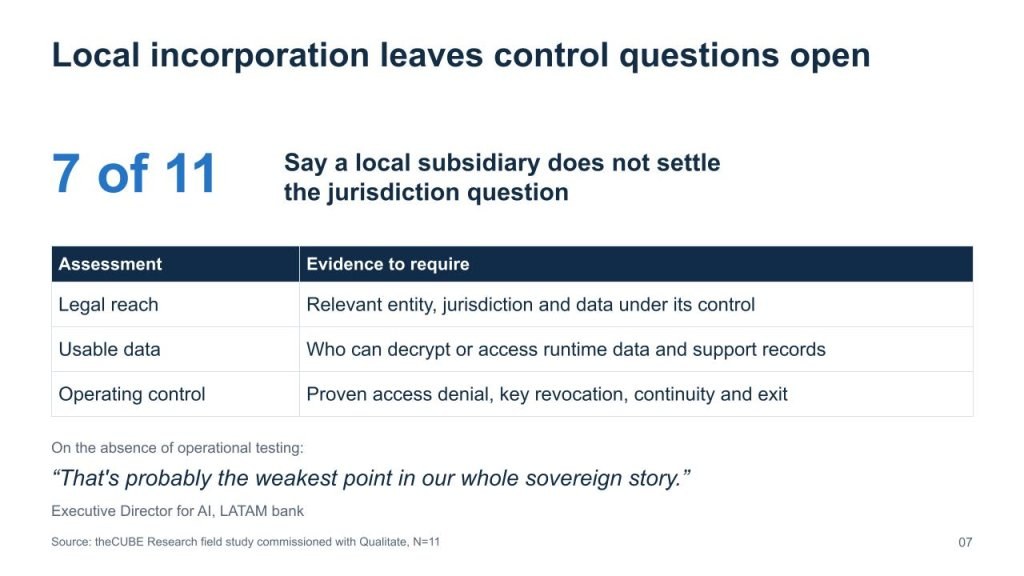
The U.S. CLOUD Act creates a significant constraint. Vendors subject to U.S. jurisdiction can be compelled to produce data in their possession or control, regardless of where that data physically resides. Corporate structure and actual operational control matter substantially in this context.
Customer-held encryption keys may restrict external access, yet key ownership does not guarantee legal immunity. Organizations must also understand what capabilities cease functioning if and when access is revoked. A South American bank's executive director for AI captured the vulnerability: "That's probably the weakest point in our whole sovereign story." The takeaway is that legal review and operational testing serve distinct purposes, and both remain essential.
Inference as a critical control point
Nine of eleven buyers require inference execution within sovereign or regional boundaries. A Latin American financial-services buyer stated plainly: "If it calls out to a U.S. endpoint, it doesn't count no matter what the contract says." This requirement demands end-to-end tracing of the request cycle—from prompt through retrieval, model invocation, output generation and logging. An application receiving approval can still depend on downstream services that operate outside the boundary, introducing hidden exposure. The actual test involves observing what happens to data during active use.
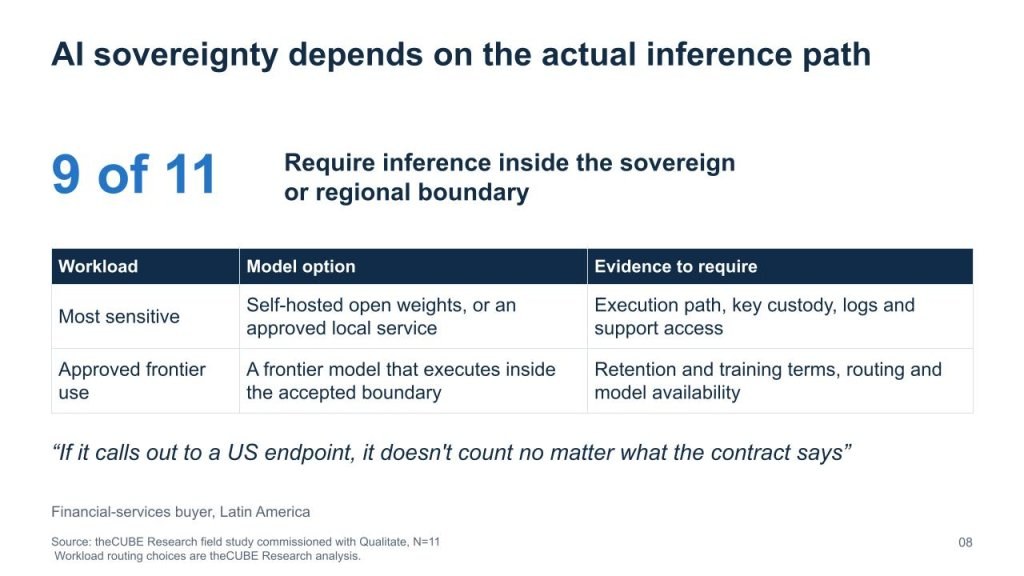
For sensitive workflows, organizations should evaluate self-hosted open-weight model architectures against approved frontier services, comparing cost and output quality. Open-weight models provide flexibility and optionality, but frontier models frequently deliver superior results that may justify relaxing sovereignty constraints.
Sovereignty as continuous governance
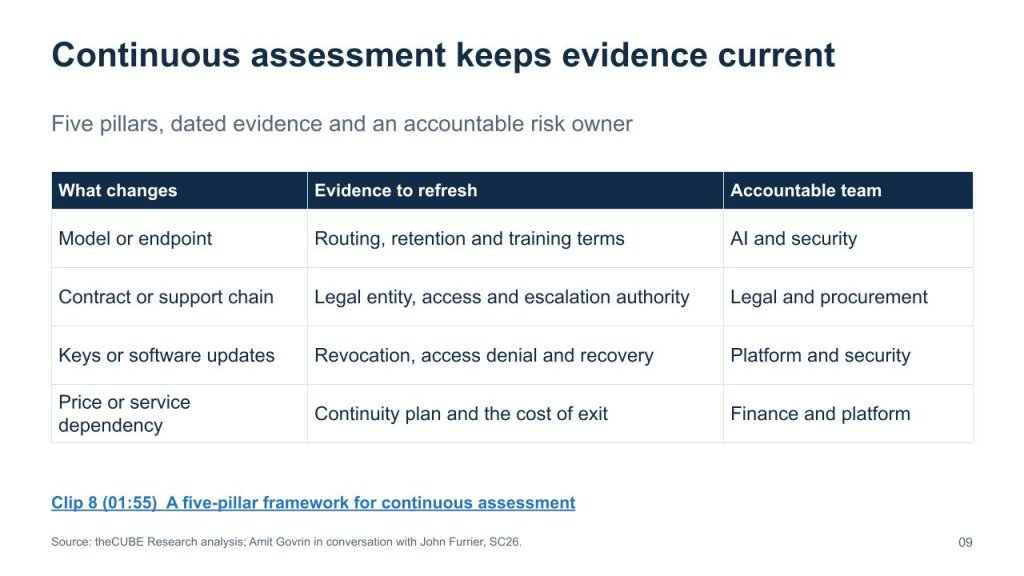
Sovereignty demands ongoing attention because architecture evolves continuously. Model endpoints shift, new models release, service contracts change and production capabilities expand. Each modification can alter exposure and risk profile. A five-pillar framework for continuous assessment brings vendor capabilities and claims into alignment with the customer's actual architecture, enabling ongoing evaluation and management of data sovereignty and third-party risk.

The evidence test for any assessment framework centers on what it reveals: what exposure exists, who controls what, who owns accountability and ultimately what risk the organization absorbs. Major changes to models, services or contracts should trigger reassessment. Both documented vendor assurance and technical testing should inform that process.
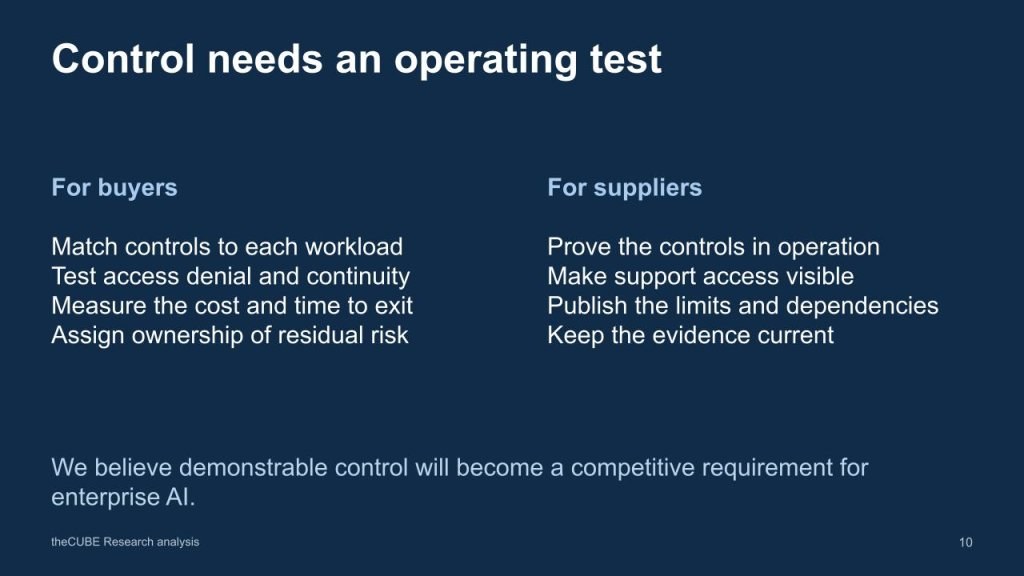
Sovereignty evaluation should operate at the workload level. Start with a core business process, identify exposures and agree on required controls based on acceptable risk. For critical workloads, obtain proof that controls function correctly in a safe sandbox before moving to production. This requires attention to privileged access and testing of key-revocation and recovery procedures. Most organizations currently lack the observability to verify model behavior and execution paths. Testing and telemetry represent major capability gaps. Can the organization observe the execution route and exercise an exit or completely disconnected scenario if required? Financial assessment must encompass ongoing operation, migration, retraining, exit costs and business disruption. Critically, a business owner must accept the risk, not an IT professional.
For vendors, substantial opportunity exists to document controls, establish transparent operating economics and provide credible evidence supporting proposed solutions. In many observed cases, public documentation and evidence fall short of marketing claims.
Sovereignty has become integral to enterprise architecture because intelligence now depends on these vendor relationships. Buyers require the ability to make informed choices and demonstrate that resulting systems behave as intended.
Read more

Anthropic Researcher Claims Claude Proved the Riemann Hypothesis
Levent Alpöge, a researcher at Anthropic, announced he used Claude to prove one of mathematics' most significant unsolved problems, though the company has not officially confirmed the breakthrough.

Beyond Token Prices: Why Enterprise AI Cost Accounting Demands a Deeper Look
Companies pursuing multi-model AI strategies are discovering that token pricing alone masks the true cost of AI deployment. New data shows task efficiency and user consumption patterns drive the real bill.

Anthropic's IPO Surge Masks Broader AI Market Jitters as OpenAI Waits in the Wings
Anthropic's initial public offering delivered a solid 17% first-day gain, but the move may have signaled caution rather than momentum across the AI sector, with broader market concerns weighing on technology stocks.