Microsoft expands Foundry platform with decision models and continuous improvement tools for enterprise AI
Microsoft has introduced new generative AI models and enhancements to its Foundry enterprise platform, including a generally available Decision-1.1 model and expanded first-party MAI model family designed to streamline autonomous agent development and deployment.

Microsoft Corp. unveiled a suite of generative artificial intelligence models alongside significant updates to Foundry, its unified enterprise platform for developers and organizations seeking to ground, test and deploy AI applications and autonomous agents.
The Foundry IQ component, which is part of Microsoft IQ, now ships with an enterprise knowledge graph that integrates unstructured and application data, providing contextual richness for building applications and addressing key business use cases.
Foundry's existing transparency and observability features now enable customers to establish learning loops for their systems. Autonomous agents can set performance baselines across quality, safety, latency and cost metrics, then use these benchmarks to drive continuous behavioral refinement.
The platform introduces human annotations, currently in preview, allowing domain experts to evaluate and provide feedback on agent traces using business-specific criteria. This feedback integrates into an iterative improvement cycle that combines optimization testing against established evaluations and validation against actual production results. Foundry can now also leverage organizational data to apply reinforcement learning during compute operations. Each enhancement becomes the new baseline, enabling teams to measure progress and validate changes for ongoing quality gains.
Decision-1.1 and expanded first-party model offerings
Microsoft announced that Decision-1.1 is now generally available. The model represents a fast, economical option for making reliable decisions in software at scale.
Unlike large language models that expend computational resources deliberating over routing, classification, prioritization, verification and workflow control decisions, Decision-1.1 reaches conclusions quickly within defined parameters. The model delivers calibrated confidence scores, permitting applications to escalate decisions when confidence falls below acceptable thresholds. This approach offers superior decision-making performance compared with LLMs while maintaining lower costs.
Decision-1.1 succeeds Microsoft-Decision-1, which launched in October. The updated version demonstrates substantial gains in intelligence and speed while maintaining competitive pricing. The model is constructed on Google LLC's Gemma 4 26B A4 base and incorporates multimodal capabilities for analyzing images alongside text instructions.
Microsoft has also broadened its MAI family of first-party models integrated into Foundry for enterprise deployments. The expanded lineup includes MAI-Code-2, engineered for complex agentic coding tasks, and MAI-Code-2-Flash, optimized for high-volume routine coding work, allowing developers to balance performance against cost considerations. Both versions are now generally available on GitHub, with Code-2-Flash entering private preview within Foundry.
MAI-Image-2.7 and MAI-Image-2.7-Flash are in preview, delivering improved editing precision and more uniform image generation. These models enable brands to maintain visual consistency across marketing initiatives while reducing operational expenses.
For cybersecurity applications, MAI-Cyber-2-Flash serves as a specialized model for security operations and is available in preview through Codename MDASH, Microsoft's agentic code security system currently in preview for qualified organizations.
Foundry's model ecosystem has expanded to include the top 50 models, supported by a model router and AI Gateway for intelligent model selection. The platform provides access to more than 11,000 models from OpenAI Group PBC, Anthropic PBC, Meta Platforms Inc., Mistral AI SAS, open-source initiatives and additional providers.
Supported models can be evaluated and deployed within Foundry as part of the same continuous improvement workflow applied to agents.
Read more
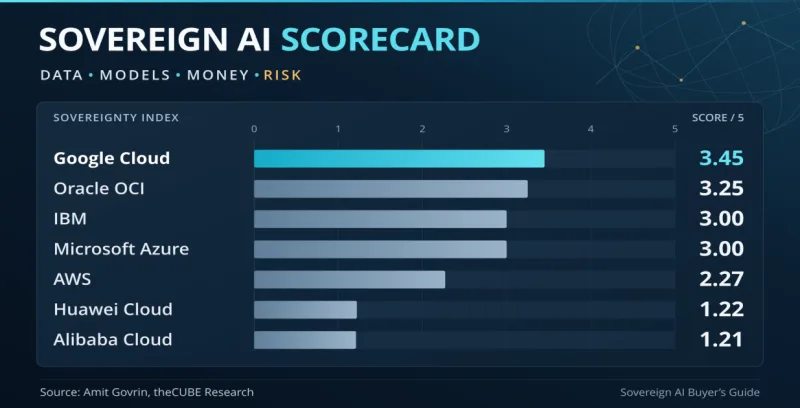
Sovereignty by Design: Why AI Control Is Now a Business Requirement
As U.S. technology dominates global AI infrastructure, organizations in regulated industries face a critical architectural choice: how much control do they need over the systems generating their intelligence, and what risks emerge when that control passes to external vendors?

Anthropic Researcher Claims Claude Proved the Riemann Hypothesis
Levent Alpöge, a researcher at Anthropic, announced he used Claude to prove one of mathematics' most significant unsolved problems, though the company has not officially confirmed the breakthrough.

Beyond Token Prices: Why Enterprise AI Cost Accounting Demands a Deeper Look
Companies pursuing multi-model AI strategies are discovering that token pricing alone masks the true cost of AI deployment. New data shows task efficiency and user consumption patterns drive the real bill.