Enterprise Infrastructure Spending Climbs as AI Workloads Push Performance to Breaking Point
A Forrester survey of 528 IT leaders reveals that latency problems are intensifying as agentic workloads strain enterprise systems, forcing organizations to spend more on infrastructure despite persistent performance gaps.

Enterprises are grappling with rising latency challenges driven by agentic workloads, according to research conducted by Forrester Consulting for cloud infrastructure provider Akamai. The survey of 528 IT decision-makers found that virtually all respondents implemented at least one measure over the past year to address deteriorating infrastructure performance.
When applications failed to achieve target response times, 58% of surveyed IT leaders responded by increasing infrastructure spending in hopes of improving performance metrics. Other organizations pursued different strategies: 38% trimmed product features, 34% postponed product rollouts, and 30% restricted system capabilities. Nearly half of respondents opted to tolerate reduced performance for certain user segments.
"Loads of organizations are struggling to hit the performance they have said they want to, and [some] said 'we just kind of deal with it,' and that's not great," said Danielle Cook, director of product marketing at Akamai. "It's definitely not great when you have agents."
The Infrastructure Challenge
Reducing the gap between computational resources and applications is becoming increasingly important for chief information officers managing agentic workloads and performance bottlenecks.
Agentic workloads are intensifying operational strain and raising costs for enterprises through higher data processing expenses, increased low-latency requirements, and elevated infrastructure expenditures, according to a joint report from Ocient and Propeller Insights. The research indicated that roughly 25% of technology leaders reported their AI infrastructure needs have outpaced available capacity.
Global IT spending is projected to reach $7.35 trillion in the coming year as organizations invest heavily in AI infrastructure to "industrialize AI deployment," according to Gartner.
Despite increased spending, only 16% of companies consistently achieve response time targets for mission-critical applications, the Akamai survey revealed. Physical distance between end users and compute resources emerged as a significant latency factor for 38% of respondents, while 41% cited misalignment between data storage locations and processing locations as a contributing issue.
Real-time applications are becoming more common, with three-quarters of respondents indicating that over 25% of their application portfolios are interactive in nature. Nonetheless, conventional workloads such as batch processing and large-scale data analytics still consume the majority of enterprise compute resources.
"Centralized infrastructure is great, there's a lot of good, solid reasons you need that," Cook told CIO Dive. "But when you have agents that are competing for information or trying to get a loop finished fast, you need to have distributed compute."
For organizations building new applications or planning to leverage open weight models, Cook recommended that IT leaders evaluate which computational workloads can be relocated and establish appropriate performance measurement strategies rather than overhauling existing infrastructure.
Read more
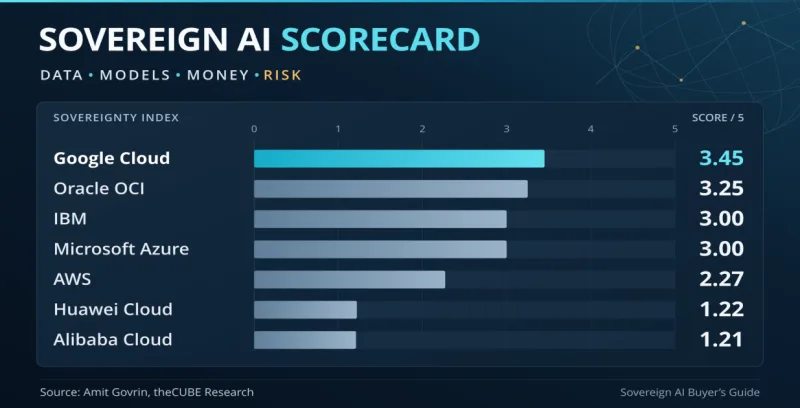
Sovereignty by Design: Why AI Control Is Now a Business Requirement
As U.S. technology dominates global AI infrastructure, organizations in regulated industries face a critical architectural choice: how much control do they need over the systems generating their intelligence, and what risks emerge when that control passes to external vendors?

Anthropic Researcher Claims Claude Proved the Riemann Hypothesis
Levent Alpöge, a researcher at Anthropic, announced he used Claude to prove one of mathematics' most significant unsolved problems, though the company has not officially confirmed the breakthrough.

Beyond Token Prices: Why Enterprise AI Cost Accounting Demands a Deeper Look
Companies pursuing multi-model AI strategies are discovering that token pricing alone masks the true cost of AI deployment. New data shows task efficiency and user consumption patterns drive the real bill.