Amazon Acquires Decart's AI Optimization Technology for $7.5 Billion
Amazon has agreed to hire Decart.AI's technical team and acquire its DOS platform, which optimizes neural networks for improved efficiency. The reported $7.5 billion price tag nearly doubles Decart's valuation from its May funding round.

Amazon.com Inc. has announced its intention to bring on board the engineering staff of artificial intelligence startup Decart.AI Inc. and secure the rights to its proprietary technology platform. While Amazon refrained from publicly stating deal specifics, Bloomberg's sources indicated the e-commerce and cloud computing giant is committing approximately $7.5 billion to the transaction. This figure represents nearly double the valuation Decart achieved following its most recent capital injection in May.
Anthropic PBC, an AI company, had previously expressed interest in acquiring Decart, reportedly offering $6 billion in August before abandoning negotiations in September. Speculation about Amazon's potential involvement surfaced the following month.
The acquisition brings Decart founders Dean Leitersdorf, Moshe Shalev and Orian Leitersdorf into Amazon's ranks, along with the startup's research personnel. Amazon is also obtaining ownership of the DOS platform, Decart's signature technology designed to enhance the operational efficiency of AI models. According to Decart's claims, the software can slash the expenses associated with certain neural networks by as much as one hundred times.
How DOS Works
Decart has kept specifics about DOS's mechanics largely under wraps. Nevertheless, a blog post accompanying the company's May funding announcement disclosed that the platform refines AI models through "tuning the kernels."
Kernels represent the foundational components of neural networks—straightforward code segments intended to execute across numerous processor cores simultaneously. A prevalent optimization strategy called kernel fusion merges several kernels into a unified code segment that demands fewer hardware resources. In July, Decart revealed that a proprietary model it constructed utilizing DOS incorporates kernel fusion.
The platform incorporates "proprietary compilers" as well. These compilers function by converting neural networks into the specific programming language required by the underlying hardware platform while simultaneously enhancing model performance. As an illustration, Amazon Web Services' compiler for its AWS Trainium machine learning processor employs quantization, a technique that compresses models into a configuration that consumes less memory.
Whether Decart positions DOS as a substitute for the standard compilers bundled with AI accelerators remains ambiguous. According to Amazon's statement, Decart has "worked closely" with its engineering teams beginning in 2025 to fine-tune performance for workloads running on Trainium chips. The most recent commercially accessible version, Trainium3, delivers 2.52 petaflops of computational throughput when handling FP8 data.
Strategic Rationale
Amazon characterized the acquisition as instrumental in "further optimize both its inference and custom silicon performance." The retailer and cloud provider aims to deliver faster model execution alongside reduced operational expenses for its customer base.
Every leap forward in AI starts with getting more out of every chip. More efficient compute means better training, better reinforcement learning, faster inference, and better models for customers at a lower cost.
Peter DeSantis, Amazon's senior vice president of foundational AI models, custom silicon and quantum computing
The transaction excludes Decart's collection of internally created AI models. The startup's two most recent algorithms, Lucy 2.5 and Oasis 3, function as world models capable of synthesizing simulated environments from textual descriptions. Lucy 2.5 emphasizes rapid content generation with minimal latency, whereas Oasis 3 concentrates on producing synthetic training information for robotic systems.
Read more
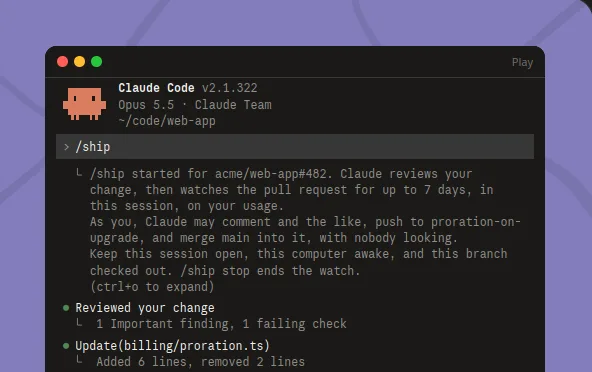
Anthropic Launches Claude Ship to Automate Code Approvals in Production Pipelines
Anthropic has introduced Claude Ship, a suite of AI agents that automates the final stages of software deployment, including code reviews, bug fixes, and approval decisions—addressing a bottleneck that emerges when development teams rely heavily on AI code generation.
Supertake Lands $20M to Automate Investment Decisions Through AI Trading Agents
The AI-powered investing platform, which converts market insights into automated stock portfolios, has closed a seed round led by Adjacent to expand its team and broker partnerships.

Williams-Sonoma Deploys AI Across Customer Experience and Internal Operations
The home goods retailer is using artificial intelligence to personalize shopping and streamline back-office work, with customer-facing chatbots handling over 1 million conversations since launch.