Two decades of Apple WWDC: from Intel chips to spatial computing
Apple's Worldwide Developer Conference has shaped the company's trajectory since Steve Jobs' return in 1997, hosting watershed moments from the Mac's processor switch to the Vision Pro reveal.
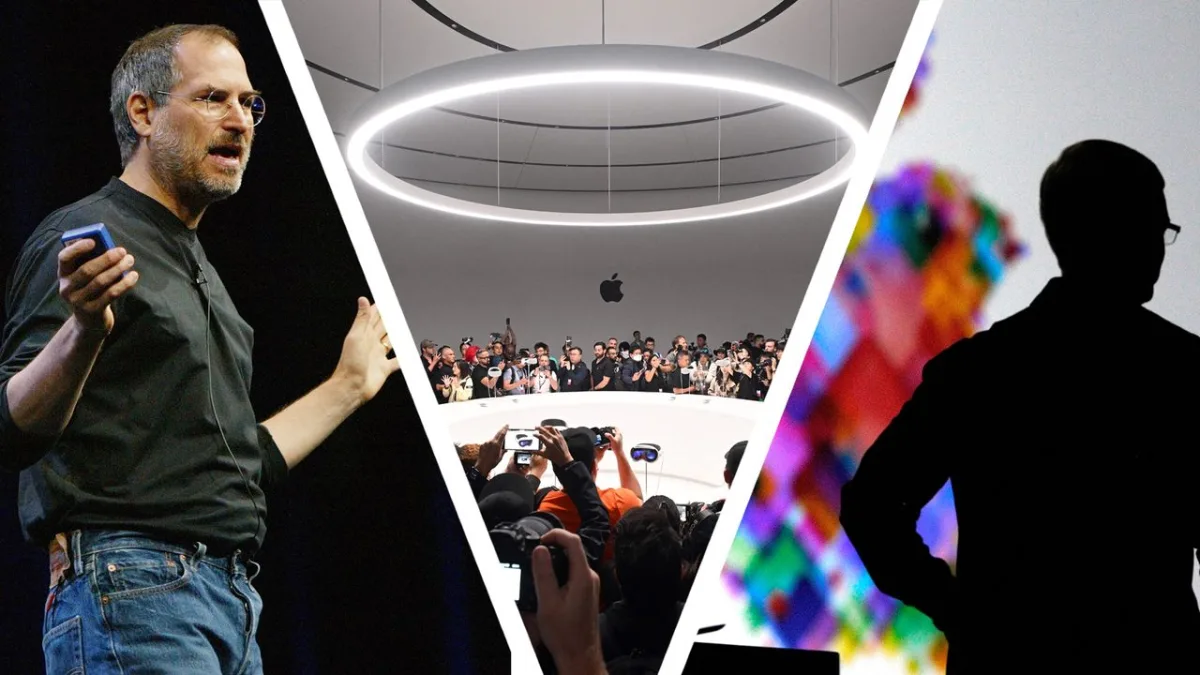
Despite its modest name, the Worldwide Developer Conference has served as the stage for pivotal announcements that have defined Apple's direction. The event has evolved from a secretive gathering for insiders in 1983, when the Apple Lisa received its first showing, into a major industry spectacle. The transformation accelerated after Steve Jobs rejoined Apple in 1997, turning WWDC into the software and hardware showcase recognized today.
As Tim Cook prepares to host his final WWDC keynote before passing leadership to John Ternus, the conference's history reflects the company's most consequential decisions and product introductions across nearly four decades.
The second Steve Jobs era
The 2000 conference marked a turning point when Jobs demonstrated Mac OS X, Apple's forthcoming desktop operating system. The public beta launched that September, and the event drew 3,500 developers—the largest WWDC attendance in Apple's history at that time.
Three years later, Jobs used his "one more thing" segment to introduce the Power Mac G5, a desktop system later nicknamed the "cheese grater" that would become one of the final machines Apple built in partnership with IBM.
The 2005 conference sent reverberations through the industry when Apple announced its shift away from PowerPC processors toward Intel architecture. On June 6, 2005, at the Moscone Center, Intel CEO Paul Otellini greeted Jobs, marking the beginning of a new era for Mac computing.
The following year's event showcased the Mac Pro, Apple's first Intel-based workstation, which gained a reputation for exceptional durability. Attendees contemplated the pricing of this new machine, which would become a standard for professional users.
Six months after the iPhone's unveiling at Macworld 2007, Jobs presented the device to developers at WWDC 2007. The phone would reach consumers on June 29, with Jobs noting that developers could begin shipping web 2.0 applications, though the full App Store would not arrive until 2008.
The 2008 conference introduced the iPhone 3G, but the more significant development occurred three months earlier when Apple released the iPhone SDK to the developer community. The App Store's official launch followed a month after WWDC, initiating a new chapter in mobile software distribution.
Phil Schiller, Apple's Senior Vice President of Marketing, demonstrated voice control capabilities for the iPhone 3GS at WWDC 2009, years before Siri's introduction. Apple would acquire Siri in 2010, with the assistant debuting on the iPhone 4S in 2011.
The 2010 event saw Jobs reveal the iPhone 4, a device that became iconic for its flat glass design and Retina display. This marked the final iPhone announcement at WWDC; subsequent models would be unveiled at consumer-focused events beginning in 2011.
Jobs appeared unusually subdued when introducing iCloud at WWDC 2011, his last developer conference appearance. The legendary executive passed away approximately four months later, concluding an era and initiating Tim Cook's tenure as CEO.
The Tim Cook era
Cook assumed the CEO position in August 2011, following Jobs' resignation, and made his first WWDC keynote appearance in 2012. The presentation opened with a comedy sketch featuring Siri, the voice assistant expected to remain central to Cook's final WWDC as CEO.
That same 2012 event highlighted the redesigned MacBook Pro, which combined the thin profile of the MacBook Air with a Retina Display—then the highest-resolution screen available on any laptop.
Cook described iOS 7, unveiled at WWDC 2013, as "the biggest change to iOS since the introduction of the iPhone." The update represented a dramatic departure from skeuomorphic design toward a flat aesthetic that proved divisive among users.
Phil Schiller made headlines at the 2013 event with a memorable declaration while introducing the new Mac Pro: "Can't innovate anymore, my ass." The powerful workstation's cylindrical form later earned it the unflattering nickname "Trash Can," undermining the intended message about innovation.
The Weeknd performed at WWDC 2015 to celebrate the launch of Apple Music, the company's streaming service. The Canadian artist premiered "Can't Feel My Face," which subsequently reached number one on the US Billboard Hot 100 and remains among the most-streamed tracks on the platform.
WWDC 2016 expanded the keynote experience by moving to the Bill Graham Civic Auditorium with a substantially larger live audience, departing from the traditional Moscone Center venue. The following year brought another relocation to the San Jose Convention Center, with events eventually settling at Apple Park.
Apple introduced the HomePod at WWDC 2017 as its entry into the smart speaker market, competing against Sonos and Amazon's Echo. The product's rollout faced delays, with a second-generation model not arriving until January 2023. Reports suggest a HomePod mini with enhanced Siri capabilities may launch later this year.
Augmented reality dominated WWDC 2018's messaging, with LEGO's director of innovation Martin Sanders demonstrating LEGO AR City built on ARKit 2. This presentation foreshadowed Apple's Vision Pro announcement five years later.
Cook announced a significant change for iPad products at WWDC 2019: the transition from iOS to a dedicated iPadOS. While this move brought tablets closer to a "touchscreen Mac" experience many users desired, Apple has consistently denied any plans to merge iPadOS and macOS.
Today we're announcing our transition to Apple silicon, making this a historic day for the Mac
Tim Cook, WWDC 2020
Cook made this declaration at WWDC 2020, a virtual event held during the early pandemic period. The announcement proved landmark despite concurrent challenges, including developer complaints about Apple's 30% commission on in-app purchases and regulatory pressure from the European Commission.
The 2021 conference reflected the strange period of virtual tech events, with Cook addressing an audience represented by Memoji avatars. The event delivered no new hardware and featured only incremental updates to iOS, macOS, and FaceTime.
WWDC 2022 marked a return to in-person normalcy alongside significant hardware announcements. Cook posed with the redesigned MacBook Air M2, a model that was deemed so compelling it created challenges for future iterations. The current M5 version maintains the same fundamental design, validating concerns about improving upon the formula.
Cook stood alongside the Apple Vision Pro at WWDC 2023, introducing what Apple called a "revolutionary spatial computer." The device's high price point and novel category proved challenging for mainstream adoption, with visionOS subsequently becoming a minor focus at subsequent developer conferences.
OpenAI CEO Sam Altman attended WWDC 2024, where Apple announced a partnership integrating Siri with ChatGPT. The company later revealed a "multi-year collaboration" with Google to power next-generation Apple services, including an updated Siri, using Gemini models.
Following the 2024 keynote, YouTuber iJustine interviewed John Giannandrea, Apple's Senior Vice President of Machine Learning and AI Strategy, and Craig Federighi, Senior Vice President of Software Engineering, about Apple Intelligence, the event's marquee announcement. The feature faced numerous delays and subsequently drew criticism, including a federal lawsuit alleging false advertising.
WWDC 2025 centered on the introduction of "Liquid Glass," a design language representing arguably the most significant visual shift since iOS 7. The aesthetic proved polarizing, prompting Apple to introduce adjustments allowing users to reduce the effect's intensity—a pattern likely to continue at future conferences.
Cook took the stage at WWDC 2025 in what may be his final appearance as Apple's chief executive, with John Ternus poised to assume leadership at today's event.
Read more
TechCrunch Disrupt 2026 offers $75 passes for laid-off workers seeking their next opportunity
Those affected by recent tech layoffs can attend TechCrunch Disrupt 2026 at San Francisco's Moscone West for $75, with the discounted Expo+ Pass limited to the first 100 qualifying applicants before the event opens October 13.
How AI Created the GTM Engineer: Clay's Kareem Amin on a Rapidly Emerging Role
A position that barely existed two years ago is now appearing across technology companies. At TechCrunch Disrupt 2026, Clay's founder will explain how AI and automation are reshaping go-to-market work.
Deadline Tonight: Last Chance to Host a Side Event at Founder Summit 2026
Applications to host a Side Event during TechCrunch Founder Summit 2026 in Boston close at midnight PT tonight. The event runs November 1–7 and will draw over 1,000 tech leaders.