Microsoft Build 2026 pivots to AI agents as the future of developer work
Arriving in San Francisco in June, Microsoft's annual developer conference will showcase how AI-powered agents are reshaping programming from writing code to directing its creation.
Since its inception in 2011, Microsoft Build has served as the company's flagship venue for developer announcements. This year's edition, taking place June 2 and 3 at Fort Mason Center in San Francisco, marks the first time the conference has relocated from Seattle since 2016. The event will draw approximately 2,500 developers in person, with CEO Satya Nadella framing his keynote around "creating new opportunities for developers across our platforms in this era of AI."
The 2026 conference carries a singular organizing principle: AI agents. Last year's Build produced more than 50 announcements spanning GitHub Copilot, Azure AI Foundry, and the Model Context Protocol (MCP), establishing autonomous coding agents and multi-agent orchestration as core developer narratives. Many of those capabilities have since transitioned from preview status to production-ready releases. Build 2026 is positioned to reveal what comes next in this evolution.
AI-native programming at Build 2026: What to expect
Microsoft has structured the Build 2026 session catalog into seven distinct tracks, with Agents & Apps, GitHub, and developer productivity occupying prominent positions. The company's central messaging for the event—'agents'—will shape the tooling announcements throughout.
GitHub Copilot's autonomous coding agent, introduced at Build 2025, has spent the past year operating in real-world environments. The agent can claim a GitHub Issue, establish an isolated environment via GitHub Actions, complete the assigned task, and submit a pull request for human review. Build 2026 is anticipated to unveil the next iteration, featuring multi-agent coding workflows and tighter integration between GitHub and Azure infrastructure.
Azure AI Foundry is poised to receive substantial enhancements. Microsoft Agent Framework 1.0 achieved general availability in April 2026, delivering a production-grade SDK for .NET and Python developers focused on multi-agent orchestration. Build sessions are expected to demonstrate how this framework integrates with Foundry's agent runtime, managed memory capabilities, and observability infrastructure at enterprise scale.
Microsoft has been extending AI functionality to the device layer. Windows AI PCs equipped with Qualcomm Snapdragon X Elite, Intel Core Ultra, and AMD Ryzen AI processors have been available for two years. Developer tooling is now catching up to the hardware. Build sessions are expected to address Windows Copilot Runtime APIs designed for on-device NPUs, enabling a hybrid model where straightforward inference runs locally while demanding computations route to cloud services.
A unifying thread connects these announcements: developers specify desired outcomes, agents execute the work, and the developer's responsibility shifts toward oversight and validation rather than line-by-line composition. Whether this paradigm proves viable in production across demanding workloads remains a central question Build 2026 is positioned to begin addressing.
What is intent-first programming?
Intent-first programming describes a development model where you articulate what a system should accomplish rather than prescribing the mechanism for accomplishing it. Traditional development demands explicit syntax and logic authoring; intent-first approaches accept natural language descriptions and convert them into functional code. This translation layer now exists within GitHub Copilot Agent Mode, the Copilot Studio Agentic Workflow Builder (which became generally available on May 20, 2026), and GitHub Spark.
For developers, this fundamentally alters the nature of daily work. You invest less effort in boilerplate composition and more in examining, redirecting, and validating agent-generated output. Crafting a prompt that precisely communicates scope and constraints becomes as critical as syntax expertise once was, though interpreting and assessing generated code still demands solid technical foundation.
The associated risks warrant explicit acknowledgment. AI-generated code can harbor security flaws, performance degradation, and logical errors that evade casual review. Cybersecurity researchers have documented these issues across multiple vibe coding and AI-assisted platforms. Intent-first programming accelerates the journey from concept to executable code, yet it does not eliminate the requirement for a technically competent reviewer.
What's the difference between code-first and intent-first?
- Code-first: Explicit syntax written by the developer; Intent-first: Natural language description of the desired outcome
- Code-first: Author of all code; Intent-first: Director of outcomes and reviewer of generated code
- Code-first: Developer iterates and self-corrects; Intent-first: Agent iterates and self-corrects, with developer oversight
- Code-first: Faster for common patterns; slower for complex edge cases; Intent-first: AI produces the code; developer remains responsible for it
Everything we know of Microsoft's plans for AI at Build
Microsoft has been constructing this foundation publicly throughout 2025 and into early 2026. The tools debuting at Build 2026 are not emerging without precedent; they have matured through preview iterations, with Build serving as the platform where Microsoft demonstrates how they integrate as a cohesive production ecosystem.
Enterprise demand has shifted in alignment with this direction. A PwC study referenced by Microsoft indicates that eight in ten enterprises now deploy some form of agent-based AI. Interest in tooling that orchestrates complete workflows, rather than isolated code suggestions, has expanded accordingly.
GitHub Copilot Agent Mode, asynchronous coding agents, and semantic search
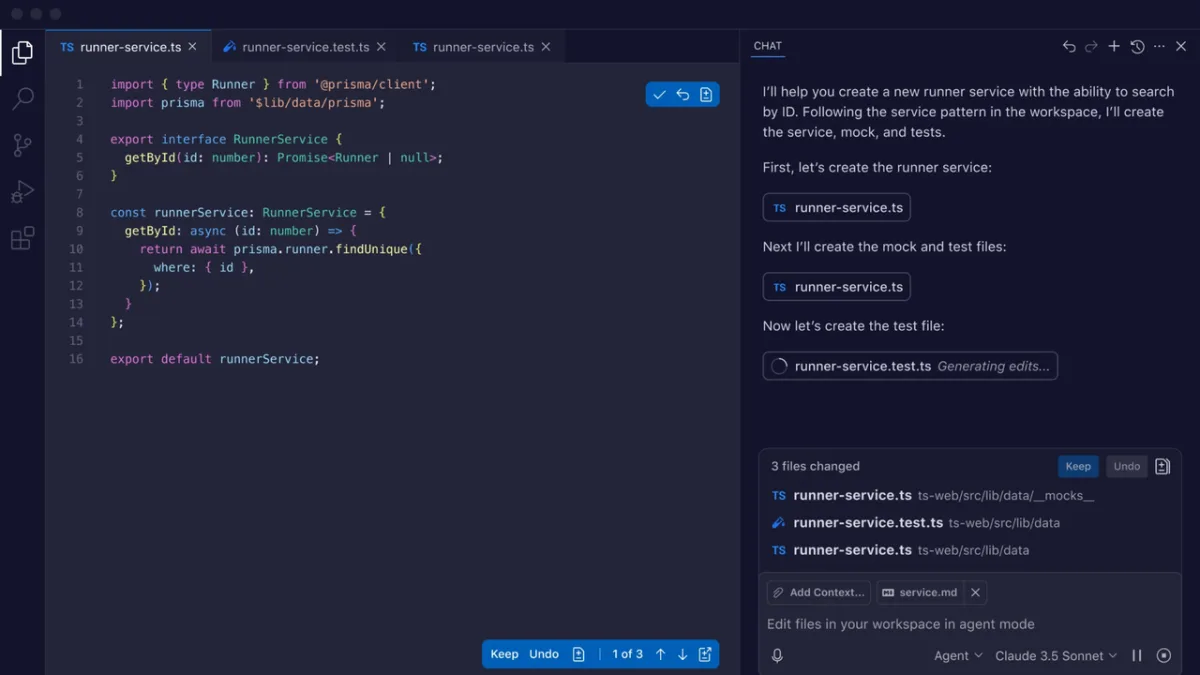
GitHub Copilot Agent Mode is now generally available and integrated directly into Visual Studio Code. In agent mode, you articulate a task in natural language. Copilot formulates a strategy, modifies files throughout your repository, executes terminal commands with your authorization, and refines the output until it satisfies your requirements. The system accommodates third-party agents from vendors including Anthropic and OpenAI alongside Copilot's native agents.
An asynchronous coding agent provides an additional capability layer. You assign a GitHub Issue to the agent. It initializes an isolated environment through GitHub Actions, progresses through the task in the background, and generates a pull request for your examination upon completion. This functionality is accessible through Pro, Pro+, Business, and Enterprise Copilot subscriptions.
Build 2026 is anticipated to reveal the subsequent phase for these agents, encompassing multi-agent coding workflows within VS Code.
GitHub Spark operates as a natural language application builder permitting you to define an application in plain English and obtain working code accompanied by a live preview. Presently restricted to Pro+ and Enterprise subscribers, it represents Microsoft's most direct competitor to dedicated vibe coding platforms. Build 2026 offers a probable opportunity for announcements regarding Spark's expanded availability and enhanced functionality.
Semantic code search, also debuted in 2026, operates on a distinct mechanism. Rather than keyword matching, it leverages embeddings that grasp code semantics: searching for a "login bug" can retrieve authentication middleware and session management code even when those files lack the term "login." Collectively, Spark and semantic search indicate a development environment that comprehends intent, not merely text.
Azure AI Foundry and Microsoft Agent Framework
Azure AI Foundry, which superseded Azure AI Studio in November 2024, has grown progressively into a consolidated platform for AI application development. The February 2026 update introduced multi-agent orchestration, MCP support, hosted agents, and options for sovereign local deployment. Developers can now express agents in YAML, execute two CLI commands, and have Foundry allocate compute resources, register endpoints, and deliver a production-ready URL.
Microsoft Agent Framework 1.0 attaining general availability in April 2026 furnished .NET and Python developers with an enterprise-grade SDK merging two former research initiatives, AutoGen and Semantic Kernel, into a unified runtime. Build 2026 is expected to explain how teams can leverage Agent Framework to unite Foundry agents, Microsoft 365 Copilot, and external systems via standardized A2A and MCP interfaces, transitioning multi-agent systems from experimental prototypes into enterprise deployment.
Windows Copilot Runtime for on-device inference
Windows Copilot Runtime furnishes APIs that direct AI inference toward the NPU in AI-equipped Windows devices. Build sessions are expected to showcase fresh capabilities within the Windows App SDK, encompassing Vision, Language, and Speech models operating entirely offline. For Windows developers, this matters because it redefines what becomes architecturally viable without cloud access.
Microsoft is also anticipated to unveil an "AI Foundry for Windows" SDK consolidating ONNX Runtime, DirectML, and the Copilot Runtime into a single NuGet package. This would substantially streamline on-device AI implementation, eliminating the necessity to assemble disparate components.
The Windows Agent Arena developer sandbox, first revealed at Ignite 2025, is also expected to host its inaugural public workshop at Build.
What you should be thinking about as a developer
The transition toward intent-first tooling does not relieve you from comprehending the underlying code. In fact, your judgment becomes more influential, since you now serve as the ultimate validation layer for a system capable of generating hundreds of lines of credible-appearing code in moments. Determining whether generated code is sound, whether it is brittle, and whether it introduces vulnerabilities still demands technical sophistication.
Prompt quality carries greater weight than most developers presently recognize. Agents interpret vague instructions literally or populate gaps with presumptions. Those presumptions may diverge from your operational environment. Developing the ability to write specifications that are transparent about scope, constraints, and edge cases is a discipline worth cultivating deliberately before agent-based workflows become standard practice within your organization.
Beyond all else, the security assessment is a mandatory step we recommend you not overlook. Cybersecurity researchers have identified serious vulnerabilities in AI-generated code spanning multiple platforms, ranging from authentication bypass weaknesses to exposed environment variables. Build 2026 features a dedicated Responsible AI track, and the compliance and safety infrastructure arriving via Foundry and GitHub indicates Microsoft recognizes this remains an unresolved challenge.
For the present, subjecting generated code to the same rigor you would apply to a pull request from a less experienced developer represents a sensible standard until these tools advance further.
Read more
TechCrunch Disrupt 2026 offers $75 passes for laid-off workers seeking their next opportunity
Those affected by recent tech layoffs can attend TechCrunch Disrupt 2026 at San Francisco's Moscone West for $75, with the discounted Expo+ Pass limited to the first 100 qualifying applicants before the event opens October 13.
How AI Created the GTM Engineer: Clay's Kareem Amin on a Rapidly Emerging Role
A position that barely existed two years ago is now appearing across technology companies. At TechCrunch Disrupt 2026, Clay's founder will explain how AI and automation are reshaping go-to-market work.
Deadline Tonight: Last Chance to Host a Side Event at Founder Summit 2026
Applications to host a Side Event during TechCrunch Founder Summit 2026 in Boston close at midnight PT tonight. The event runs November 1–7 and will draw over 1,000 tech leaders.