Australia's 'My Feed, My Way' Plan Hands Users Control Over Social Media Algorithms
Australia is proposing to let users over 16 choose between algorithmic feeds and chronological posts from accounts they follow, with tech companies facing fines up to AU$109.2 million for non-compliance.
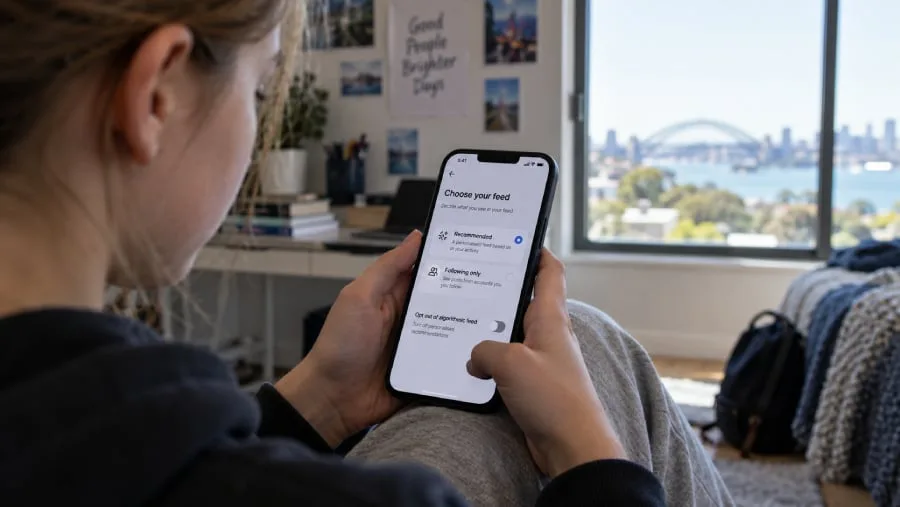
Users in Australia could soon decide whether algorithms curate their social media experience. The country's federal government has introduced the "My Feed, My Way" proposal, which would mandate that social media platforms offer users aged 16 and older the option to receive either personalized algorithmic recommendations or content exclusively from accounts and creators they deliberately choose to follow. Noncompliant companies would risk financial penalties reaching AU$109.2 million, equivalent to approximately US$79 million.
This initiative follows Australia's groundbreaking ban on social media access for children under 16, enacted less than a year ago. Rather than restricting who can use these platforms, the government is now focusing on controlling how platforms shape user experiences once they are accessed.
How Australia's feed choice would work
The proposed framework would obligate platforms to inform both new and returning users about their available feed options. Users could maintain algorithmically curated content or switch to a feed displaying only posts from accounts they have intentionally subscribed to.
Prime Minister Anthony Albanese framed the initiative as transferring authority to individual users. "This is not about giving government control. It's about giving people control. It's about putting choice back into the hands of Australians online," Albanese stated, as reported by CNBC.
The government has not finalized the specific mechanism for presenting this choice. Communications Minister Anika Wells indicated that policymakers are consulting with experts regarding whether algorithmic feeds should require users to actively enable them or actively disable them.
Wells also recognized that numerous Australians value personalized recommendations and may elect to retain them. "Big tech is not a protected species, and they should offer their customers basic safety standards," Wells remarked, per BBC.
According to the Associated Press, platforms must grant users over 16 a "genuine and enduring choice" and inform them regarding their default-feed configuration.
My Feed, My Way represents one component of a larger proposed Digital Duty of Care framework designed to assign greater accountability to technology companies for online harms.
ABC reported that this duty would extend to online platforms encompassing social media services, AI chatbots, and search engines. For Australians under 18, companies would be required to implement protections against material promoting eating disorders, misogyny, pornography, glorification of crime, bullying, abuse, and other potentially serious harm.
For adult users, the proposed duties are narrower in scope, concentrating on existing criminal categories including child abuse, sexual violence, serious harassment, terrorist support, and encouragement of suicide.
Social media platforms would face stricter obligations when serving younger users, such as disabling personalized algorithms and infinite scroll features. Given that Australia already prohibits users under 16 from maintaining social media accounts, this proposal would impose an additional layer of operational constraints on how platforms serve this demographic.
"We have an opportunity to shape technology for the better, rather than let it shape us," Albanese stated, according to ABC News.
Opposition lawmakers have raised concerns about the extent of discretionary power granted to the communications minister in designating new categories of harmful content. The government has disputed suggestions that the changes aim to restrict political discourse.
Australia's teen ban shows how hard these rules are to enforce
Australia already possesses evidence that legislative changes do not automatically translate into altered user behavior.
Within three months of the under-16 prohibition becoming effective, over 81% of Australian minors continued accessing at least one age-restricted platform, based on research from the eSafety Commissioner cited by CNBC. The figure stood at 86% prior to the ban.
Daily or more frequent platform engagement decreased only marginally, dropping from roughly 60% to 58%.
BBC noted that Wells acknowledged that no technology company had received a fine for violating the age-restriction requirements.
Australia's prohibition on under-16 users has already illustrated the enforcement difficulties surrounding social media regulations. The proposed feed controls could encounter comparable implementation obstacles once platforms are obligated to deploy them.
What could change for users and platforms
Adults would retain the ability to maintain algorithmic feeds if they prefer them. The proposal would introduce an additional option for users, though the actual implementation could differ based on how platforms interpret the final regulations.
The default could shape how many people switch
The government has not yet determined whether personalized recommendations will be enabled by default or require active user selection.
The pre-selected option could significantly influence the proportion of users who modify their feed settings. Users tend to maintain whatever configuration is already active on their accounts.
A further uncertainty concerns what occurs once a user selects the alternative feed. According to the proposal, it would display posts from accounts they follow. Whether these posts would be arranged chronologically or sorted according to another ranking system remains unspecified.
Platforms may need more than a feed toggle
For technology companies, meeting compliance requirements could necessitate modifications extending well beyond inserting a simple switch in user settings.
Depending on the final legislative text, platforms may need to:
- Inform both new and current Australian users regarding their feed options.
- Maintain and respect each user's selected feed preference.
- Enforce age-based controls, encompassing limitations on algorithmic recommendations and infinite scrolling.
Platforms may be required to modify application behavior for distinct user groups, particularly when age and geographic location determine feature availability.
Australia could require its own product setup in APAC
Major social platforms typically serve multiple Asia-Pacific nations through unified systems and shared product capabilities. Australia's proposal might necessitate a distinct configuration for Australian accounts, particularly regarding default settings, age controls, notifications, and feed preferences.
Regional product and safety teams may still need to enforce separate rules for Australian accounts, even if the platform delivers largely consistent functionality across APAC. User experience could fluctuate depending on location and age.
Australia's regulatory approach does not guarantee that other APAC jurisdictions will adopt comparable measures. However, it provides policymakers and platforms across the region with a tangible model for regulating recommendation systems by expanding user choice rather than prohibiting the technology outright.
The under-16 ban has already demonstrated that creating legislation is simpler than compelling platforms and users to adhere to it. For My Feed, My Way, implementation success may hinge on product specifics: what Australians encounter when making their selection, how readily they can alter that selection later, and whether their chosen feed continues functioning as intended.
Australia's earlier social media regulations have already compelled platforms to modify their operations within the country, with Meta eliminating more than 750,000 underage Facebook and Instagram accounts.
Read more
TechCrunch Disrupt 2026 offers $75 passes for laid-off workers seeking their next opportunity
Those affected by recent tech layoffs can attend TechCrunch Disrupt 2026 at San Francisco's Moscone West for $75, with the discounted Expo+ Pass limited to the first 100 qualifying applicants before the event opens October 13.
How AI Created the GTM Engineer: Clay's Kareem Amin on a Rapidly Emerging Role
A position that barely existed two years ago is now appearing across technology companies. At TechCrunch Disrupt 2026, Clay's founder will explain how AI and automation are reshaping go-to-market work.
Deadline Tonight: Last Chance to Host a Side Event at Founder Summit 2026
Applications to host a Side Event during TechCrunch Founder Summit 2026 in Boston close at midnight PT tonight. The event runs November 1–7 and will draw over 1,000 tech leaders.