TypeSafe AI Launches Structured Decision Model Designed for Production Software
A startup founded by a former OpenAI researcher has raised $40 million to deploy AI models that produce reliable, machine-readable outputs rather than conversational text, targeting high-volume business processes.
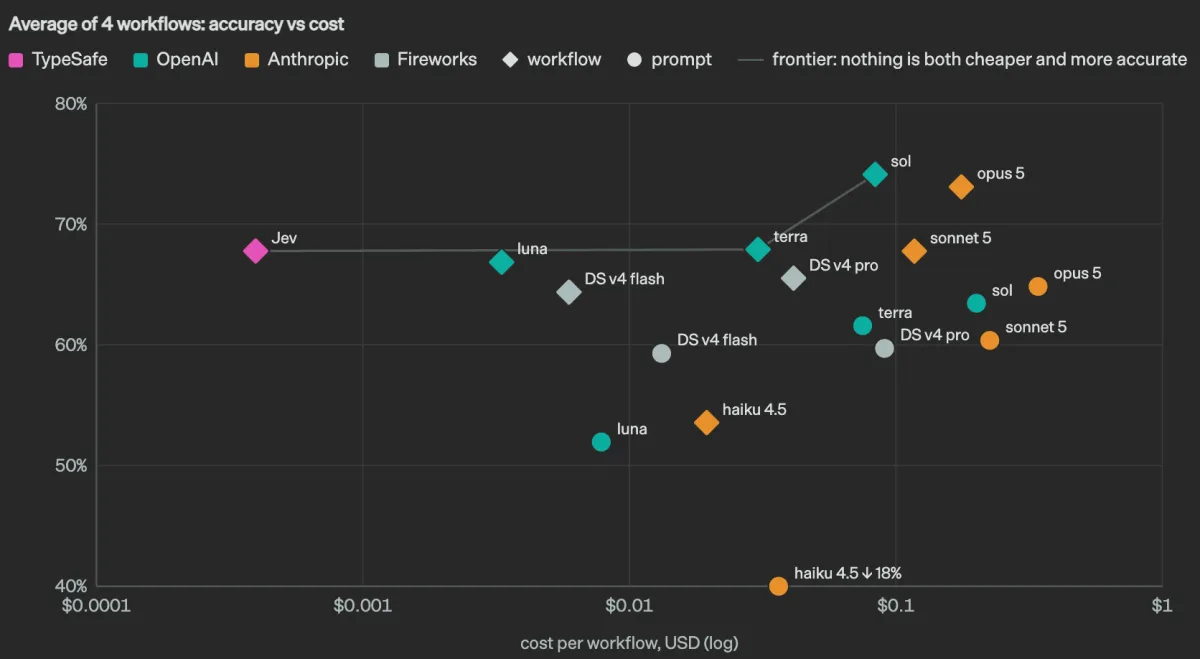
TypeSafe AI Inc. has emerged from stealth with $40 million in seed funding to develop AI systems built for embedding directly into software applications. The San Francisco-based company, founded by Diogo Almeida—a researcher who contributed to ChatGPT and GPT-4 at OpenAI—is positioning itself against the limitations of conventional large language models in production environments.
The company's first offering, Jev, represents a departure from traditional generative AI. Rather than producing conversational text, Jev generates structured decisions: yes/no probabilities, selections from predefined categories, or scores on specified scales. Each output includes confidence measures and probability ratings, allowing developers to automate decisions when confidence is high, request additional information when uncertain, or escalate to human review when needed.
DCVC Management Co. LLC led the funding round, valuing TypeSafe at $200 million according to Forbes. Co-founders Erik Gafni and Sasha Sheng bring additional AI expertise to the team alongside Almeida, who previously focused on reinforcement learning from human feedback and model training at OpenAI.
Rethinking AI for Software
TypeSafe's core argument addresses a fundamental mismatch: the characteristics that make AI models effective at human conversation often undermine their reliability in production systems. Large language models can generate plausible but inaccurate information, produce inconsistent outputs across requests, and express uncertain conclusions with unwarranted confidence. Software applications requiring dependable, repeatable results typically demand human verification before acting on such outputs.
We've been optimizing for humans, and we're superhuman at pleasing humans
Diogo Almeida, CEO of TypeSafe AI, referring to popular generative AI models
Machine-Ready Output
Jev operates by accepting structured questions and returning typed answers that software systems can process directly. The model's outputs include confidence scores that let developers establish thresholds for automatic execution, additional investigation, or human intervention. In insurance underwriting, for instance, Jev could assess property risk data and calculate fire probability, enabling underwriters to automate routine approvals while flagging complex cases for review.
TypeSafe describes Jev as a "System One Model" built using its proprietary Reinforcement Learning for Calibrated Decisions methodology. The design treats AI as a composable software component that integrates with traditional deterministic code. The platform can generate hundreds of decisions in parallel from a single prompt and combine them into larger workflows.
Performance metrics highlight Jev's efficiency. The company claims sub-100-millisecond response times, positioning it as up to 100 times faster and less expensive than competing frontier models. TypeSafe's pricing stands at 39 cents per 1,000 workflows, compared with $3.31 for OpenAI's Gpt-5.6 Luna and $19.49 for Anthropic PBC's Claude Haiku 4.5. Internal testing suggests Jev delivers approximately 194 times faster performance and roughly 445 times lower costs than the language models used in comparison, though TypeSafe notes these figures remain unverified and will fluctuate based on workload, geographic location, and testing methodology.
Structured outputs reduce hallucination risk—the phenomenon where models confidently present incorrect information—but don't eliminate it entirely. Developers must validate how accurately Jev's confidence scores align with real-world accuracy on their specific datasets.
TypeSafe identifies its primary market as high-volume business operations: categorizing support tickets, processing invoices, prioritizing security alerts, and validating AI agent outputs. In these scenarios, a specialized decision layer could work alongside language models that handle text generation and similar tasks.
James Hardiman, General Partner at DCVC, characterized TypeSafe's approach as tackling "one of the biggest remaining challenges in AI" by enabling models reliable enough for production-scale deployment.
Jev is accessible through an early-access waitlist.
Read more
Identity governance faces new test as AI agents proliferate across enterprises
Autonomous AI agents are forcing organizations to rethink how they manage access and permissions at machine speed. SailPoint's Navigate conference will explore how identity security must evolve to handle this expanding population of non-human actors.

Vertical AI and Purpose-Built Hardware Drive Next Wave of Technology Growth
Specialized AI systems tailored to specific industries are emerging as the primary engine for the next phase of technology expansion, according to insights from the Bank of America Private Tech Trailblazers Conference 2026.
CrowdStrike and CoreWeave Partner to Automate AI Security at Machine Speed
As cyberattackers breach systems in seconds, CrowdStrike and CoreWeave are embedding automated defenses throughout AI infrastructure, turning attacks into training data for faster response.