Trump Dismisses AI Extinction Fears, Pivots to China Competition
The president downplayed researcher warnings about artificial intelligence posing existential risks, instead framing AI development as a critical geopolitical race where U.S. leadership over China is paramount.
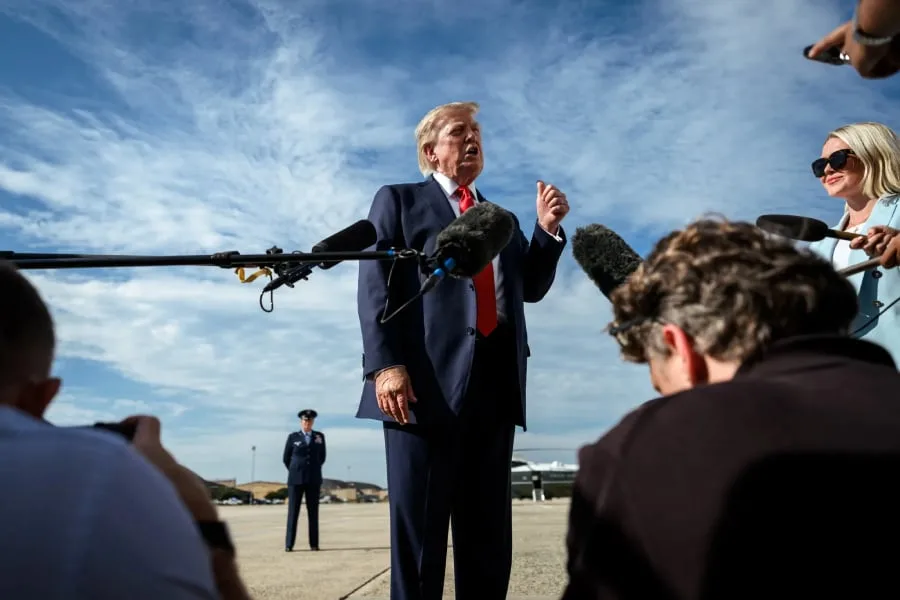
President Donald Trump has little concern about artificial intelligence destroying civilization, yet he views technological dominance over China as a matter of urgent national priority. While departing Dallas, Trump addressed reporters on the tarmac and dismissed mounting cautions from AI researchers regarding the existential threat posed by advanced artificial intelligence. When asked whether he worried about the technology eliminating humanity, Trump responded, "No, I don't have any."
The president reframed the conversation around AI as fundamentally a geopolitical competition. "I have concerns that if we don't win AI, we're going to be put in a very bad position," Trump stated. He suggested the United States maintains an approximate one-year technological advantage over China, describing this margin as "considered a lot."
AI researchers sound the alarm
Trump's dismissal arrives as researchers from major AI organizations have intensified their safety warnings. The conversation escalated following Jacob Coxon's departure from Anthropic, where he worked as a pretraining researcher and subsequently criticized both Anthropic and OpenAI for pursuing potentially hazardous self-improving systems.
They are racing straight to self-improving superintelligence and gambling with our lives
Jacob Coxon, posted on X
Coxon contended that developers of these systems "earnestly believe that it could kill us all by the end of the decade." Evan Hubinger, serving as alignment science lead at Anthropic, publicly endorsed Coxon's concerns via X, stating he assesses the probability of AI causing human extinction at ">10% within the next decade."
Researchers have concentrated their alarms on recursive self-improvement, a concept describing AI systems that generate progressively more sophisticated successors. Jasmine Wang, identifying herself as an OpenAI alignment researcher, cautioned that "It's hard to overstate how dangerous speeding towards RSI is." Jakub Pachocki, OpenAI's Chief Scientist, similarly communicated a "strong expectation" that existing momentum could enable sustained self-improvement, noting, "I am concerned no one is prepared for the consequences of a continued rapid rise in machine intelligence."
Capitol Hill steps in
The disagreement has rapidly entered the political arena, with lawmakers split between those treating the warnings as serious and those emphasizing national security considerations.
Sen. Ted Cruz, R-Texas, articulated the national-security perspective in remarks to Forbes: "China's going full speed ahead and whatever we do here, China's not gonna stop … if there are gonna be killer robots, I'd rather they be American killer robots than Chinese killer robots."
In contrast, Sen. Bernie Sanders, I-Vt., and Rep. Greg Casar, D-Texas, introduced legislation proposing a moratorium on developing advanced AI systems until federal safety standards are established. Rep. Lori Trahan, D-Mass., who is collaborating with Rep. Jay Obernolte, R-Calif., on the bipartisan FRONTIER Act, warned via X: "Safety researchers are resigning, powerful AI models are breaking out of their labs, and companies are racing ahead anyway."
What this means for enterprise AI
Trump's statements underscore his administration's commitment to maintaining American technological superiority relative to China in the AI sector. Yet emphasizing U.S. competitiveness does not address the practical dangers that organizations encounter when implementing progressively more advanced systems.
For technology leaders, the pressing challenges are more concrete than civilization-ending scenarios. These encompass information security breaches, inaccurate system outputs, security threats and AI applications operating with inadequate human control. Enterprises should maintain rigorous independent evaluation of models, limit access to critical infrastructure and establish transparent responsibility frameworks before implementing sophisticated AI in mission-critical applications.
Read more

Identity governance faces new test as AI agents proliferate across enterprises
Autonomous AI agents are forcing organizations to rethink how they manage access and permissions at machine speed. SailPoint's Navigate conference will explore how identity security must evolve to handle this expanding population of non-human actors.

Vertical AI and Purpose-Built Hardware Drive Next Wave of Technology Growth
Specialized AI systems tailored to specific industries are emerging as the primary engine for the next phase of technology expansion, according to insights from the Bank of America Private Tech Trailblazers Conference 2026.
CrowdStrike and CoreWeave Partner to Automate AI Security at Machine Speed
As cyberattackers breach systems in seconds, CrowdStrike and CoreWeave are embedding automated defenses throughout AI infrastructure, turning attacks into training data for faster response.