OpenAI's ChatGPT Ads Hits $1B Run Rate, Expands Self-Service to Four New Regions
ChatGPT Ads has reached a $1 billion annualized revenue run rate in less than 200 days, with OpenAI now rolling out self-service advertising capabilities to India, Europe, the Middle East, and North Africa.

The advertising platform attached to ChatGPT has achieved a $1 billion annualized revenue run rate within under 200 days of launch. OpenAI is now making the product available through its Ads Manager self-service tool in four additional regions: India, Europe, the Middle East, and North Africa. The expansion brings self-service access to tens of thousands of advertisers already using the platform globally.
OpenAI's strategy positions ads at a critical juncture in user decision-making. The company observes that ChatGPT users frequently arrive at the platform mid-deliberation—evaluating competing products, planning home improvements, considering career changes, or evaluating purchases. Rather than interrupting with separate ad placements, OpenAI embeds suggestions into the ongoing conversation itself.
The product began through managed-sales, agency, and partner-led channels. Today, it operates across more than 40 countries via OpenAI's Ads Solutions team and its network of agency and technology partners. The ecosystem has expanded to include more than 50 technology and measurement partners supporting the platform.
When Ads Manager launched in May, it democratized access for small and medium-sized businesses that lacked managed contracts. OpenAI characterizes SMBs as representing a material portion of total ad revenue. International advertisers now contribute a growing share of revenue, with many major clients running simultaneous campaigns across multiple markets.
The new self-service rollout to India, Europe, the Middle East, and North Africa allows businesses in these regions to establish Ads Manager accounts and deploy campaigns independently, bypassing OpenAI's managed-sales teams and agency partners. These four regions previously accessed ChatGPT Ads exclusively through managed and partner channels—the same approach still required in markets where self-service remains unavailable.
EU Regulatory Designation Adds Compliance Requirements
As OpenAI expands its advertising footprint in Europe, the European Commission has imposed heightened regulatory oversight. The Commission designated ChatGPT as a Very Large Online Search Engine (VLOSE) under the Digital Services Act (DSA). Reddit and Roblox received equivalent designations as Very Large Online Platforms. All three services had reported reaching at least 45 million average monthly users in the EU, the threshold triggering the classification.
OpenAI has four months from the notification date to comply with the additional DSA obligations accompanying VLOSE status, establishing a deadline of January 2027. These obligations mandate that the company assess and mitigate systemic risks posed by its service and algorithmic systems.
The Commission's risk categories encompass the distribution of illegal content and harm to minors. The framework extends to impacts on user physical and mental health, protection of individual rights under EU law, and threats to electoral processes and public security.
The designation grants the Commission expanded investigative authority over ChatGPT's functionality and related systems. The Commission will oversee compliance alongside Coimisiún na Meán, Ireland's Digital Services Coordinator, reflecting OpenAI's EU operational base in Ireland.
The Commission characterizes ChatGPT as a hybrid service—an AI system that processes user prompts and includes web search functionality. This search capability led the Commission to classify it as a search engine under the DSA. ChatGPT already fell under general DSA obligations applicable to search engines; VLOSE status adds an additional compliance layer.
will now be held to a higher standard of scrutiny and accountability in the European Union, in line with their large impact on our citizens and society.
Henna Virkkunen, the Commission's Executive Vice-President for Tech Sovereignty, Security and Democracy
Virkkunen indicated that the Commission will continue monitoring online platforms and will designate any service meeting the threshold for enhanced DSA oversight. The Commission has now designated 28 very large online platforms and search engines under the DSA, with enforcement responsibilities distributed between the Commission and national Digital Services Coordinators across EU member states.
Targeting draws on the conversation itself
Ad selection operates by analyzing the active conversation. OpenAI's system examines the context of what a user is discussing with ChatGPT and matches relevant advertisements to that topic.
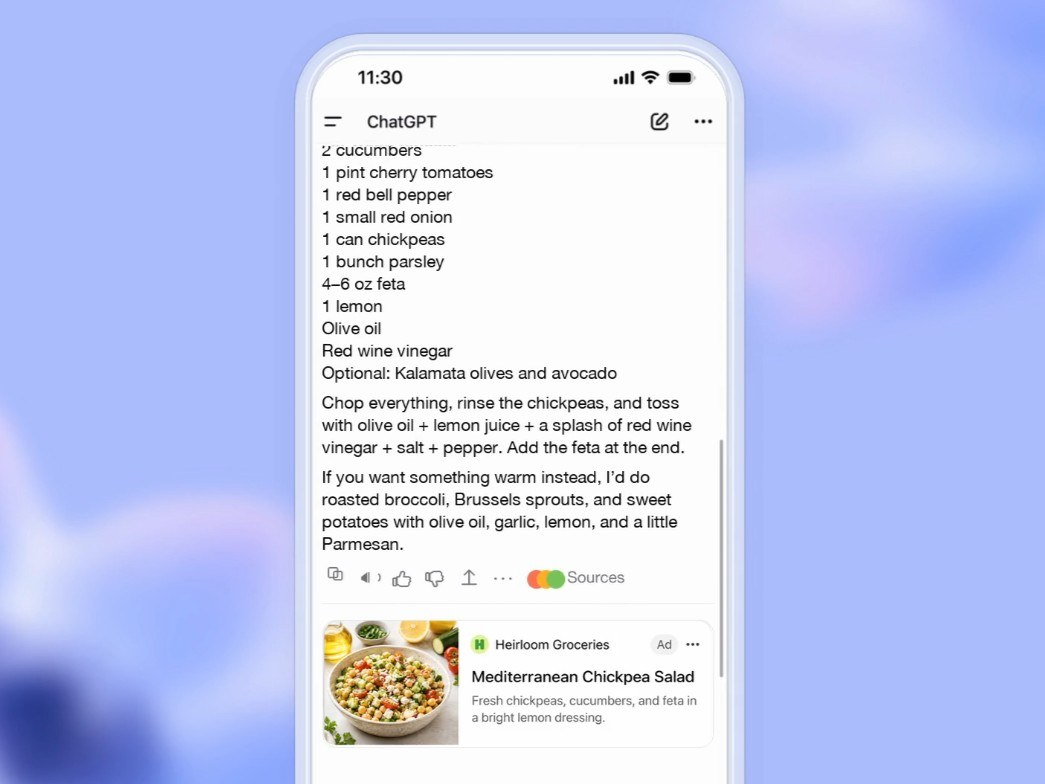
Depending on jurisdiction and user preferences, the targeting mechanism can incorporate context from broader ChatGPT usage patterns, extending beyond the current conversation to interests users have consented to share. OpenAI describes the outcome as advertising that reflects both immediate queries and, where permitted, wider user interests and preferences.
OpenAI frames its advertising principles around user trust preservation. Advertisements carry clear labeling and display separately from ChatGPT's responses. The company maintains that advertising does not shape ChatGPT's answers to users. Advertisers cannot access private conversations, and users retain control over personalization settings for their ad experience.
OpenAI reports that internal metrics tracking trust, relevance, and user experience have remained robust throughout the global expansion, though specific data has not been disclosed publicly.
Bidding and measurement tools grow more sophisticated
The advertising platform has evolved alongside its advertiser base. Cost-per-click and outcome-optimized bidding strategies now dominate the majority of active campaigns. Pixel and Conversions API integrations have become the primary mechanisms advertisers employ to transmit conversion data back into the system for measurement and optimization.
OpenAI has introduced product feeds, enabling advertisers to synchronize catalog data into their campaigns. Platform and geographic targeting options allow advertisers to restrict campaigns to specific devices or regions. Custom audience functionality permits advertisers to target existing customer databases. OpenAI contends that these combined capabilities help advertisers identify and reach their most valuable customer segments.
OpenAI highlights two performance examples beyond raw impressions. One ecommerce advertiser reportedly achieved a 3x return on ad spend across its campaigns over a 28-day period. A technology partner claimed that more than 80 percent of ad-driven ChatGPT traffic originated from new customers.
The next growth phase will extend ChatGPT Ads to additional markets. New ad formats and campaign objectives are in development alongside geographic expansion. OpenAI plans to introduce additional purchasing options and measurement capabilities.
OpenAI also intends to develop more native ways for businesses to engage with consumers within ChatGPT, though specific details and timelines for these formats remain undisclosed.
The immediate change involves the rollout to the four new regions. Businesses in India, Europe, the Middle East, and North Africa can now establish Ads Manager accounts and launch campaigns using cost-per-click or outcome-optimized bidding strategies without involving OpenAI's managed-sales team or agency partners.
Read more

Identity governance faces new test as AI agents proliferate across enterprises
Autonomous AI agents are forcing organizations to rethink how they manage access and permissions at machine speed. SailPoint's Navigate conference will explore how identity security must evolve to handle this expanding population of non-human actors.

Vertical AI and Purpose-Built Hardware Drive Next Wave of Technology Growth
Specialized AI systems tailored to specific industries are emerging as the primary engine for the next phase of technology expansion, according to insights from the Bank of America Private Tech Trailblazers Conference 2026.

CrowdStrike and CoreWeave Partner to Automate AI Security at Machine Speed
As cyberattackers breach systems in seconds, CrowdStrike and CoreWeave are embedding automated defenses throughout AI infrastructure, turning attacks into training data for faster response.