Nvidia's SC26 Vision: AI Agents as the New Engine of Scientific Discovery
At the supercomputing conference, Nvidia shifted focus from raw processing speed to iteration velocity, unveiling a stack designed for AI agents that autonomously conduct research through hypothesis-simulation-refinement loops.
The high-performance computing industry has traditionally tracked progress through a single metric: how quickly a system could solve a fixed computational problem. New rankings emerged, systems climbed the charts, and the cycle repeated. While raw computational power remains central to scientific work, Nvidia Corp. presented a different thesis at SC26 this week: the real measure of leadership is now how many times a researcher—or an AI agent that operates continuously—can move from hypothesis to validated result within a single day.
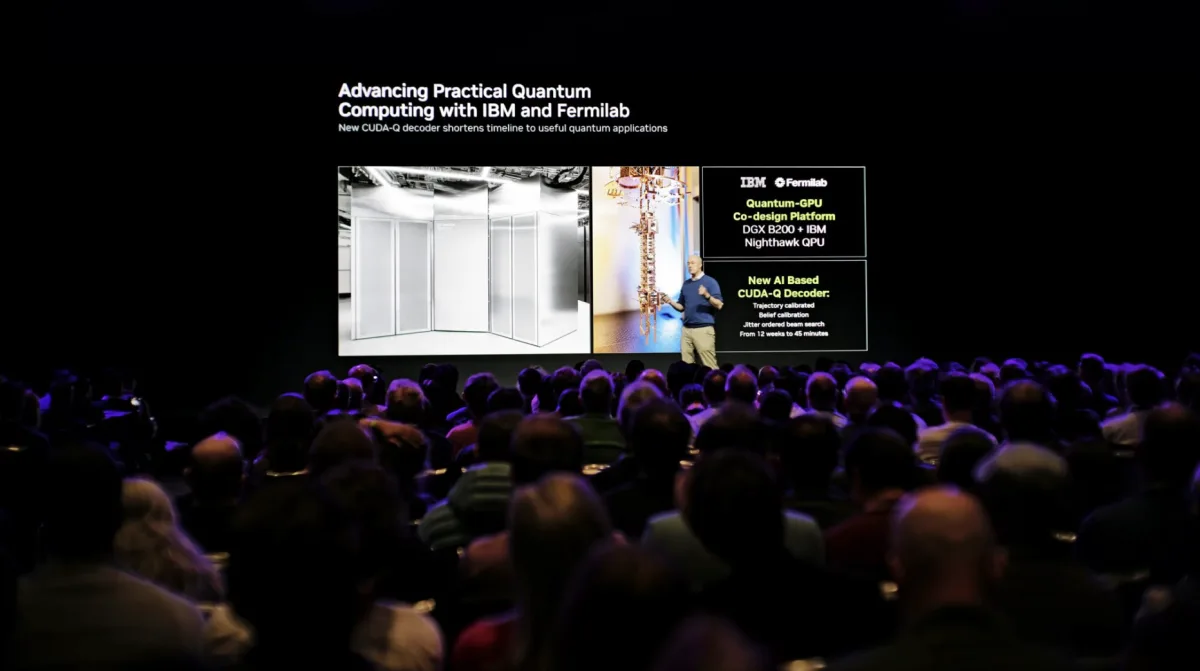
This perspective unified Nvidia's announcements at the conference. The company unveiled open science models, a CPU-only supercomputing platform, a new HPC-focused GPU, fresh CUDA-X libraries, quantum integration for the Slurm workload manager, a quantum co-design platform developed with IBM and Fermilab, and co-packaged optics deployment at Lambda. The milestone of CUDA's 20th anniversary also coincided with the event.
Individually, each announcement fits the typical cadence of a supercomputing conference. Collectively, they outline an infrastructure stack built for a fundamentally different user: an AI agent that reasons through scientific challenges, triggers simulations, interprets results, and determines the next experiment to run.
The announcements in detail
- Nemotron for Science pairs the open Nemotron 3.5 Super VL model with LitmusBench v0.2, an open dataset containing nearly 50,000 chemistry-reasoning questions, and post-training recipes for developing domain-specific science agents.
- The Vera CPU rack-scale platform integrates 192 Vera CPUs, roughly 300TB of memory, and Quantum-X800 InfiniBand into a liquid-cooled rack optimized for non-accelerated workloads such as climate and molecular modeling. Dell, HPE, Lenovo and Supermicro will begin shipping starting in early 2027.
- Rubin HPC is a new GPU within the Vera Rubin family, offering more than 50,000 CUDA cores and sparse-data acceleration, scheduled for 2028 availability.
- New CUDA-X libraries—cuPhoton, cuPotential and cuSpa—address applications in astrophysics, drug discovery, materials science and single-cell biology.
- Quantum: A modular codesign platform developed with IBM and Fermilab, a new error-correction decoder and quantum scheduling support in Slurm.
- Lambda is deploying Nvidia Photonics co-packaged optics switches to connect GB300 NVL72 racks containing more than 10,000 GPUs.
Theme 1: The loop is the new benchmark
Ian Buck, Nvidia's vice president of hyperscale and high-performance computing, articulated this shift when unveiling Rubin HPC: "For agents tackling science and engineering, faster simulation means faster discovery." This represents a fundamental industry transition. Simulation previously served as the endpoint of research. In an agentic workflow, it functions as a tool invoked within a much broader cycle of hypothesis generation, simulation execution, and iterative refinement.
When agents can generate thousands of candidate molecules or material designs, the constraint shifts from creative ideation to the duration required to validate each candidate. This explains why much of SC26's announcements emphasize loop speed alongside peak floating-point operations. Nvidia demonstrated that cuPhoton reduced the time to correlate Event Horizon Telescope black-hole data from over a month to eight minutes.
At Pacific Fusion, a Nemotron-powered agent operating on the same infrastructure can examine plasma simulations in real time, enabling researchers to adjust the simulation's direction rather than awaiting completion. Lawrence Berkeley National Laboratory is using Nvidia's DAQIRI networking library to move electron-microscopy analysis directly into the experimental apparatus, permitting researchers to decide which measurements to prioritize while data collection is underway.
These applications share a common objective: minimize the interval between posing a question and obtaining sufficient information to formulate a superior question. For research teams, this should reshape how they assess computing infrastructure. While single-job time-to-solution remains important, time-to-insight per iteration deserves equal attention and tracking.
Theme 2: Small, specialized and open beats big and general for science
A startup may have delivered the most significant data point at SC26. Lila Sciences applied post-training to Nemotron using laboratory feedback, nearly doubling its accuracy on quantum-dot synthesis protocols to 61%, surpassing GPT-6 Astra's 54% while achieving what Nvidia characterizes as 10 to 20 times lower inference cost. Therna nearly doubled accuracy relative to frontier models in predicting mRNA protein-expression ranges. Terray Therapeutics fine-tuned the model to extract reactants, products, and conditions from chemistry diagrams.
This aligns with observations from enterprise clients: frontier models provide an excellent foundation, yet domain-tuned open models frequently outperform them on both accuracy and economics within specialized domains. Science amplifies this dynamic more than most sectors for three reasons. Research data frequently remains proprietary or subject to regulation. Experimental results serve as training signals that general-purpose models cannot access. Research groups prefer models operating on infrastructure they manage directly.
This preference explains why Nvidia optimized Nemotron 3.5 Super VL to execute on a 128GB DGX Spark. KTH Royal Institute of Technology reports that an agent constructed on this platform resolved 81% of broken GROMACS molecular-dynamics configurations in a single overnight run on one Spark.
Nvidia's decision to release the dataset and adaptation recipes, not merely the model weights, carries significance. While the model itself is a commodity, the expertise to customize it for specific domains represents what research teams have previously lacked.
Theme 3: Nvidia wants every processor and the scheduler that runs them
Nvidia's reputation centers on GPU leadership, yet it now offers a CPU rack through Vera. The company is pursuing the segment of HPC that has remained unaccelerated, territory x86 processors have dominated for decades. In Nvidia's testing, Vera achieved 1.9 times the performance and 2.4 times the performance per watt compared to x86 on an OpenFOAM airflow simulation.
DKRZ, the German Climate Computing Center, has chosen Vera for its HLRE-5 system. A new Fortran compiler beta may lack glamour, but it addresses a practical barrier. Vast quantities of scientific code exist in Fortran, and rewriting them is impractical. Removing this friction is how a CPU challenger gains market share.
Across its portfolio, Vera addresses CPU-intensive simulation. Rubin HPC targets sparse, memory-bound science rather than AI training. DGX systems operate alongside IBM quantum computers. Nvidia is extending Slurm, the open-source scheduler deployed at most supercomputing centers, to manage QPUs alongside CPUs and GPUs using standard commands. Nearly 30 data centers are now running more than 50 quantum processors, and Alice & Bob, IBM, IQM, Pasqal and Quantinuum have integrated the expanded Slurm.
Nvidia's strategy is to become the company orchestrating whichever processor an agent requires next. A drug-discovery agent might invoke a CPU-bound molecular dynamics job, a GPU-accelerated docking operation, and eventually a quantum chemistry routine. The vendor controlling orchestration controls the workflow. Hardware ownership remains valuable, but less decisive than previously.
Theme 4: Quantum is becoming a systems problem
Quantum announcements warrant separate attention because the conversation has evolved. Two or three years ago, vendors emphasized qubit counts. At SC26, discussion centered on error correction, decoding, and integration—all classical computing challenges. Nvidia's new TCBP-JOBS decoder, available in CUDA-Q QEC 0.9.0, delivers up to 13,000 times faster decoding for error-correction research and reduces certain design studies from 12 weeks to 45 minutes. IBM and RIKEN's hybrid quantum-classical chemistry work, which modeled protein-ligand complexes containing up to 12,635 atoms, is a Gordon Bell Prize finalist.
Jerry Chow from IBM outlined the opportunity: "Scaling quantum and classical together will open new frontiers in high-energy and nuclear physics and beyond." Nvidia has consistently adopted a systems perspective spanning a broad partner ecosystem, and IBM strengthens that approach. IBM does not require Nvidia to manufacture qubits; it needs accelerated classical computing to make those qubits productive. This positions Nvidia as essential to quantum advancement, independent of which qubit technology ultimately prevails.
Theme 5: Efficiency and resiliency are now science features
Energy consumption once represented a facilities concern in HPC. Today it constrains research because every watt spent on overhead is unavailable for simulation. Nvidia's Vera delivers twice the energy efficiency of x86 on the Weather Research and Forecasting model.
Lambda's deployment illustrates the same principle at the network layer. Across more than 10,000 GPUs, Lambda deployed co-packaged optics switches and observed network latency decrease by roughly 4% at rack scale and up to roughly 10% at pod scale, with a median optics temperature of 36 degrees Celsius versus 51 degrees for pluggable optics. This approach is up to five times more power-efficient and up to 15 times more reliable than pluggables, and field personnel can replace the light sources without system replacement.
As Nvidia's documentation notes, with agentic inference, a single network disruption can trigger cascading latency across numerous agents. When the workload becomes a continuous loop rather than a batch job, system uptime transforms into a research metric. Lambda represents the first large-scale neocloud validation for co-packaged optics, a capability other GPU cloud providers will likely need to address.
The thread that holds it together: CUDA at 20
Nvidia's celebration of CUDA's 20th anniversary at this conference carries symbolic weight. CUDA debuted at SC06, and Nvidia reports that more than 11 million developers now build on it, supported by more than 1,000 CUDA-X libraries. From AlexNet to AlphaFold, the pattern has remained consistent: hardware captures attention, while libraries establish lock-in.
The agentic era amplifies the importance of this library ecosystem. A human scientist masters a limited set of tools. An agent can invoke any available tool, making the breadth and quality of the toolbox increasingly consequential. Each new CUDA-X library effectively grants every science agent built on Nvidia's platform an additional capability. This represents the competitive moat that AMD, Intel, and custom-silicon developers must overcome, and Nvidia deepened it this week.
What research and IT leaders should be doing
- Measure iterations, not jobs. Evaluate infrastructure by counting hypothesis-to-result cycles a team can complete per day, including data movement, scheduling, and analysis time.
- Start an open-model post-training pilot. Results from Lila, Therna, and Terray indicate that a domain-tuned open model trained on your experimental data can outperform frontier APIs in accuracy and cost. Select one narrow, high-value task and validate it.
- Plan for heterogeneous scheduling. If quantum is part of your roadmap, even experimentally, standardize on schedulers and interfaces (Slurm, QRMI, QDMI) that treat QPUs as another resource rather than as a separate initiative.
- Put CPU-bound HPC back on the evaluation list. Arm-based CPU racks are now a practical alternative for climate, CFD and other unaccelerated codes, particularly when power availability is limited. Test your own applications.
- Treat the network as part of the science. Optics reliability and latency directly influence agentic workflows. Ask your cloud and infrastructure providers about their co-packaged optics roadmaps.
Final thoughts
Most performance figures presented at SC26 originate from Nvidia or its partners. Historically, Nvidia's numbers have proven reliable, but purchasers should validate them against their specific workloads. Several major products, including Rubin HPC and HLRE-5, will not arrive until 2028.
Every additional component Nvidia controls—from CPU to scheduler integration to quantum decoding—raises the persistent question of how open an integrated stack can remain. Nvidia's response this week emphasized open source: open models, open datasets, open libraries, and contributions to Slurm.
The more significant shift concerns what Nvidia is selling. For two decades, it accelerated the computations scientists executed. Now it is constructing the infrastructure for an agent to execute the scientific method itself: reason, simulate, measure, refine and repeat. Should this model gain adoption, scientific computing's winners will not be companies with the fastest individual chip. They will be those that make the entire discovery loop rotate fastest. Currently, no organization is better positioned than Nvidia to achieve that outcome.
Read more

Anthropic Researcher Claims Claude Proved the Riemann Hypothesis
Levent Alpöge, a researcher at Anthropic, announced he used Claude to prove one of mathematics' most significant unsolved problems, though the company has not officially confirmed the breakthrough.

Beyond Token Prices: Why Enterprise AI Cost Accounting Demands a Deeper Look
Companies pursuing multi-model AI strategies are discovering that token pricing alone masks the true cost of AI deployment. New data shows task efficiency and user consumption patterns drive the real bill.

Anthropic's IPO Surge Masks Broader AI Market Jitters as OpenAI Waits in the Wings
Anthropic's initial public offering delivered a solid 17% first-day gain, but the move may have signaled caution rather than momentum across the AI sector, with broader market concerns weighing on technology stocks.