Nvidia's Les Karpas on why robotics hasn't had its ChatGPT moment yet
Speaking at TechCrunch Disrupt 2026, Nvidia's head of Physical AI will explain the data bottleneck holding back general-purpose robots and what could unlock the field's breakthrough.

Since ChatGPT arrived in November 2022, artificial intelligence has moved from theoretical promise into everyday use, driven by accessible interfaces to large language models. Robotics, by contrast, remains in a holding pattern despite decades of research, investment, and real-world deployment. The field awaits its defining inflection point—and at TechCrunch Disrupt 2026, Nvidia Inception's Global Head of Physical AI Les Karpas will examine what's blocking that breakthrough and how it might finally arrive.
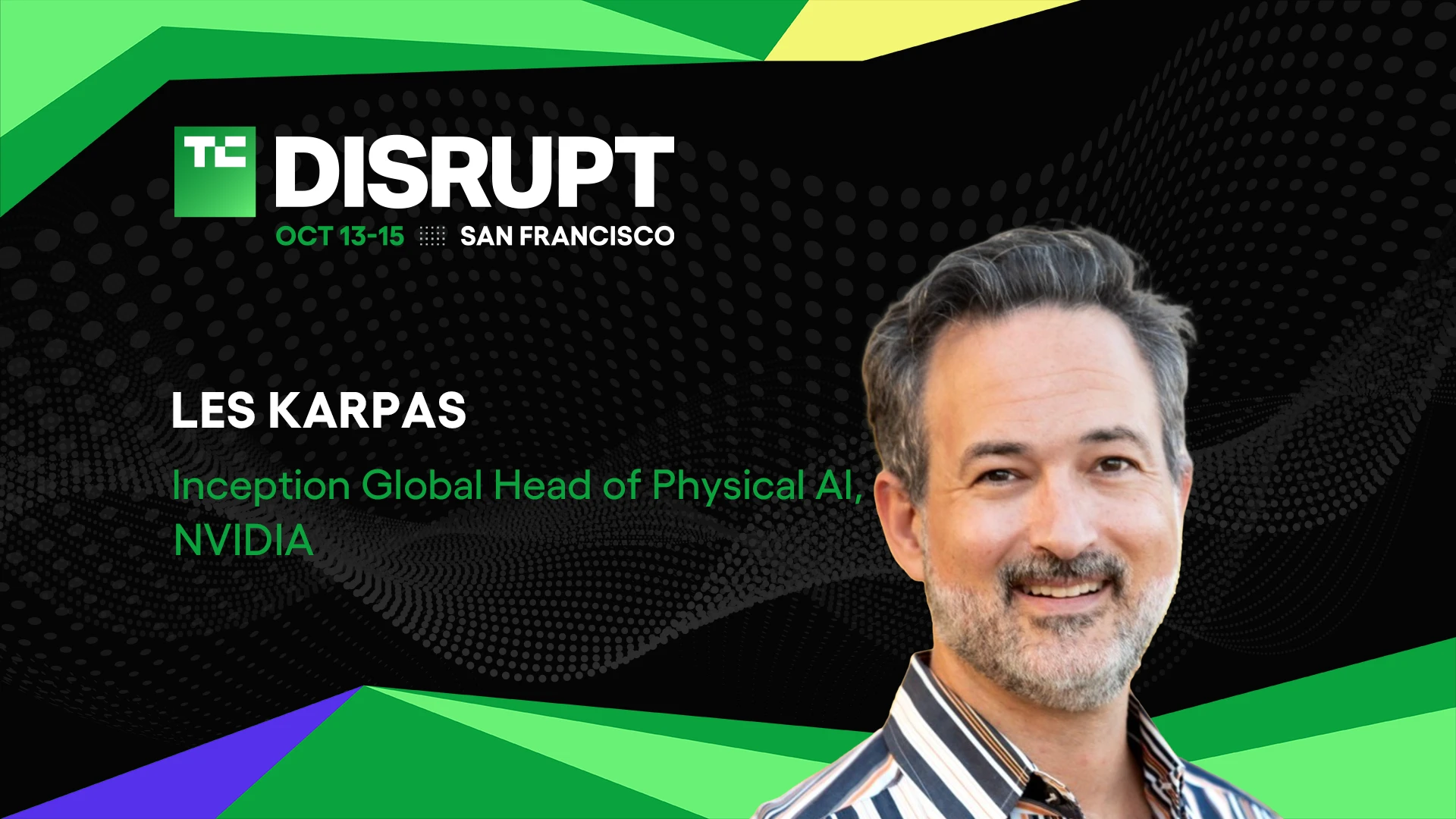
Karpas will take the stage on the Real World AI Stage at Disrupt, which runs October 13–15 at San Francisco's Moscone West. His session, titled "Robots Are Waiting for Their ChatGPT Moment. Here Is What Is Standing in the Way," will draw on Nvidia's deep involvement in the robotics sector—a focus CEO Jensen Huang has emphasized repeatedly in recent keynotes. The event will gather more than 10,000 technology leaders, founders, and investors, with programming spanning AI company building and physical-world applications.
The data problem at robotics' core
Karpas identifies a fundamental constraint that is straightforward in concept yet extraordinarily difficult to solve: the robotics industry lacks the kind of massive, internet-scale dataset that enabled language models to flourish. OpenAI, Anthropic, and similar organizations built their systems on enormous text corpora. Waymo and competing autonomous vehicle makers accumulated comparable advantages through years of accumulated driving data, which continues to expand as they operate in new markets.
A wave of startups is now attempting to manufacture this scale through simulation, synthetic data generation, and foundation models trained across multiple robot architectures at once. Bridging the gap between digital training environments and physical reality represents one of the sector's defining challenges—a recognition that shaped the creation of the Real World AI Stage. Karpas will be joined by founders from Shield AI, Colossal Biosciences, FieldAI, and Foxglove as they discuss the distinct obstacles and possibilities their companies navigate.
Karpas brings rare cross-industry expertise
Few people occupy a vantage point as well-suited as Karpas to address the question his session poses. In his role at Nvidia Inception, he manages the company's engagement with a sprawling ecosystem of startups spanning robotics, automotive, manufacturing, mobility, smart cities, and adjacent fields. The very companies working to close the data gap are those he encounters regularly through his work.
His career trajectory reflects the multidisciplinary background the robotics sector demands. He has held positions as an architect, manufacturing engineer, startup founder and chief executive, venture studio leader, and corporate venture capitalist across organizations including Stanley Black & Decker, Intellectual Ventures, Herman Miller, iRobot, and Cirque du Soleil.
Read more

Identity governance faces new test as AI agents proliferate across enterprises
Autonomous AI agents are forcing organizations to rethink how they manage access and permissions at machine speed. SailPoint's Navigate conference will explore how identity security must evolve to handle this expanding population of non-human actors.

Vertical AI and Purpose-Built Hardware Drive Next Wave of Technology Growth
Specialized AI systems tailored to specific industries are emerging as the primary engine for the next phase of technology expansion, according to insights from the Bank of America Private Tech Trailblazers Conference 2026.
CrowdStrike and CoreWeave Partner to Automate AI Security at Machine Speed
As cyberattackers breach systems in seconds, CrowdStrike and CoreWeave are embedding automated defenses throughout AI infrastructure, turning attacks into training data for faster response.