Nvidia unveils Rubin HPC chip and scientific software suite at SC26
Nvidia has announced a collection of hardware and software tools aimed at accelerating scientific discovery, centered on the forthcoming Rubin HPC graphics processor with over 50,000 CUDA cores.
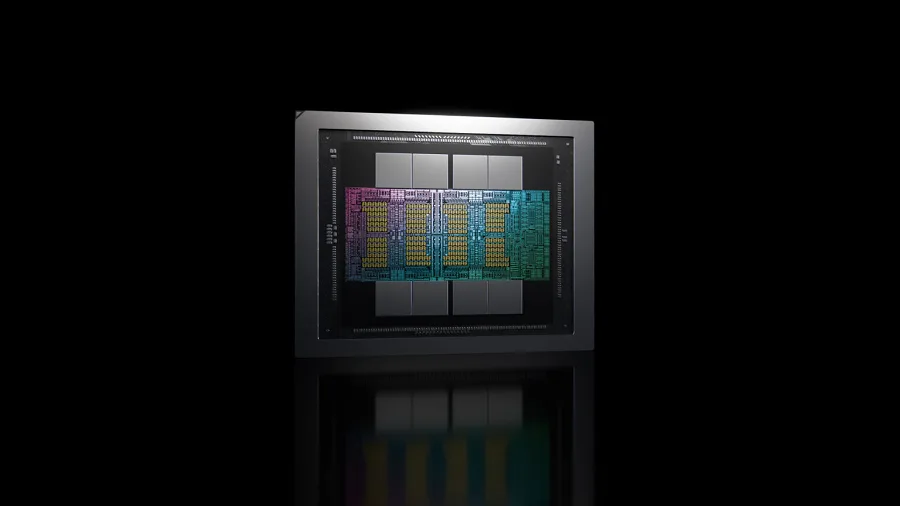
Nvidia Corp. unveiled a comprehensive package of technologies intended to enhance scientific research productivity across multiple disciplines. The centerpiece is Rubin HPC, a forthcoming graphics card that will substantially exceed the core count of Nvidia's current top-tier processor. The announcement also encompassed more than six software libraries tailored for use by scientists and researchers. These offerings were revealed at SC26, the high-performance and supercomputing conference held in Chicago.
Rubin HPC for scientific workloads
Nvidia's existing flagship Rubin GPU contains 898 Tensor cores—specialized transistor groupings optimized for large language models—alongside more than 28,000 CUDA cores. These processing elements support both LLM operations and additional computational tasks such as scientific simulations.
The Rubin HPC variant that Nvidia demonstrated will incorporate more than 50,000 CUDA cores and will incorporate an enhanced version of NVLink, Nvidia's interconnect technology that enables GPUs to transmit data to central processors. The existing iteration of NVLink achieves throughput of 3.6 terabits per second per graphics card.
Nvidia also highlighted a "sparse data acceleration" capability in Rubin HPC. Sparse data refers to datasets containing numerous zero values—a common characteristic in scientific research, particularly in domains like biology and astrophysics. For instance, astronomical observations may use zeros to denote sky regions devoid of visible stellar objects.
For agents tackling science and engineering, faster simulation means faster discovery. Rubin HPC accelerates the simulations agents use to test ideas and guide their next steps, helping scientists and engineers explore more possibilities and bring breakthroughs closer.
Ian Buck, Nvidia vice president of hyperscale and high-performance computing
Rubin HPC is scheduled for delivery in 2028. Until then, researchers can leverage the software tools that debuted alongside the processor announcement to optimize their current scientific applications.
Faster astrophysics research
Nvidia distributes CUDA-X, a collection of libraries designed to facilitate scientific investigation efforts. The SC26 event introduced several new components to this ecosystem.
Astrophysics specialists now have access to cuPhoton.xBeam, which streamlines analysis of observations from the Event Horizon Telescope network—a coordinated array of observatories dedicated to black hole research. Nvidia reports that cuPhoton.xBeam can execute analytical procedures that previously required approximately one month in just eight minutes. The rollout includes cuPhoton.xLens, designed for simulating the plasma environments within fusion reactors used for power generation.
In biological research, Nvidia is making cuSpa available as open-source software. This tool accelerates calculations involving cell polygons, which researchers employ to examine cellular architecture and intercellular interactions. Additionally, rapids-singlecell, an established cellular analysis platform, is now accessible to Nvidia customers through containerized deployment.
LLM-driven research
Complementing the biology research offerings is Nemotron for Science, an AI package constructed around Nemotron 3.5 Super VL, an open-source language model that Nvidia released the previous month. This model operates with 124 billion parameters while utilizing approximately one-tenth of them during operation. The architecture incorporates elements from Mamba-2, a computationally more efficient variant compared to the standard Transformer architecture.
Nemotron for Science combines the language model with pre-configured post-training workflows. These enable researchers to customize Nemotron 3.5 Super VL for particular scientific applications. Nvidia has also integrated approximately 50,000 chemistry-focused inquiries that serve dual purposes: fine-tuning AI models for scientific tasks and assessing the performance of models that have undergone post-training.
Nemotron for Science gives researchers open models, scientific data and post-training recipes to build specialized agents that reason through scientific problems and use CUDA-X accelerated tools to turn ideas into discoveries.
Ian Buck
Quantum algorithms
Quantum computers depend on standard processors to control their qubits. Nvidia offers CUDA-Q, a software toolkit that facilitates integration between quantum systems and Nvidia's GPU and CPU architectures. The company expanded this offering with additional software components for quantum application development and a technique for reducing qubit errors.
Nvidia is collaborating with IBM Corp. and the U.S. Energy Department's Fermilab to establish a "modular quantum codesign platform." This initiative will pair Nvidia's DGX B200 systems with IBM's quantum hardware. The organizations indicate the platform will serve as a testbed where researchers can develop novel qubit error correction techniques and additional quantum software solutions.
Read more

Anthropic Researcher Claims Claude Proved the Riemann Hypothesis
Levent Alpöge, a researcher at Anthropic, announced he used Claude to prove one of mathematics' most significant unsolved problems, though the company has not officially confirmed the breakthrough.

Beyond Token Prices: Why Enterprise AI Cost Accounting Demands a Deeper Look
Companies pursuing multi-model AI strategies are discovering that token pricing alone masks the true cost of AI deployment. New data shows task efficiency and user consumption patterns drive the real bill.

Anthropic's IPO Surge Masks Broader AI Market Jitters as OpenAI Waits in the Wings
Anthropic's initial public offering delivered a solid 17% first-day gain, but the move may have signaled caution rather than momentum across the AI sector, with broader market concerns weighing on technology stocks.