Mirror Particle Challenges LLM-Based Behavior Prediction With Foundation Model Approach
A San Francisco startup is rethinking how AI predicts human behavior, arguing that fine-tuned language models miss the mark and building a world model from scratch instead.

The market for AI systems that forecast human behavior is heating up. Simile secured $200 million at a $2 billion valuation; Aaru brought in $88 million at a $1 billion valuation; and Humans&, which announced a $480 million seed round in January at a $4.48 billion valuation, unveiled Persimmon as its human behavior modeling tool.
Current approaches to predicting human behavior typically rely on large language models that are prompted or fine-tuned to simulate specific demographic groups. Mirror Particle, a two-year-old San Francisco company, rejects this strategy as fundamentally flawed.
It's like bringing a super soaker to Niagara Falls. LLMs have been trained on hundreds of billions of data points. How much can you influence its behavior by [fine-tuning] with such a small amount of data? It's still stuck in the past.
Abhivyakti Ahuja, co-founder and CEO of Mirror Particle
Ahuja contends that language models operate on fundamentally different principles than human cognition. "LLMs are modeling written language, but humans are made of visual perception, spatial reasoning, social intelligence," she explains. Relying on such models produces insights disconnected from how humans actually perceive and act.
Instead, Mirror Particle is constructing a foundation model—what Ahuja calls a world model built from the ground up—designed to simulate the reasons behind human actions and how those behaviors shift through time.
We don't want to capture the static person. We want to capture the changing person. That means capturing the longitudinal data on how people are changing, what triggers are changing them and to what degree.
Abhivyakti Ahuja
The startup has completed an angel funding round and indicates it is nearing closure on its Series A. Mirror Particle will also compete in Startup Battlefield 200 next week, part of TechCrunch Disrupt 2026 running October 13-15 in San Francisco.
Mirror Particle combines proprietary data sources—client customer information, current events, pop culture, social media and more—to construct demographic models that function as evolving systems. The company tracks how motivations transform as people encounter new experiences. The emphasis centers on "revealed behavior," meaning actual actions rather than survey responses.
Like competing firms, Mirror Particle targets sectors where budgets already support this type of analysis: market research, brand strategy, and product development. The system might help a beauty company craft more compelling advertising for Gen Z, or determine whether that audience even desires the product in question.
What if [the target demographic] doesn't want eyeshadow palettes? Maybe blush is a better option to go for if you want to sell a product to this market.
Abhivyakti Ahuja
Beyond predictions, Mirror Particle's engine explains the reasoning—motivations, obstacles, and contextual factors—that supports its recommendations, enabling organizations to make more informed strategic choices.
In an early engagement, a major pet food manufacturer sought guidance on packaging imagery—chicken, beef, or vegetables—to increase sales. Mirror Particle's analysis revealed the company was addressing the wrong issue. Imagery had no bearing on sales. The actual barrier was the brand's perception as mass-market and inexpensive, a positioning problem that would need resolution before sales could grow.
The way we see our model evolving is like how a baby learns about the world.
Abhivyakti Ahuja
Ahuja's background in neuroscience and computer science shaped this vision. Originally from India, she studied at the University of Toronto, where she became influenced by AI researcher Geoffrey Hinton's work on neural networks. At Amazon Robotics, she designed robots that manufacture other robots, where she connected with co-founders Will Song and Thomson Yen. Song has built sales personalization systems throughout his career, while Yen has applied deep learning to understand how AI agents perceive human behavior.
The company's ultimate goal is establishing itself as the foundational layer for predicting human behavior, transitioning from population-wide insights to individual-level understanding.
We just need a better model of humans if we're going to work alongside AI and with each other.
Abhivyakti Ahuja
Mirror Particle and dozens of other startups vetted by TechCrunch's editorial team will showcase their work at Disrupt next week in downtown San Francisco. The Startup Battlefield winner will be selected by a panel of venture capital judges on the afternoon of Thursday, October 15.
Read more
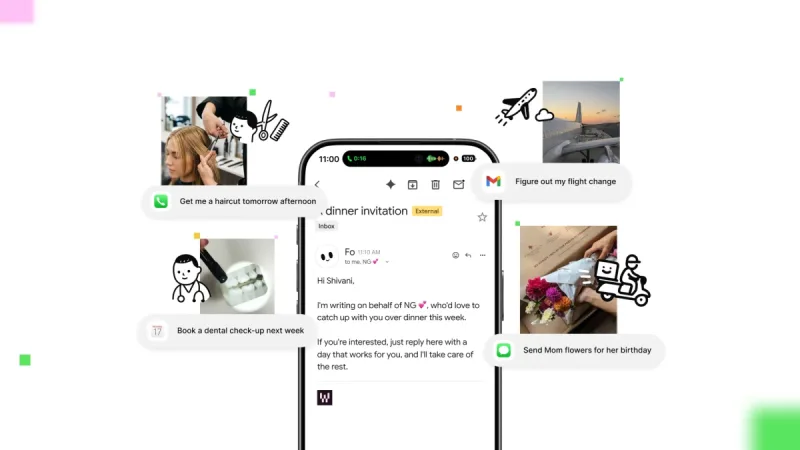
Khosla backs Wajo's trust-first approach in crowded personal-agent market
Venture capitalist Vinod Khosla is betting on Shivani Poddar's Wajo to dominate the personal-agent space, citing trust and safety as the differentiator against rivals like Meta's Muse and OpenAI's Dot.
SAP Brings Autonomous Enterprise Out of Apps With Expanded Joule Platform
SAP is shifting its autonomous AI strategy from in-app agents to a broader layer that lets users interact with AI assistants across multiple enterprise systems simultaneously. The company launched Joule Work and Desktop alongside its Autonomous Enterprise architecture in October.

Utah Clears First AI-Powered Prescription System for Acne, Minimal Doctor Oversight
Nolla Health has won regulatory approval to operate an artificial intelligence system that can issue prescription refills for acne treatment with limited human physician review, marking the first such authorization in the United States.