Khosla backs Wajo's trust-first approach in crowded personal-agent market
Venture capitalist Vinod Khosla is betting on Shivani Poddar's Wajo to dominate the personal-agent space, citing trust and safety as the differentiator against rivals like Meta's Muse and OpenAI's Dot.
The market for personal agents has intensified dramatically, with Meta's Muse, OpenAI's Dot, and Instinct establishing themselves as frontrunners while new entrants arrive regularly. Yet venture capitalist Vinod Khosla is placing his confidence in Wajo, a startup led by Shivani Poddar, a former engineer at Google and DeepMind. His reasoning centers on a single factor: trust.
I think the most important thing in an agent, because it's acting for you, is trust. You have to have trust in the agent, and I think compared to either Muse or Instinct, Wajo is the most trustworthy because it is architected to focus on trust and safety first, and some of the others are not.
Vinod Khosla
Khosla elaborated on his skepticism toward competitors backed by large technology firms. "I mean, who wants to give all their data to Facebook [Meta]? I don't. And if I give my data to Facebook, I'm the product, not the product I am buying, because they are in the ad business. So trust is important, and most people don't trust a large company like Facebook," he said in an interview.
How Wajo's Fo agent works
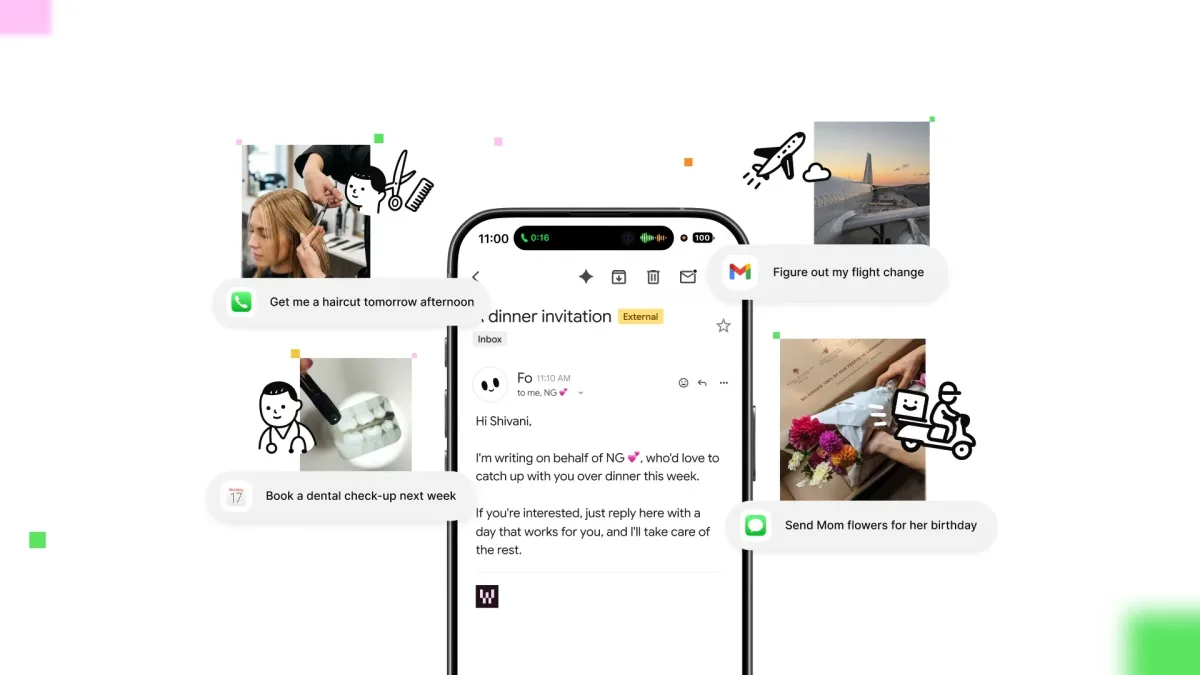
Wajo's Fo agent operates along similar lines to its competitors. It integrates with iMessage and WhatsApp and offers a web interface displaying task cards. Users can organize requests into categories including "scheduling," "gifting," and "life admin." The agent can place calls to businesses or individuals to book or cancel services on the user's behalf.
Early testing demonstrated mixed results. When asked to contact an airline regarding upgrade availability, the agent completed the task successfully. A request to call a partner and remind her to feed the cats proved less effective, with unclear disclosures during the interaction. As Instinct and Muse gradually roll out calling capabilities, questions are emerging about how AI agents should identify themselves when making calls on someone's behalf.
A distinctive feature of Fo is its ability to engage human workers to handle tasks when necessary. The agent can also generate virtual credit cards and process payments without revealing the user's financial information. It maintains its own email address for communicating with people and organizations. When websites or services refuse to interact with AI agents, Fo alerts users to take action or establishes a group conversation involving the user and the business for verification purposes.
Wajo has attracted investment from Jeff Dean and Gokul Rajaram, though the company has not disclosed the funding amount. The startup reported no specific user numbers but stated that Fo operates across 107 countries and has expanded tenfold since launching in late September.
Founder story
Before launching Wajo, Poddar held engineering positions at Meta, Google, and DeepMind, where she contributed to the development of Facebook's initial assistant. She expressed a desire to create products that genuinely serve users' needs.
The whole journey of bringing Gemini to the world and building safety for it made me realize the technological depth that you need to do this. Google is so good in technology that sometimes it can be left behind in product. I thought I needed to do something that is both technology and product at the same time. It has to be something different, which is very grounded in what the user needs.
Shivani Poddar
Poddar aligned with Khosla's emphasis on trust as a foundational principle for Wajo. She stressed that establishing trust from inception is essential, particularly given an unresolved technical challenge in the field.
Trust is something you have to build from the get-go because one of the technological things that has not been solved yet is teaching agents to unlearn. If they get access to your personal data on day zero, they will always have it for the future. I think trust needs to be built from day zero, not only in your architecture, but in product choices.
Shivani Poddar
Trust and safety initiatives
Wajo is pursuing several initiatives focused on trust and safety. The company has filed a patent application for its virtual card technology designed to shield user information from websites. Regarding agent calls, Wajo plans to implement a "trusted contact" list feature that restricts which individuals the agent can call. Users will also have the option to instruct the agent not to contact them again, with Wajo recording these preferences.
https://x.com/shivanipod/status/2107311070604071357?ref_src=twsrc%5Etfw
The startup faces a significant challenge in avoiding the privacy concerns that have affected competitors, particularly given that safety is central to its marketing message. Wajo maintains that its architecture complies with Amazon's terms of service, distinguishing it from Muse, which Amazon has blocked.
Looking ahead, Wajo intends to develop capabilities for Fo to operate in social contexts involving multiple users while maintaining privacy protections as a core principle.
Read more
SAP Brings Autonomous Enterprise Out of Apps With Expanded Joule Platform
SAP is shifting its autonomous AI strategy from in-app agents to a broader layer that lets users interact with AI assistants across multiple enterprise systems simultaneously. The company launched Joule Work and Desktop alongside its Autonomous Enterprise architecture in October.

Utah Clears First AI-Powered Prescription System for Acne, Minimal Doctor Oversight
Nolla Health has won regulatory approval to operate an artificial intelligence system that can issue prescription refills for acne treatment with limited human physician review, marking the first such authorization in the United States.

Reflection AI Unveils Beam, a 501B-Parameter Open-Source Model Trained on SpaceX Infrastructure
The startup, valued at $25 billion, has released Beam, an open-source large language model that matches the performance of much larger competitors while requiring significantly less computational power.