JD.com Accelerates Robotics Rollout Across Chinese Logistics Network
JD.com is deploying a sweeping automation initiative across its supply chain, targeting procurement of 3 million robots, 1 million autonomous vehicles, and 100,000 delivery drones over five years.
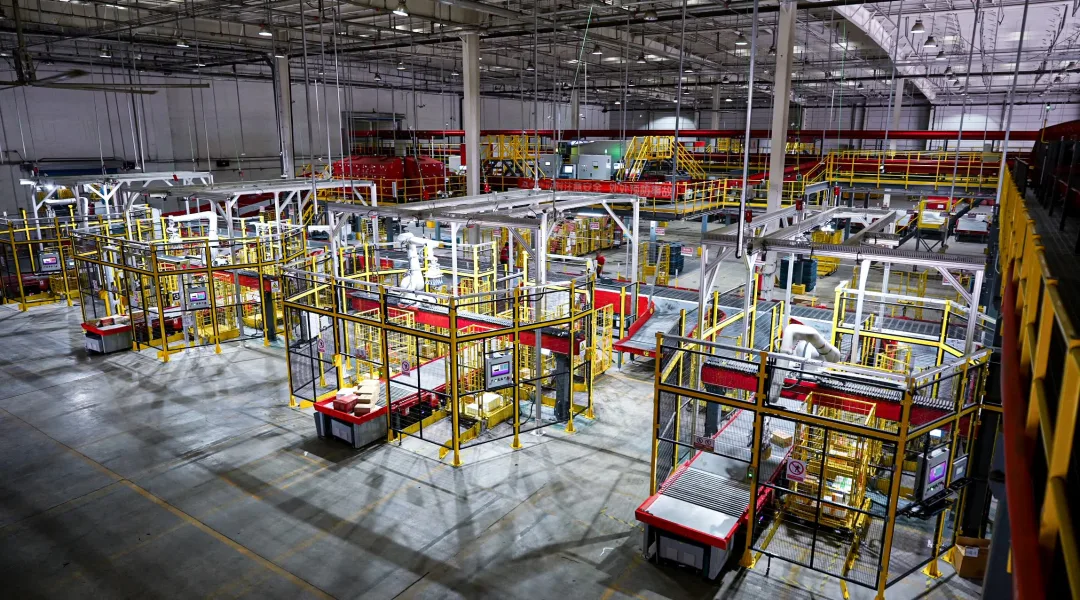
JD.com unveiled its Physical AI Acceleration Plan at JDDiscovery 2026 in Beijing, committing to a five-year procurement target of 3 million robots, 1 million autonomous vehicles, and 100,000 delivery drones. The initiative represents a major expansion of robotics and artificial intelligence across the company's logistics operations.
JD Logistics introduced the Wolf Robot series, a line of industrial machines built to handle warehousing, sorting, transport, and delivery functions. The equipment includes specialized variants capable of operating in temperatures reaching minus 20 degrees Celsius, automated pharmacy dispatch systems, autonomous delivery vehicles, and unmanned aircraft.
The five-year plan builds on existing automation infrastructure already in use. As of June 30, JD Logistics had deployed its LangzuTech Goods-to-Person automated warehousing system across more than 30 warehouses in China, with additional installations in the UK and Germany. The company operates more than 1,800 self-operated warehouses and more than 2,000 third-party cloud warehouses through its Open Warehouse Platform, spanning more than 36 million square metres combined.
By the end of June, thousands of unmanned vehicles were operating regularly across more than 20 Chinese provinces. The company also had more than 100 domestic drone routes in service for parcel delivery, food delivery, emergency medicine transport, and disaster relief operations.
From AI decisions to physical execution
JD Logistics is integrating its physical equipment with Meta Brain, an AI system deployed across warehousing, transportation, and delivery. Meta Brain 3.0 can calculate optimal routes for hundreds of millions of parcels in seconds, a significant improvement over the minutes required previously.
The LangzuTech Packer robotic arm, powered by Meta Brain combined with multimodal sensor data, tracks, grasps, and places parcels of varying shapes. According to a first-quarter regulatory filing, the Packer employs parallel reinforcement learning in simulated environments to optimize parcel-placement sequences and loading layouts, enhancing sorting efficiency and carrier space utilization.
During the second quarter, JD upgraded the robotic arm's force-control technology to enable more precise cage-loading operations. By June, the Packer was running continuously across multiple JD Logistics facilities, according to the company's interim report.
JD Cloud is expanding computing infrastructure to support AI development, planning a collaboration with Chinese chipmaker Moore Threads on a cluster containing 100,000 GPUs for large-model training, inference, and embodied-AI workloads. The two companies previously worked together on a 10,000-GPU cluster, according to Data Center Dynamics, though specific details about which Moore Threads GPU models will be used in the planned 100,000-GPU system remain undisclosed.
JD Cloud also intends to collect more than 10 million hours of video depicting real-world human activities over the next two years to support embodied-AI training.
Beyond warehouse operations, JD Logistics has extended its autonomous vehicle network to include night-time delivery. The interim report noted that the company launched night-time autonomous routes in Shenzhen, enabling vehicles to operate throughout the day and night.
JD is also leveraging drones for rural logistics. In June, JD Logistics established a drone delivery network in Zizhong, Sichuan province, serving 78 administrative villages, with deliveries to certain mountain villages achievable in as little as seven minutes.
Scaling automation across JD's logistics network
JD did not reveal the total anticipated cost of the five-year procurement programme at JDDiscovery or establish a network-wide return-on-investment target.
JD Logistics invested RMB2.3 billion in research and development during the first half of 2026, representing a 23.7% increase from RMB1.9 billion in the prior-year period. The company attributed this growth to sustained investment in technology and innovation but did not specify how much was allocated to AI or robotics initiatives.
Depreciation of property and equipment and amortisation of other intangible assets climbed 18.7% to RMB2.6 billion in the first half of 2026, compared with RMB2.2 billion a year earlier. JD Logistics linked the increase primarily to additional logistics equipment and vehicles.
Capital expenditures on property and equipment and investment properties reached RMB3.09 billion over the six-month period, up from RMB2.70 billion in the same period a year prior. These figures encompass the broader logistics business and are not broken out as spending specifically tied to the physical AI programme.
JD's automation expansion occurs as China's major ecommerce platforms invest heavily in fulfilment infrastructure. Reuters reported on September 3 that competition among JD.com, Alibaba, and Meituan has shifted from aggressive delivery subsidies toward logistics infrastructure, broader supply networks, and order-level economics.
Alibaba and JD have been opening dark stores and rapid-fulfilment "lightning warehouses" in high-density areas to enable one-hour deliveries, while Meituan has been constructing supermarkets to expand its grocery business. Ministry of Commerce research cited by Reuters projects China's instant-retail market will reach RMB1.2 trillion, approximately $178 billion, by the end of 2026.
JD and entities within its ecosystem employ approximately 700,000 delivery and logistics workers, according to the South China Morning Post.
JD founder Richard Liu stated earlier this year that robots would eventually assume parcel-delivery responsibilities currently performed by human couriers. The Financial Times reported in June that JD had established agreements with roughly 120 educational institutions to retrain workers for positions including robot repair and maintenance.
JD Logistics currently operates eight robot repair centres in China and intends to expand its robotics after-sales capabilities over the next five years. The company anticipates this expansion will generate more than 100,000 robotics service engineer positions.
Read more

Identity governance faces new test as AI agents proliferate across enterprises
Autonomous AI agents are forcing organizations to rethink how they manage access and permissions at machine speed. SailPoint's Navigate conference will explore how identity security must evolve to handle this expanding population of non-human actors.

Vertical AI and Purpose-Built Hardware Drive Next Wave of Technology Growth
Specialized AI systems tailored to specific industries are emerging as the primary engine for the next phase of technology expansion, according to insights from the Bank of America Private Tech Trailblazers Conference 2026.

CrowdStrike and CoreWeave Partner to Automate AI Security at Machine Speed
As cyberattackers breach systems in seconds, CrowdStrike and CoreWeave are embedding automated defenses throughout AI infrastructure, turning attacks into training data for faster response.