Hugging Face Opens Robot Designs to the Developer Community
The AI platform provider has released open-source blueprints for two robots, HopeJR and Reachy Mini, marking an expansion into hardware that builds on its LeRobot initiative.
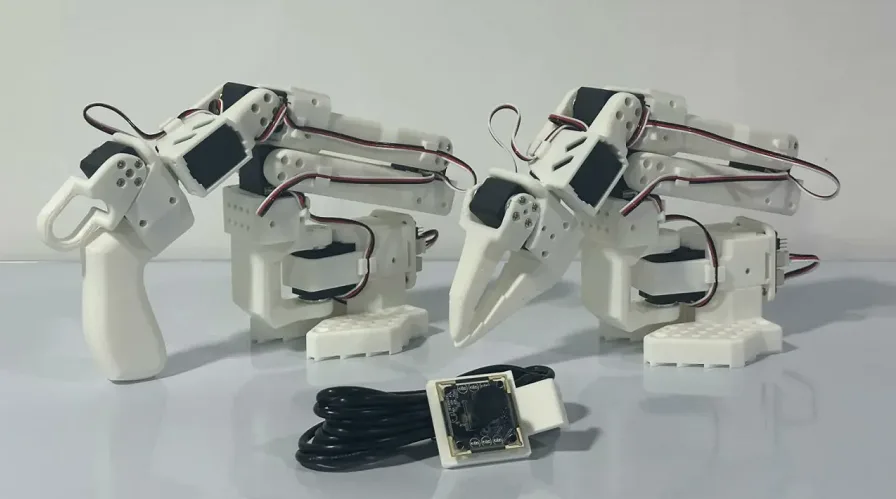
Hugging Face Inc. unveiled two robot designs this week by making their blueprints publicly available. The machines, designated HopeJR and Reachy Mini, represent the company's latest push into robotics hardware.
With backing exceeding $390 million from investors including Nvidia Corp. and IBM Corp., Hugging Face operates a platform resembling GitHub that serves as a repository for open-source AI initiatives. The platform currently contains over 1 million AI models, hundreds of thousands of datasets, and various other resources for developers.
The company's robotics focus intensified following the launch of LeRobot last year, a dedicated section offering AI models for autonomous systems alongside training datasets. Late in the previous year, Hugging Face released its initial hardware offering: the SO-100, a robotic arm created alongside The Robot Studio.
HopeJR: A Humanoid with Remote Control
Hugging Face collaborated again with The Robot Studio on HopeJR, the first of this week's announcements. According to TechCrunch, this humanoid robot possesses the capability to execute 66 distinct movements, including locomotion.
The robot features dual robotic arms controlled remotely through specialized gloves embedded with chips. The arms mirror the hand movements of the person wearing the gloves. In a demonstration video released by Hugging Face, the robot demonstrated handshakes, pointing at text on paper, and performing similar interactions.
Reachy Mini: Desktop-Sized Automation
The second robot, Reachy Mini, also carries an open-source license. Its design stems from technology acquired when Hugging Face purchased Pollen Robotics, a venture-backed robotics company, earlier this year.
Resembling a turtle, Reachy Mini arrives in a rectangular housing. A retractable neck serves as its primary mechanical component, enabling the robot to track users with its head or collapse back into the stationary case. The compact, lightweight design fits conveniently on a desk.
Years before its acquisition by Hugging Face, Pollen Robotics had introduced a proprietary neck mechanism. This module operates via a specialized actuator called Orbita, which Pollen Robotics indicated was driven by several small motors manufactured by Swiss firm Maxon Motor AG.
Hugging Face sees Reachy Mini as a platform for developing AI applications. Manufacturing firms might, for instance, use it to prototype AI systems enabling robots to collaborate safely with human workers before rolling out such solutions in actual production environments.
Pricing and Availability
Pre-built units of Reachy Mini and HopeJR will retail for approximately $250 and $3,000, respectively. Hugging Face projects initial shipments to arrive by year's end. Since both robots operate under open-source licensing, organizations retain the freedom to construct their own versions and implement modifications as needed.
Read more

Identity governance faces new test as AI agents proliferate across enterprises
Autonomous AI agents are forcing organizations to rethink how they manage access and permissions at machine speed. SailPoint's Navigate conference will explore how identity security must evolve to handle this expanding population of non-human actors.

Vertical AI and Purpose-Built Hardware Drive Next Wave of Technology Growth
Specialized AI systems tailored to specific industries are emerging as the primary engine for the next phase of technology expansion, according to insights from the Bank of America Private Tech Trailblazers Conference 2026.

CrowdStrike and CoreWeave Partner to Automate AI Security at Machine Speed
As cyberattackers breach systems in seconds, CrowdStrike and CoreWeave are embedding automated defenses throughout AI infrastructure, turning attacks into training data for faster response.