HackerRank's Chakra AI Moves Beyond Right Answers to Judge How Developers Think
HackerRank is rolling out Chakra, an AI interviewer that conducted over 500,000 test interviews during its six-month beta. The tool aims to assess not just whether candidates solve problems correctly, but how they think, judge trade-offs, and work with AI itself.

As artificial intelligence shifts from assisting job seekers to evaluating them, HackerRank is demonstrating what the next phase of technical hiring could resemble. The developer assessment platform is launching Chakra, an AI agent designed to run interviews, monitor how candidates approach problems, and measure dimensions beyond correctness—including reasoning, judgment, and what the company calls "AI fluency."
The tool moves into general availability Monday after roughly six months of testing. During that period, Chakra ran more than 500,000 interviews, with trial participants including Snowflake, Snorkel, and Capgemini, alongside internal HackerRank testing.
Automated screening has long been part of hiring workflows, with companies deploying voice agents and other systems to streamline candidate evaluation. Simultaneously, job applicants have increasingly adopted their own AI tools to prepare for and navigate interviews, sometimes without employer awareness.
Chakra represents HackerRank's wager that AI can reshape both the mechanics and the metrics of technical interviews. The platform targets harder-to-quantify capabilities like critical thinking and judgment, alongside "AI fluency"—a candidate's ability to frame problems for AI systems, assess their outputs, and guide them toward solutions.
The previous modality of evaluation was evaluating the output. Now, because of AI, anybody can produce an artifact.
HackerRank co-founder and CEO Vivek Ravisankar
According to Ravisankar, the shift means employers must now evaluate the reasoning and decision-making embedded in that output.
How Chakra Interviews Work
The interview format mimics actual job responsibilities rather than traditional coding tests. Candidates receive a task based on a real codebase and work through it in an interface that includes an embedded AI assistant. As they progress, Chakra poses contextual follow-up questions—asking why they selected a particular strategy, or how their approach would adapt if requirements changed.
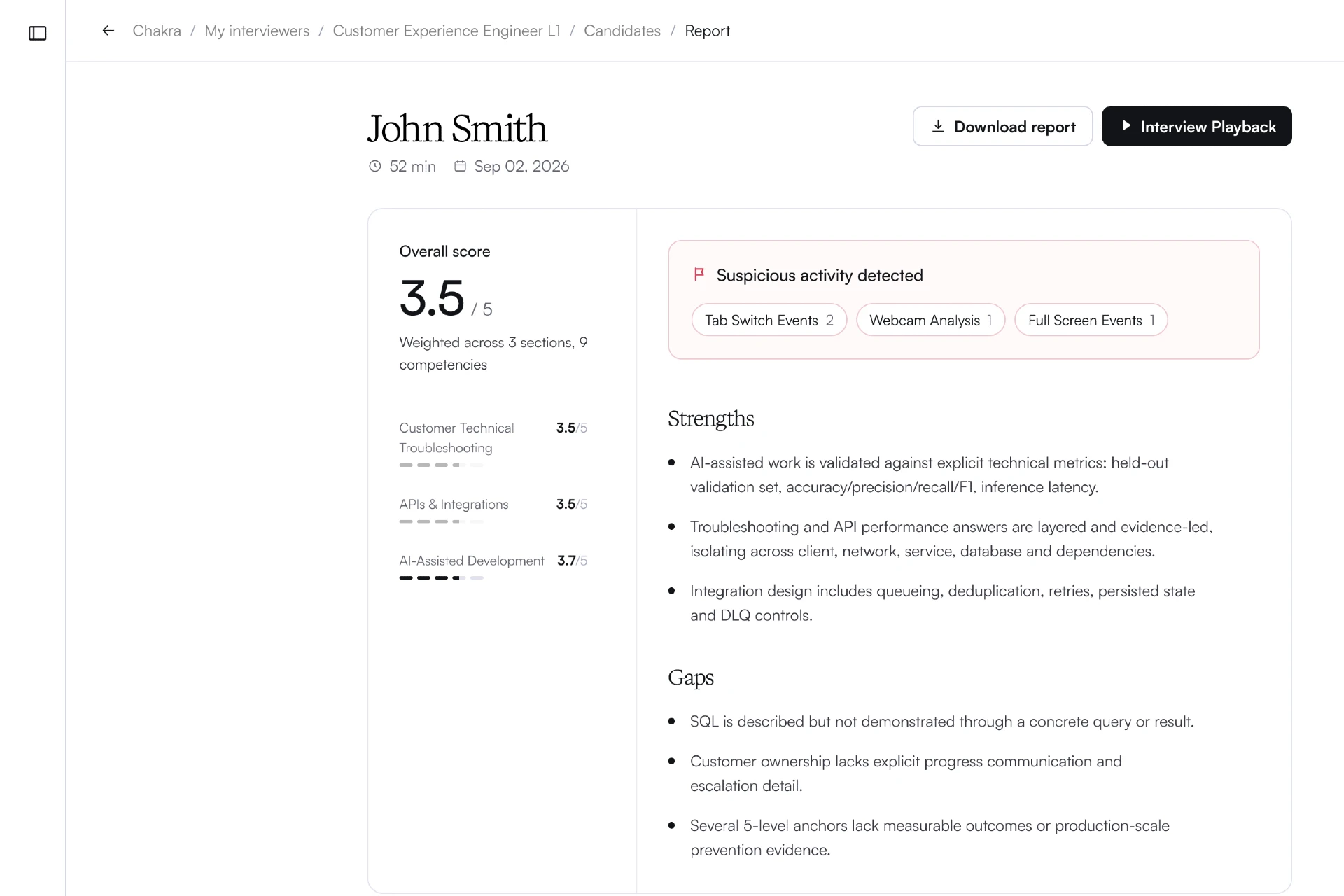
Ravisankar told TechCrunch that Chakra consolidates what previously required three separate stages—recruiter screening, take-home assignment, and engineer interview—into a single session.
Cheating and Transparency
Providing candidates with AI access during interviews might appear to increase the risk of dishonesty. HackerRank reports the opposite finding: suspicious-activity flags occurred 70% to 80% less frequently in Chakra interviews compared to standard HackerRank assessments, though rates varied by geography and experience level.
Ravisankar explained that permitting candidates to use AI openly removes the motivation to secretly deploy external tools that could feed them answers.
A Strategic Pivot
Founded at TechCrunch Disrupt in 2012 and backed by Y Combinator, HackerRank built its business on coding challenges and technical skill assessment for hiring. The company now serves more than 3,000 enterprise customers—including Amazon, Nvidia, Clay, and Replit—and maintains a developer community exceeding 30 million members worldwide.
Chakra signals a departure from the technical-assessment model HackerRank spent years developing. The legacy product primarily measured whether developers could correctly solve coding problems. Ravisankar contends that AI has diminished the relevance of that approach for gauging engineering capability.
He drew a parallel to Apple's transition from the iPod to the iPhone—the older product retained utility, but the newer one represents where HackerRank believes the market is moving. "Chakra is going to be the headline," Ravisankar said. "It's going to be the way that we're going to move forward."
The Human Element and Bias Questions
Expanding AI's role in candidate evaluation raises concerns about how much hiring responsibility should rest with algorithms. Ravisankar emphasized that Chakra generates scores to inform decisions, not make them unilaterally—humans retain final hiring authority.
He argued that AI can standardize the structured portions of interviews by uniformly applying employer-defined criteria, freeing human interviewers to assess cultural fit and answer questions about the company, team, and role.
AI is way less biased than humans, if you tune it properly.
Vivek Ravisankar
Ravisankar contended that an AI system can be configured to apply the same evaluation framework to every candidate without influence from background or educational factors.
Consistent application of criteria does not automatically eliminate algorithmic bias. Automated hiring systems can absorb or magnify biases embedded in their training data, underlying models, and design choices—a concern that has prompted regulatory bodies to scrutinize their deployment in employment contexts.
Regulatory attention on AI-driven hiring is already intensifying. New York City, for example, mandates that employers using certain automated employment-decision tools conduct independent bias audits and notify candidates before deployment. Ravisankar acknowledged that hiring falls under regulatory oversight and that HackerRank has built compliance infrastructure to meet such requirements.
Read more
Founders Face Expanding Choices on AI Models and Infrastructure at Disrupt 2026
As open models advance and frontier APIs evolve, AI startup founders are no longer locked into single-model decisions. TechCrunch Disrupt 2026 will explore how builders navigate multi-model architectures, ownership decisions, and the hardware layer underneath.

Equs Launches Personal AI Platform Where Users Own Their Data
Equs X pairs a personal AI assistant with private data storage that users control themselves, letting them grant or revoke file-by-file access to the model without surrendering ownership to a provider.

At Dreamforce, CIOs Grapple With Scaling AI Agents Responsibly
Nearly 44,000 attendees gathered at Dreamforce 2026 to discuss the enterprise AI agent boom—and the governance challenges that come with deploying thousands of autonomous systems across organizations.