Google's Gemini 4 Neon Splits the Difference With Speed and Cost Gains Over Its Flagship
Google has introduced Gemini 4 Neon, a midtier model that runs three times faster than its flagship Gemini 4 Carbon while undercutting it on price, though performance gains on some benchmarks may not justify the switch for all users.
Google is reasserting itself in the artificial intelligence race after a quiet summer that saw Anthropic and OpenAI roll out their most advanced models. The company has now unveiled Gemini 4 Neon, positioning it as a middle ground between its powerhouse Gemini 4 Carbon, released a month earlier, and the budget-friendly Gemini 4 Hydrogen. In a blog post announcing the new model, Google characterized Neon as a general-purpose system built to tackle intricate coding assignments, multi-step agentic workflows and analytical reasoning challenges.
Neon's performance metrics reveal an interesting dynamic: despite Carbon holding the title of Google's strongest model, Neon actually outperforms it on certain tasks based on benchmarks Google published today. The company reports that Neon executes most operations roughly three times faster than Carbon while maintaining costs approximately 60% lower, positioning it as "competitive with the leading models in its class."
When examined against competing offerings, Neon demonstrated superiority over Anthropic's Claude Opus 5.5 and OpenAI's GPT-6.2 Sol across multiple evaluation categories. Google's internal testing showed advantages in knowledge work, reasoning, automation, multimodal understanding, cybersecurity, science and math.
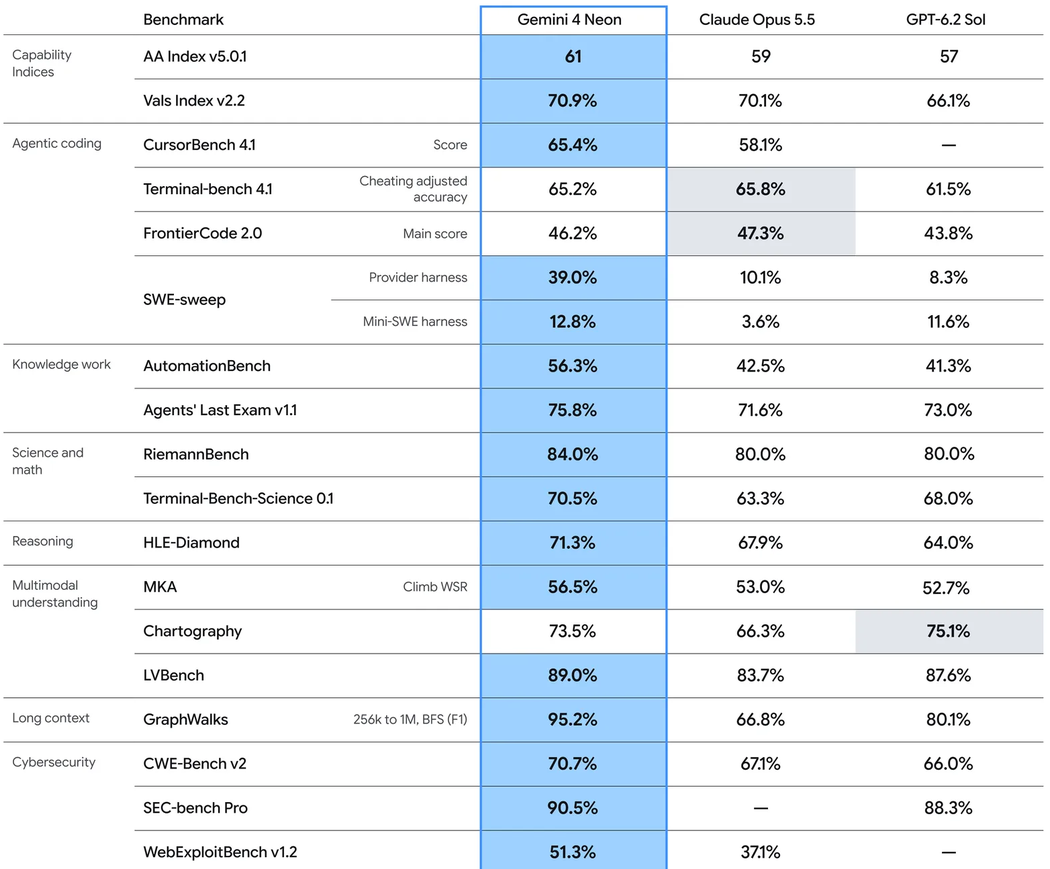
Third-party analysis from Artificial Analysis paints a somewhat different picture. Neon achieved a score of 61 on the Intelligence Index, placing it third overall. Anthropic's Claude Fable 5.2 topped the rankings with a 65, while OpenAI's GPT-6.2 Astra came in second with a 62.
https://x.com/ArtificialAnlys/status/2123170645777526962?ref_src=twsrc%5Etfw
Pricing tells a more complicated story. Google set Neon's rates at $3 per million input tokens, 15 cents per million cached input tokens and $15 per million output tokens. This positions Neon between GPT-6.2 Sol—priced at $2 per million input tokens, 10 cents per million cached tokens and $10 per million output tokens—and Claude Opus 5.5, which costs $4 per million input tokens, 20 cents per million cached tokens and $20 per million output tokens.
The pricing strategy highlights an ongoing industry question: which provider can establish genuine competitive advantage? As these midtier offerings converge in capability, cost efficiency increasingly matters to enterprise decision-makers. Although Neon appears to edge out competitors in handling several critical workloads, many organizations may conclude the performance differential doesn't justify paying premium rates.
Google is rolling out Neon access today for subscribers to Google AI Pro and Ultra through the Gemini application. Developers can also tap into the model via Google's paid application programming interface, the Google Antigravity platform and other enterprise solutions.
Read more

Anthropic Researcher Claims Claude Proved the Riemann Hypothesis
Levent Alpöge, a researcher at Anthropic, announced he used Claude to prove one of mathematics' most significant unsolved problems, though the company has not officially confirmed the breakthrough.

Beyond Token Prices: Why Enterprise AI Cost Accounting Demands a Deeper Look
Companies pursuing multi-model AI strategies are discovering that token pricing alone masks the true cost of AI deployment. New data shows task efficiency and user consumption patterns drive the real bill.

Anthropic's IPO Surge Masks Broader AI Market Jitters as OpenAI Waits in the Wings
Anthropic's initial public offering delivered a solid 17% first-day gain, but the move may have signaled caution rather than momentum across the AI sector, with broader market concerns weighing on technology stocks.