Google Cloud and Salesforce Deepen Integration, Linking Gemini to Agentforce and CRM Tools
The two companies announced expanded partnerships at Dreamforce 2026, bringing Salesforce's AI agents, data platforms, and analytics closer to Google's Gemini models. The move promises to reduce integration work, though implementation complexity remains.
Google Cloud and Salesforce are tightening their technical integration, making it easier for enterprises to move data, AI agents, and analytics across both platforms. The partnership expansion, unveiled at Dreamforce 2026, combines Hyperforce, Agentforce, Salesforce's headless architecture, and Gemini Enterprise into a more cohesive stack. Salesforce has already moved certain workloads onto Google Cloud infrastructure, and fresh integrations will expose Salesforce capabilities directly through Gemini Enterprise.
The practical benefit for enterprise customers centers on reducing manual integration work and minimizing the need to switch between systems. However, these connections are not fully automated: IT teams will still need to handle agent setup, access controls, permissions management, and workflow orchestration.
customers can build trusted agents that reason across their business context and securely take action.
Kevin Ichhpurani, President, Global Partner Ecosystem at Google Cloud
Several integrations have already reached general availability, including Agentforce Reasoning Engine paired with Gemini. Other components will become available throughout the remainder of this year and into next year.
What the partnership delivers
Google Cloud is currently running live production workloads for Hyperforce, Salesforce's cloud-based data storage platform. Through Hyperforce on Google Cloud, organizations can construct applications that interact with their business data while running on the same underlying infrastructure.
Placing workloads on shared infrastructure can enhance application responsiveness and lower operational overhead. Development teams benefit from building on a single platform without needing to incorporate external systems, improving both speed and efficiency.
Agentforce, Salesforce's AI agent system, also gains from this alignment. Customers using Agentforce can now leverage Google's Gemini models directly within the platform.
Despite the native availability of many cross-platform services, enterprises cannot skip implementation work entirely. Configuration of agents, enforcement of governance rules, and design of workflows still demand developer attention and operational oversight.
Customer implications
Organizations pursuing an AI-driven CRM solution will face reduced integration complexity through this announcement.
Google Cloud customers now have the ability to pull Tableau analytics directly into Gemini Enterprise. Tableau, a Salesforce subsidiary, allows enterprises to examine CRM information using natural language queries through Tableau Cloud.
This development could meaningfully decrease the number of times employees need to switch applications if they already rely on both Gemini Enterprise and Tableau.
The real measure of success will emerge when enterprises move beyond testing and deploy these integrations at scale. While linking Salesforce data, Gemini models, Agentforce, and Tableau may streamline certain processes, the underlying challenges of governance, permissions, and technical complexity do not vanish.
For organizations already invested in both platforms, the actual value hinges on how much of the implementation burden the new native integrations can genuinely eliminate.
Read more
Infor bets industry expertise can make AI agents trustworthy in enterprise operations
As agentic AI moves from labs into production systems, enterprises face a critical challenge: determining what autonomous systems should be permitted to do. Infor is positioning industry-specific context as the answer.
19-Year-Old Founder Raises $11M for Ghost, Launching $3,499 Personal AI Computer
Zain Javaid, who abandoned a career in quantitative finance after ChatGPT's release, has secured seed funding for Ghost, a startup building dedicated hardware for running AI agents locally on a person's device.
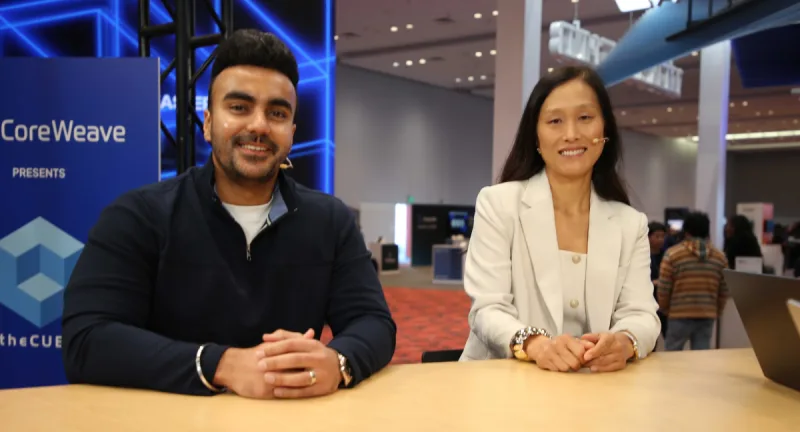
Nvidia and CoreWeave Address CPU Constraints in Agentic AI Systems
As agentic AI systems shift from answering questions to executing tasks, CPU performance has become a critical bottleneck. Nvidia's Vera CPU, deployed through CoreWeave's infrastructure, aims to handle the execution work that GPUs cannot, supported by security controls and performance optimizations.