China's Humanoid Robots Shift From Entertainment to Military Combat Role
Following competitive games showcasing dancing and boxing robots, China's military has begun accelerating development of humanoid systems for battlefield deployment, leveraging the nation's dominance in commercial robotics manufacturing.
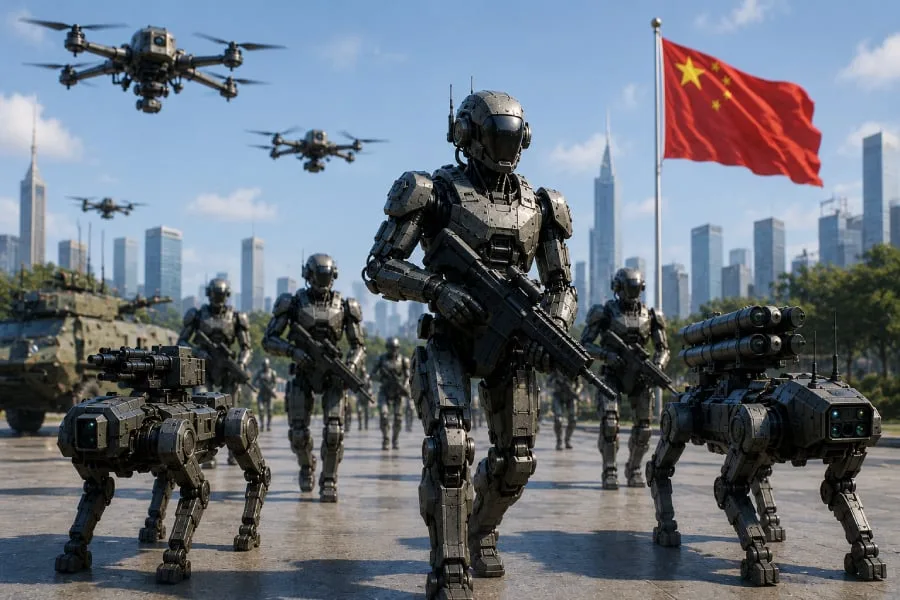
Entertainment demonstrations have given way to military preparation as China's humanoid robots prepare for combat operations alongside armed forces. The transition became evident following last month's World Humanoid Robot Games, where machines competed in running, boxing and dancing events. Within two days, PLA Daily—the official publication of the People's Liberation Army—published a call for researchers to expedite the movement of cutting-edge innovations from research facilities to military training environments for robotic "combatants," according to Reuters.
An examination by Reuters of over 100 military procurement documents, scientific publications, intellectual property filings, government materials and industry records indicates the PLA has pursued military applications for humanoid technology, with particular intensity beginning in 2025. Development priorities extend beyond mechanical improvements to encompass sensor systems, manipulation capabilities and training datasets—the foundational technologies enabling robots to operate beyond controlled laboratory settings.
The nation's robust commercial robotics sector stands positioned to accelerate this military agenda substantially. Chinese firms represented roughly 95% of worldwide humanoid robot shipments during 2025, per Bank of America analysis referenced by Reuters.
Built for dangerous places
Military researchers have identified urban combat scenarios as a particularly promising application area for humanoid deployment. A 2025 research project conducted by scientists at the National University of Defense Technology examined a scenario involving six "combat robots" operating in coordination with military personnel to systematically clear a structure controlled by adversaries, advancing room by room. Such formations could incorporate humanoid units, quadrupedal platforms or ground-based unmanned systems.
Military training exercises have also explored scenarios involving robotic units moving into enemy-controlled territory ahead of human forces, conducting surveillance of strategic areas and identifying military targets. A procurement request issued in June 2026 allocated approximately $300,000 toward gathering and annotating visual, sensor and kinematic information for humanoid platforms.
The reasoning behind this approach is evident: humanoid systems could eventually navigate hazardous locations unsuitable for human personnel while employing tools and infrastructure designed for human operators. Dennis Hong, a UCLA researcher, explained to Reuters: "If losing a robot means avoiding the loss of a human life, then the robot can become expendable." However, this capability faces substantial practical constraints. Humanoid platforms currently suffer from significant power consumption demands and instability when confronted with unpredictable real-world conditions. For reconnaissance missions or supply chain operations, alternative designs—including four-legged, tracked or wheeled configurations—may offer superior cost-effectiveness and scalability, according to specialists interviewed by Reuters.
China's next step: human-controlled robots
Military-industrial participants are contributing to this development trajectory. Norinco, a state-controlled defense manufacturer, has created the Fuxi humanoid platform, which company documentation identifies as suitable for guard duties, surveillance operations, patrol missions and high-risk assignments. The Fuxi system supports remote operation, enabling human operators to direct robotic actions rather than depending entirely on autonomous decision-making algorithms.
This operational model may prove more pragmatic than immediately pursuing fully self-directed combat systems. Simultaneously, it raises a consequential challenge: what degree of autonomy should remain with human operators as robotic systems eventually receive weaponry? Military publications from the PLA have contemplated transitioning humanoids "from supporting combat toward primary combat," encompassing scenarios where human authorization precedes weapons deployment by robotic units.
The real race is not just about robots
The underlying technological infrastructure may ultimately prove more significant than the robots themselves. Military procurement patterns suggest Chinese defense planners recognize that effective humanoid systems require more than powerful actuators and precise manipulators. Success demands extensive sensor information, sophisticated environmental perception and mechanisms capable of converting sensory input into coordinated physical responses.
This reality positions China's manufacturing advantage as potentially more consequential than any particular robot design. Should production expenses decrease and manufacturing processes mature, military organizations could access a substantially expanded industrial base for experimentation and deployment. The United States pursues comparable military humanoid initiatives, yet China's commercial position provides Beijing with a considerably broader foundation for advancement. Currently, no documented evidence indicates operational deployment of armed humanoid systems within PLA units. Malcolm Davis of the Australian Strategic Policy Institute told Reuters: "But in five to 10 years," such systems could achieve practical viability.
Read more

Identity governance faces new test as AI agents proliferate across enterprises
Autonomous AI agents are forcing organizations to rethink how they manage access and permissions at machine speed. SailPoint's Navigate conference will explore how identity security must evolve to handle this expanding population of non-human actors.

Vertical AI and Purpose-Built Hardware Drive Next Wave of Technology Growth
Specialized AI systems tailored to specific industries are emerging as the primary engine for the next phase of technology expansion, according to insights from the Bank of America Private Tech Trailblazers Conference 2026.

CrowdStrike and CoreWeave Partner to Automate AI Security at Machine Speed
As cyberattackers breach systems in seconds, CrowdStrike and CoreWeave are embedding automated defenses throughout AI infrastructure, turning attacks into training data for faster response.