China's Dual-Arm Robot Automates Crop Pollination With AI and Gene-Edited Plants
Researchers in China have unveiled GEAIR 2.0, a two-armed humanoid robot designed to pollinate crops autonomously by combining robotics with genetically modified plants engineered to work with mechanical systems.
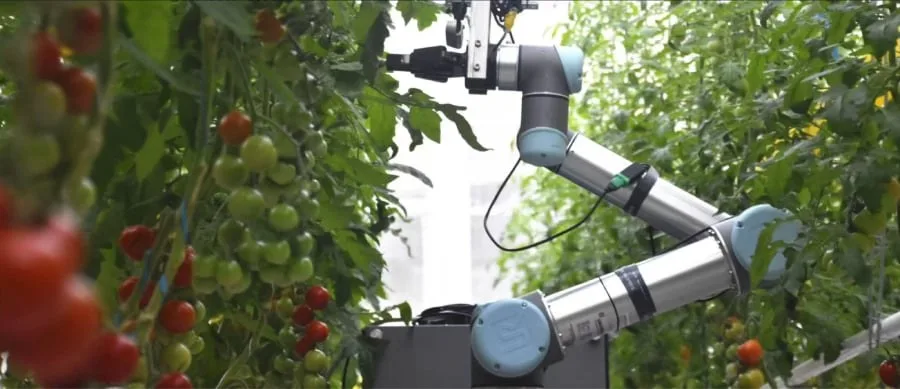
A two-armed humanoid robot developed in China can perform continuous crop pollination without human intervention. Presented at the 33rd China Beijing Seed Industry Conference, GEAIR 2.0 represents what its developers claim is the first embodied-AI humanoid robot purpose-built for crop breeding applications.
The robot was created by a research team headed by Xu Cao at the Institute of Genetics and Developmental Biology under the Chinese Academy of Sciences. All components used in the machine's construction are sourced domestically within China.
Building on a single-armed model, GEAIR 2.0 incorporates two robotic arms optimized for precision work in greenhouse settings. During a demonstration broadcast by China Central Television, the robot grasped a pollen tube with one arm while using the other to apply a fine brush to tomato flowers, completing the pollination of each blossom in fewer than 10 seconds. The brush requires only one application of pollen to treat approximately 50 flowers, and the robot's computer vision system identifies the flower's stigma—the narrow female reproductive component—with 92.8% accuracy, as reported by China Daily.
For agricultural research groups, GEAIR 2.0 serves as a preliminary demonstration of whether machine vision, robotic systems and genetic modification can be integrated to reduce labor in breeding operations. Whether the technology achieves commercial viability will ultimately depend on how well it performs in real-world conditions, what it costs to operate and whether it can maintain reliability outside laboratory settings.
Rewriting the plant to fit the machine
The mechanical system forms only one component of the overall approach. GEAIR is an acronym for "Genome Editing combined with AI-based Robotics," employing a methodology that researchers refer to as "crop-robot co-design." This strategy was published in the journal Cell during 2025.
Rather than programming the robot to manipulate flower petals, the research team applied genetic modification to produce tomato plants lacking functional male reproductive organs, with exposed stigmas positioned for easier robotic access. The same genetic modifications were also introduced into soybean varieties. Through this approach of adapting the plant structure to accommodate the robot's mechanical capabilities, the machine navigates through thick plant growth while avoiding damage to the crop.
Cross-pollination is repetitive labor. It has to be done bent over within a very short time window, and it is exhausting. But this robot can work as soon as it is charged, and its operating window is much longer. What's more, it can operate autonomously in heat or cold, day or night. This way, farmers can get the job done better by managing the robot.
Xu Cao
The limits of crop-robot co-design
Modifying crops to function with robotic systems can enhance the efficiency of machine-based pollination, yet this approach may restrict initial deployment to specific agricultural contexts. Farmers implementing the technology would require access to compatible plant varieties and controlled growing spaces suitable for robot operation.
The development team has not released information regarding the price of GEAIR 2.0, the expenses associated with running it or results from testing at commercial scale. The reliability of the system in outdoor or non-greenhouse environments remains unproven, positioning it as a valuable tool for experimental breeding rather than as an immediate substitute for human agricultural labor.
Targeting food security
The technology emerges as China's government prioritizes cutting-edge solutions to bolster its food self-sufficiency, though a recent incident involving AI recommendations that led to crop failure underscores the necessity for rigorous evaluation and human judgment in farming systems. China's grain output totaled 715 million metric tons in 2025, with government targets aiming to expand production to approximately 725 million metric tons annually by 2030, according to the Global Times.
Should GEAIR 2.0 reach the commercial market, it could help seed breeding companies decrease labor requirements and expenses in hybrid crop development. Before the technology can be considered beyond an experimental system, agricultural research organizations will require proof of consistent operation, economically competitive running expenses and applicability across additional crop species.
The subsequent phase involves determining whether the technology can expand beyond greenhouse tomato cultivation to support larger breeding initiatives encompassing soybeans and additional crop types.
Read more

Identity governance faces new test as AI agents proliferate across enterprises
Autonomous AI agents are forcing organizations to rethink how they manage access and permissions at machine speed. SailPoint's Navigate conference will explore how identity security must evolve to handle this expanding population of non-human actors.

Vertical AI and Purpose-Built Hardware Drive Next Wave of Technology Growth
Specialized AI systems tailored to specific industries are emerging as the primary engine for the next phase of technology expansion, according to insights from the Bank of America Private Tech Trailblazers Conference 2026.

CrowdStrike and CoreWeave Partner to Automate AI Security at Machine Speed
As cyberattackers breach systems in seconds, CrowdStrike and CoreWeave are embedding automated defenses throughout AI infrastructure, turning attacks into training data for faster response.