Broadcom and AMD Team Up to Automate AI Deployment in Enterprise Data Centers
As companies scale artificial intelligence beyond pilot programs, infrastructure complexity has become the real bottleneck. Broadcom is positioning automated private cloud solutions as the answer to streamline the journey from hardware to trained models.
When enterprises attempt to move AI from experimental phases into full-scale production, they face a surprising realization: building the model itself is no longer the primary challenge. Instead, the underlying infrastructure—encompassing expenses, token economics, data security, and the intricate work of assembling GPUs, servers, network components, and software layers—has emerged as the critical constraint limiting large-scale rollouts.
This dynamic is redirecting more production AI initiatives back toward on-premises data centers, where companies can maintain proximity between their models and their data. Broadcom Inc. is positioning itself to address this shift through automated, ready-to-deploy solutions, as explained by Prashanth Shenoy, who serves as chief marketing officer and vice president of the VMware Cloud Foundation Division at Broadcom.
A lot of our customers are looking at private cloud in an on-premises environment to deploy their production AI workloads at scale. But as they've been trying to do this, it's been a very complex process from what we call the metal to model. Setting up GPUs, servers, networking, Kubernetes, containers, AI software stack, testing, validating which models to use. It's an extremely manual and complex process.
Prashanth Shenoy, Broadcom
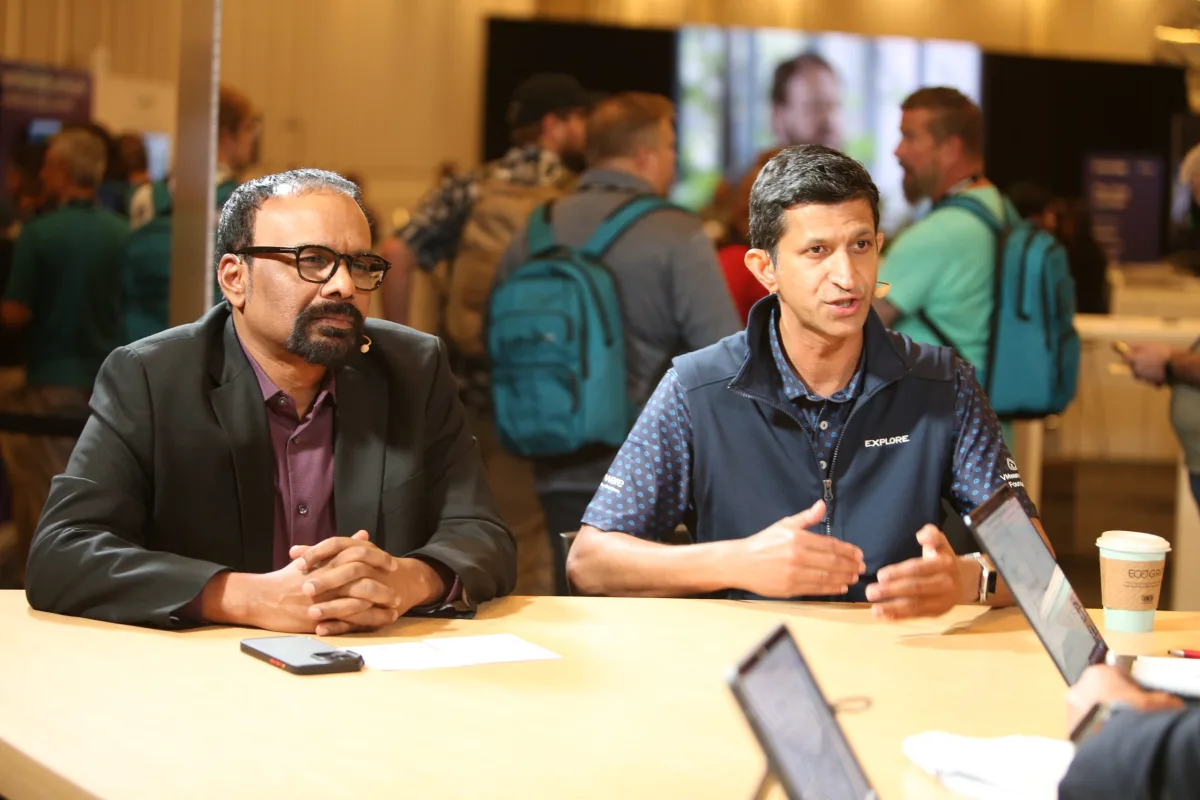
During an exclusive discussion at VMware Explore, Shenoy and Raghu Nambiar, corporate vice president of software and solutions at Advanced Micro Devices Inc., shared insights with theCUBE Research's Christophe Bertrand and co-host Alison Kosik. The conversation centered on how pre-validated AMD-powered VMware Cloud Foundation systems could enable a more streamlined and adaptable approach to rolling out AI models alongside traditional workloads.
Hardware flexibility forms the foundation of the AI factory concept
Broadcom's AI factory strategy rests on two pillars: operational automation and hardware adaptability. The latter carries particular significance because most organizations already operate conventional and containerized workloads on unified platforms and expect AI capabilities to integrate without requiring separate infrastructure management, Shenoy noted.
They already have the AI factory built in with VCF. We have automated this to do a lot simpler way of deploying.
Prashanth Shenoy, Broadcom
AMD addresses requirements across multiple performance tiers. The newly introduced MI350P PCIe accelerator targets enterprises beginning their AI journey. Nambiar pointed out that the company maintains over 1,600 vSAN ReadyNodes deployed across major server manufacturers, with sizing recommendations now aligned to model complexity.
https://www.youtube.com/embed/qJz-qlWDzKM?start=8&feature=oembed
If your problem size is 10 billion parameters, CPU is the answer. But if you're looking at the 100 billion parameters range, then MI350P is the answer. If you have a larger model, 1 trillion plus, then MI355X is the answer.
Raghu Nambiar, Advanced Micro Devices Inc.
Read more

Identity governance faces new test as AI agents proliferate across enterprises
Autonomous AI agents are forcing organizations to rethink how they manage access and permissions at machine speed. SailPoint's Navigate conference will explore how identity security must evolve to handle this expanding population of non-human actors.

Vertical AI and Purpose-Built Hardware Drive Next Wave of Technology Growth
Specialized AI systems tailored to specific industries are emerging as the primary engine for the next phase of technology expansion, according to insights from the Bank of America Private Tech Trailblazers Conference 2026.

CrowdStrike and CoreWeave Partner to Automate AI Security at Machine Speed
As cyberattackers breach systems in seconds, CrowdStrike and CoreWeave are embedding automated defenses throughout AI infrastructure, turning attacks into training data for faster response.