Arm Introduces Physical AI Framework and Robotics Standards for Industrial Automation
Arm has unveiled Arm Total Design for Physical AI and a new robotics framework aimed at creating uniform standards for automated systems across mining, agriculture, manufacturing, and transport sectors.
The chip designer has brought together more than 80 partner organisations to tackle fragmentation in the physical automation space. Participants in the initiative span software, hardware, and artificial intelligence domains, with notable members including AWS, ECARX, Hugging Face, Liquid AI, NXP, PlusAI, PSYONIC, QNX, Qwen, Siemens, and Unitree Robotics.
Industries focused on physical operations—including mining, agriculture, manufacturing, and global transport—represent trillions of dollars in economic value and present an estimated $200 billion annual compute opportunity by the 2030s. The new framework addresses the need for standardised approaches to system design, integration, and deployment at scale.
Physical systems that combine artificial intelligence models, runtime software, compute silicon, sensors, and actuators require common baselines to reduce integration complexity, streamline compute workloads, and transition from experimental phases to widespread deployment. The initiative seeks to provide these standardised foundations across the ecosystem.
Robotics Capability Framework establishes common language
Robotics lacks a unified approach for describing, comparing, and communicating system capabilities, according to an architectural manifesto published by Arm chief architect Richard Grisenthwaite. This absence of common standards complicates the design, integration, and scaling of robotic systems in industrial settings.
To address this gap, Arm has introduced the Robotics Capability Framework as a foundation for establishing shared technical terminology. The framework draws inspiration from the SAE Levels methodology used in driving automation.
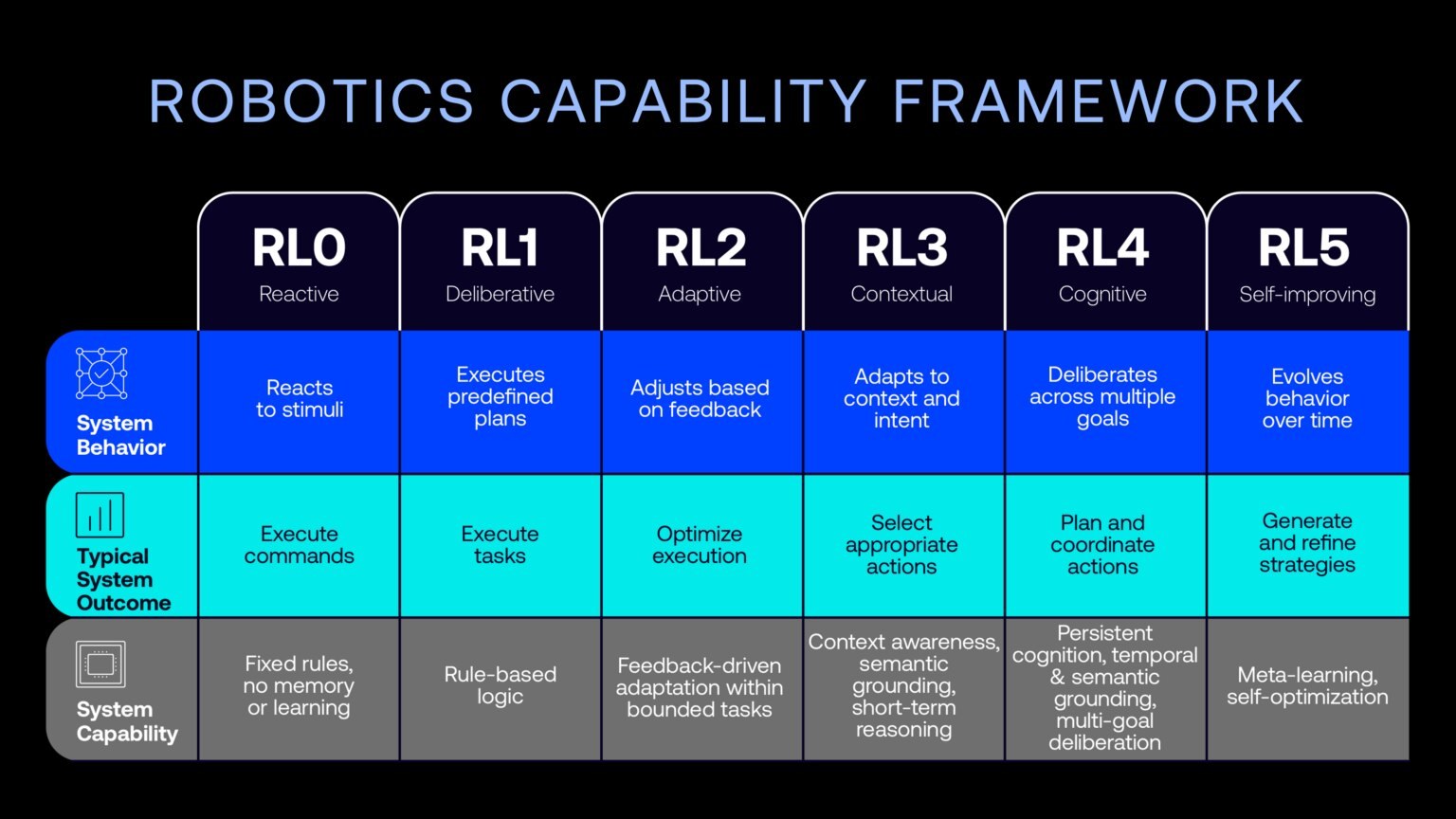
The framework organises robotic systems into progressive tiers reflecting increasing operational sophistication, ranging from reactive configurations to context-aware, cognitive, and self-improving machines. Each tier connects practical applications to machine behaviours, outputs, and hardware requirements.
The capability tiers define specifications for system latency, compute placement, memory allocation, power constraints, determinism, and safety standards. Arm created the initial version drawing on input from the robotics sector, with contributors including Anaxi Labs, ANYbotics, FMC³ Robotics, Fourier, GALBOT, Gravis Robotics, Lenovo, McKinsey, and Robotec.ai.
Virtual platforms support pre-silicon development for autonomous systems
Arm Total Design for Physical AI builds on a collaborative model previously applied to cloud artificial intelligence infrastructure. The programme integrates artificial intelligence models, virtual platforms, digital twins, sensors, compute silicon, and software stacks to enable earlier development and validation cycles.
Autonomous transport and robotics share overlapping technical needs in sensory perception, artificial intelligence processing, real-time control, safety, and power-efficient computing. Arm demonstrated this collaborative approach in the automotive domain working with AWS, Google, HERE, RemotiveLabs, and Siemens.
The automotive partners created an integrated digital cockpit reference solution that allowed software teams to develop, test, and validate complex automotive applications on the Arm Zena CSS platform before physical silicon became available. Arm is now inviting technical contributions from the broader engineering community to refine the Robotics Capability Framework as physical artificial intelligence deployments advance.
Read more

Identity governance faces new test as AI agents proliferate across enterprises
Autonomous AI agents are forcing organizations to rethink how they manage access and permissions at machine speed. SailPoint's Navigate conference will explore how identity security must evolve to handle this expanding population of non-human actors.

Vertical AI and Purpose-Built Hardware Drive Next Wave of Technology Growth
Specialized AI systems tailored to specific industries are emerging as the primary engine for the next phase of technology expansion, according to insights from the Bank of America Private Tech Trailblazers Conference 2026.
CrowdStrike and CoreWeave Partner to Automate AI Security at Machine Speed
As cyberattackers breach systems in seconds, CrowdStrike and CoreWeave are embedding automated defenses throughout AI infrastructure, turning attacks into training data for faster response.