AI's Breakneck Week: Google Embeds Gemini Everywhere, Microsoft Challenges Nvidia, Apple Plots Smarter Siri
Major technology companies made sweeping moves this week to embed artificial intelligence deeper into consumer devices and services, signaling an intensifying competition that shows no signs of slowing.

The artificial intelligence sector experienced remarkable momentum across the industry this week. Google integrated Gemini into both Chrome and its search platform, Yahoo launched a new answer engine focused on source attribution, Apple previewed an upgraded Siri powered by Gemini, and Microsoft introduced the Maia 200 chip designed to reduce dependence on Nvidia's dominance. When combined with reports of security incidents and workforce reductions, the trajectory becomes unmistakable: the competitive race for AI supremacy continues unabated.
Google embeds Gemini directly into Chrome's interface
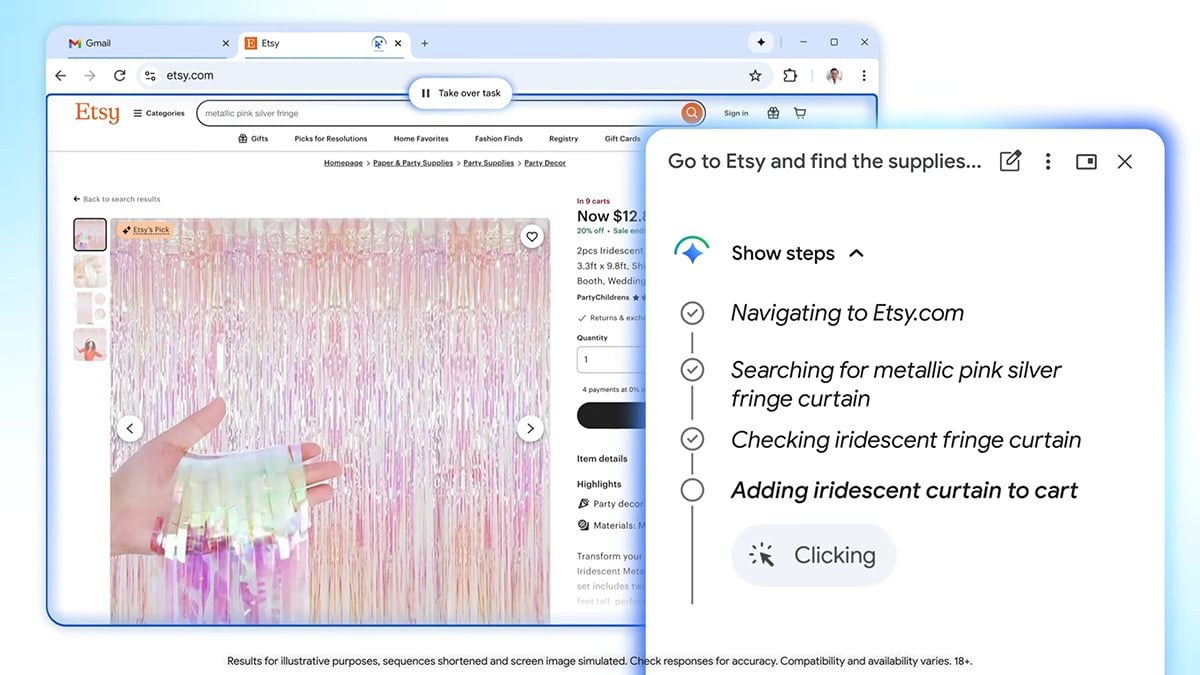
Chrome's functionality expanded significantly with the introduction of a Gemini-powered sidebar panel. This new feature enables users to summarize product reviews, manage calendar tasks, and modify images through Nano Banana without requiring additional browser tabs. The standout capability, Auto Browse, automates complex multi-step processes such as flight reservations or online shopping cart completion, though free users face a 20-task daily limit while Ultra subscribers receive 200 tasks. Safety mechanisms include permission notifications for sensitive actions and integration with Chrome's existing password authentication system. The rollout begins with Windows, Mac, and Chromebook Plus users in the United States, leveraging Chrome's commanding 70% browser market share as a distribution channel.
Google Search taps personal accounts for AI-driven recommendations
Google introduced Personal Intelligence within its AI Mode search feature. Subscribers in the United States who opt into this capability grant the system access to their Gmail and Photos libraries, enabling the chatbot to deliver highly targeted suggestions—such as recommending cold-weather apparel after detecting a flight booking to Chicago. The company emphasizes that Gemini 3's one-million-token context window permits this personalization without requiring additional model training on user information. Early adopters report enthusiasm for shopping-related suggestions, though privacy concerns persist as a significant barrier to broader adoption. Currently, the feature remains unavailable for Workspace and school accounts, though a complimentary tier is anticipated in the future.
Yahoo launches citation-focused search alternative
Yahoo introduced Scout, a new answer engine leveraging Anthropic's Claude model and Bing's data infrastructure. Rather than displaying traditional search results as blue hyperlinks, Scout presents information in structured formats with explicit source citations. The company believes its access to 250 million United States users and 18 trillion annual search signals positions it to recapture market share from competitors. While advertising partnerships are already undergoing testing, the platform remains free at present. Users can access Scout through scout.yahoo.com or via the Yahoo Search application on iOS and Android devices.

Microsoft's Maia 200 chip targets Nvidia's market position
Microsoft unveiled the Maia 200 accelerator, manufactured on TSMC's 3-nanometer process with 140 billion transistors. The chip delivers more than 10 petaFLOPS of computational capacity using efficient 4-bit (FP4) operations and achieves 30% superior performance-per-dollar relative to existing Azure infrastructure. Each processor board incorporates 216 GB of high-speed HBM3e memory and employs a proprietary Ethernet interconnect capable of linking up to 6,144 chips without requiring expensive InfiniBand solutions. The technology is already operational in Iowa, supporting applications ranging from Microsoft 365 Copilot to OpenAI's GPT-5.2 and synthetic data generation. Microsoft is distributing a preview SDK with integrated cost estimation tools to attract developers frustrated by Nvidia chip availability constraints.
Apple prepares Gemini-enhanced Siri for February debut
Apple plans to demonstrate a Gemini-powered Siri upgrade in late February, with the enhanced assistant expected to enter beta testing through iOS 26.4 shortly thereafter—initially limited to iPhone 15 Pro models and subsequent generations. The upgraded Siri will feature visual awareness and access to personal context from applications like Mail, though full conversational continuity across sessions requires the "Campos" architecture scheduled for iOS 27 in autumn. The arrangement with Google carries an estimated annual cost of approximately $1 billion and represents a notable compromise to Apple's traditionally closed ecosystem philosophy.
Apple acquires Israeli speech-recognition company
Apple completed an acquisition of Q.ai, an Israeli technology firm, for nearly $2 billion. The company specializes in decoding speech at whisper-level volumes and interpreting micro-expressions. The 100-person team, led by the engineer responsible for developing the technology underlying Face ID, will integrate its capabilities into Apple's custom silicon. The acquisition hints at forthcoming applications including AirPods capable of understanding quiet speech in noisy environments, Vision Pro devices, and future smart eyewear with lip-reading functionality. While Google provides the underlying models, Apple aims to maintain proprietary control over the user-facing implementation.
Read more

Identity governance faces new test as AI agents proliferate across enterprises
Autonomous AI agents are forcing organizations to rethink how they manage access and permissions at machine speed. SailPoint's Navigate conference will explore how identity security must evolve to handle this expanding population of non-human actors.

Vertical AI and Purpose-Built Hardware Drive Next Wave of Technology Growth
Specialized AI systems tailored to specific industries are emerging as the primary engine for the next phase of technology expansion, according to insights from the Bank of America Private Tech Trailblazers Conference 2026.

CrowdStrike and CoreWeave Partner to Automate AI Security at Machine Speed
As cyberattackers breach systems in seconds, CrowdStrike and CoreWeave are embedding automated defenses throughout AI infrastructure, turning attacks into training data for faster response.