AI Adoption in Contact Centers Hits a Wall: Orchestration, Not Technology, Separates Winners From the Rest
Nearly every customer service operation now uses AI, but most deployments remain limited to single chatbots or agent assist tools. The real competitive advantage lies in orchestrating data, systems and people across the entire customer journey—a capability that only 15% of companies have mastered.
Artificial intelligence has become ubiquitous in customer service environments, yet the vast majority of implementations remain confined to isolated use cases: a standalone chatbot or a panel that helps human agents. The genuinely difficult challenge—weaving together data sources, multiple systems and teams to handle customer requests from start to finish—has largely gone unaddressed. This gap is increasingly determining which organizations see tangible business results and which continue to measure success only by the number of calls their systems deflect.
Bridging this divide requires less advanced AI technology and more organizational readiness: the governance structures, system integrations and operational workflows needed to make everything work together. This concept underpins customer experience automation, or CXA—a way of operating rather than a specific product, according to Pedro Andrade, vice president of AI and generative AI business specialist at Talkdesk Inc.
Customer Experience Automation, CXA, is what we defined as an operating model. It's not a category of technology. It's the system that coordinates a hybrid workforce of AI and human employees. Then connecting the systems, connecting knowledge and also connecting the workflows.
Pedro Andrade, Talkdesk Inc.
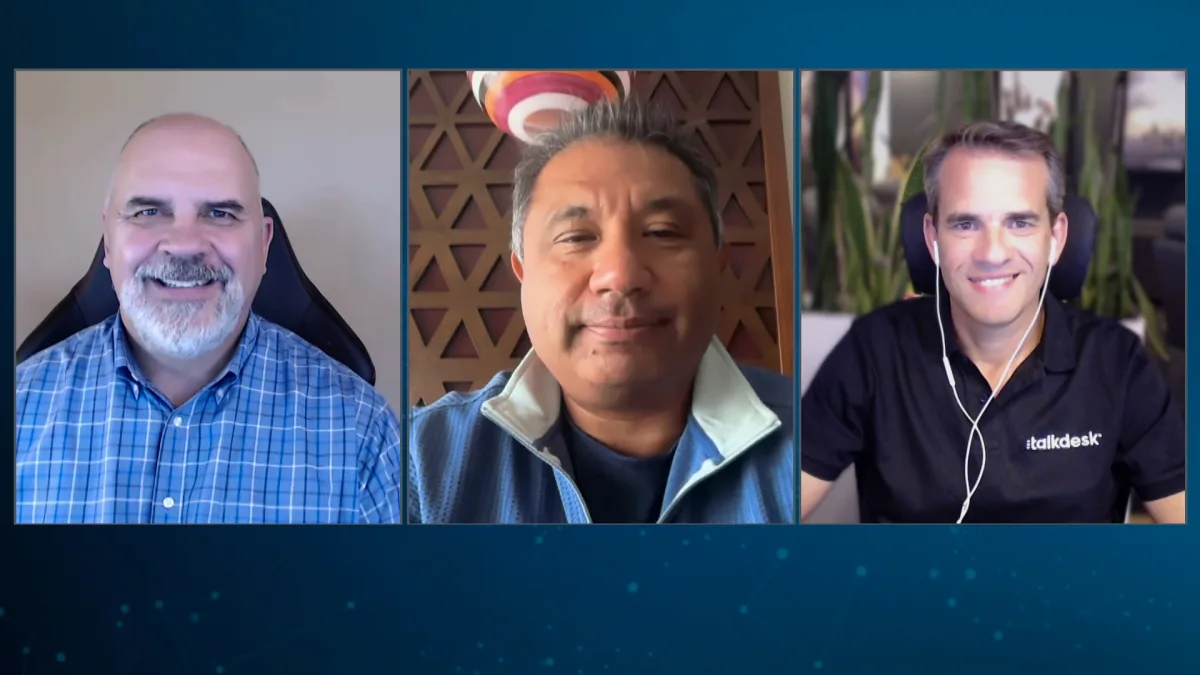
Andrade shared these insights during an exclusive conversation with theCUBE's Bob Laliberte, principal analyst for networking and observability, and Zeus Kerravala at The AI ROI in Contact Center Summit. The discussion centered on why orchestration and governance—not mere AI adoption—now determine whether contact center AI investments generate meaningful returns.
Orchestration emerges as the true differentiator
Research from Talkdesk reveals that 98% of companies have implemented AI somewhere within their customer journey, yet only 15% have combined agentic AI with cross-departmental orchestration. The obstacles extend beyond the technology itself, Andrade noted, with compliance concerns raised by 50% of survey participants, security worries by 48% and fragmented system architectures by 45%.
Adoption is easy. The orchestration is the hardest part. Agentic orchestration requires AI to maintain a context across all those systems.
Pedro Andrade, Talkdesk Inc.
This distinction translates directly into measurable outcomes. Organizations that Talkdesk identifies as CXA leaders achieve roughly four times the net promoter score improvement compared to less mature implementations—22% versus 5%—while the gap in cost-per-contact reductions between the two groups proves far narrower, Andrade explained. Churn prediction and personalized recommendations display comparable disparities.
Savings alone don't tell the whole story. They understate the value that you can get with AI.
Pedro Andrade, Talkdesk Inc.
Overseeing this combination of human and artificial intelligence is spawning an entirely new role that barely existed before. Talkdesk designed its CXA Operations Center on the principle that supervisors will assess, track and adjust AI agents using the same methods they apply to human staff, transitioning from script writing to behavioral oversight. The metrics framework evolves accordingly.
Now you don't measure just average handle time. You are going to measure how much time it takes from opening of a problem until it gets closed. Not because average handle time just measures the time of an agent, but what about the rest of the process?
Pedro Andrade, Talkdesk Inc.
The ultimate vision extends customer service well beyond reactive inbound support into anticipatory engagement—service notifications, contract renewals, collections management—since the customer's call typically represents the final stage of a process that started elsewhere, Andrade noted. Automating a single failure point leaves the broader workflow unchanged.
https://www.youtube.com/embed/gBFOWE5I_Fg?feature=oembed
Inbound is kind of the last piece of a journey is when everything breaks, people call in. Look at the whole spectrum, look at the whole journey and put your journey all on paper and now start thinking about automating the whole journey instead of just having a one-point solution that takes you nowhere.
Pedro Andrade, Talkdesk Inc.
Read more
Identity governance faces new test as AI agents proliferate across enterprises
Autonomous AI agents are forcing organizations to rethink how they manage access and permissions at machine speed. SailPoint's Navigate conference will explore how identity security must evolve to handle this expanding population of non-human actors.
Vertical AI and Purpose-Built Hardware Drive Next Wave of Technology Growth
Specialized AI systems tailored to specific industries are emerging as the primary engine for the next phase of technology expansion, according to insights from the Bank of America Private Tech Trailblazers Conference 2026.

CrowdStrike and CoreWeave Partner to Automate AI Security at Machine Speed
As cyberattackers breach systems in seconds, CrowdStrike and CoreWeave are embedding automated defenses throughout AI infrastructure, turning attacks into training data for faster response.